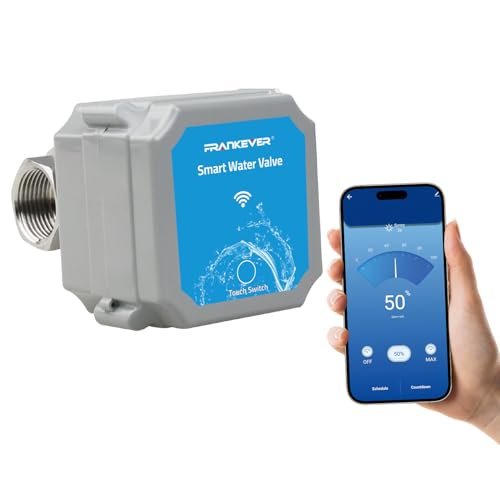
Frankever Smart Water Valve Review: WiFi Remote Shutoff, Adjustable Flow Control, Scheduling, and Stainless Steel Construction
A smart water valve can be useful anywhere you need more control over when water flows and how much passes through a line. Instead of walking to a manual valve every time you want to irrigate a garden, fill a pool, shut off a supply, or adjust flow, a connected valve can bring those functions into a smartphone app.
The Frankever Smart Water Valve is designed as a WiFi-enabled electric ball valve that can be controlled remotely through the Smart Life app. According to the supplied product information, it supports scheduled opening and closing, adjustable flow from 0% to 100% in 10% increments, 2.4 GHz WiFi connectivity, and USB-powered operation.
Its construction combines SS304 stainless steel with ABS engineering plastic, and the valve is intended for a range of applications including household water lines, garden irrigation, agricultural watering, pool filling, and other situations where remotely controlled water flow is useful.
The main distinction between this product and a conventional smart hose timer is that it is presented as a more general-purpose smart water control valve. That means its usefulness extends beyond simple timed irrigation, but proper installation, plumbing compatibility, power availability, and fail-safe expectations become more important.
What Is the Frankever Smart Water Valve?
The Frankever unit is an electrically actuated ball valve designed to regulate water flow through a plumbing line.
Once connected to a 2.4 GHz WiFi network, it can be managed through the Smart Life app on compatible Android and iOS devices.
The supplied product description highlights several core capabilities:
- Remote valve control through Smart Life
- 2.4 GHz WiFi connectivity
- Scheduled opening and closing
- Adjustable valve position from 0% to 100%
- 10% flow-control increments
- SS304 stainless steel construction
- ABS engineering-plastic components
- USB DC 5V power
- Current draw below 2A
- Household water applications
- Garden and farm irrigation
- Pool-filling applications
- General smart water shutoff use
This makes it more flexible than a timer that simply switches water fully on or fully off.
Why a Smart Water Valve Can Be Useful
Traditional water valves are simple and reliable, but they require someone to operate them manually.
That can be inconvenient when the valve is:
- Outside
- In a utility area
- Far from the house
- Used several times per day
- Part of an automated irrigation routine
A smart valve adds remote control and scheduling.
Instead of walking to the valve, users can potentially open, close, or partially adjust it from the Smart Life app.
Remote Control Through the Smart Life App
The Frankever valve connects to the Smart Life ecosystem.
Once paired with a compatible 2.4 GHz WiFi network, the valve can be controlled through a smartphone.
Remote operation can be useful for situations such as:
- Turning garden irrigation on or off
- Closing a water line while away
- Starting a pool-filling session
- Managing farm irrigation
- Adjusting water delivery remotely
The exact app interface and available automation options should be confirmed in the current Smart Life implementation.
Why 2.4 GHz WiFi Matters
The valve requires 2.4 GHz WiFi according to the supplied information.
This frequency is widely used for smart-home and outdoor-connected devices because it generally offers better range through walls than 5 GHz.
Before installation, verify that the intended valve location has usable 2.4 GHz coverage.
A smart valve installed far from the router may behave unreliably if WiFi strength is poor.
Check Signal Strength Before Permanent Installation
WiFi performance can be reduced by:
- Concrete walls
- Metal enclosures
- Utility cabinets
- Distance from the router
- Outdoor structures
If the valve will be installed in a location with weak coverage, consider improving the network first through a mesh node or access point.
Reliable connectivity is especially important if remote shutoff is one of the main reasons for buying the product.
Adjustable Flow Control From 0% to 100%
One of the more distinctive features is the ability to adjust valve opening rather than simply choosing between fully open and fully closed.
The supplied description states that users can select values from 0% to 100% in 10% increments.
That may allow the valve to function as both:
- A shutoff valve
- A basic flow-regulation valve
This can be useful in irrigation applications where full flow is unnecessary.
What 10% Valve Position Actually Means
A 50% valve position should not automatically be interpreted as exactly 50% of maximum gallons per minute.
Ball valves have nonlinear flow characteristics.
Actual flow depends on:
- Valve geometry
- Water pressure
- Pipe diameter
- Downstream resistance
- Connected irrigation equipment
So the percentage setting is best understood as a valve-position control rather than a precise volumetric-flow measurement.
Useful for Irrigation Adjustment
Partial valve positioning can still be useful even without exact flow metering.
For example, it may help reduce water delivery to:
- Drip irrigation
- Small garden zones
- Low-demand watering systems
The best setting should be determined by observing the downstream irrigation performance.
Scheduled Water Shutoff
The Smart Life app can reportedly be used to create opening and closing schedules.
This allows the valve to operate automatically at predetermined times.
For garden irrigation, a schedule might open the valve early in the morning and close it after the desired watering period.
For other applications, scheduling could be used to limit when water is available.
Scheduling vs. a Dedicated Irrigation Timer
A general-purpose valve schedule can handle simple on/off automation.
However, dedicated irrigation timers may offer more specialized functions such as:
- Multiple daily programs
- Rain delays
- Weather-based watering
- Cycle-and-soak programming
- Zone management
The Frankever valve is better suited to users who prioritize remote valve control and adjustable positioning rather than advanced landscape scheduling.
Household Water-Supply Applications
The listing describes the valve as suitable for home water-supply use.
A connected shutoff valve can be useful in certain plumbing applications where remote isolation is valuable.
However, whole-home water shutoff is a more critical use case than garden irrigation.
Before using any smart valve as the primary shutoff for a house, verify:
- Pipe size
- Pressure rating
- Valve certification
- Installation orientation
- Fail-state behavior
- Power-loss behavior
- Local plumbing requirements
A consumer smart valve should not automatically be assumed suitable for every main-water application.
Garden Irrigation
Garden irrigation is one of the clearest applications.
The valve can be used to control water feeding:
- Drip lines
- Soaker hoses
- Sprinklers
- Raised beds
- Greenhouse irrigation
Smartphone control can make temporary watering adjustments much easier.
Farm Irrigation
The product is also marketed for agricultural watering.
Whether it is suitable depends heavily on the scale of the system.
Small irrigation lines may be compatible, while larger farm systems can involve much higher:
- Flow rates
- Pressure
- Pipe diameters
- Duty cycles
Those technical requirements should be checked before using the valve in a demanding agricultural installation.
Pool Filling
The source mentions pool filling as another application.
Remote shutoff could be convenient when adding water to a pool.
However, pool filling should still be monitored.
A smart valve is not necessarily a substitute for:
- Automatic level control
- Overflow protection
- Dedicated pool equipment
Do not assume app control alone eliminates the risk of overfilling.
SS304 Stainless Steel Construction
The valve is described as using 304 stainless steel for its primary water-contact structure.
304 stainless steel is widely used in plumbing and food-processing applications because of its corrosion resistance and durability.
For normal freshwater use, stainless steel can provide a more robust body than lightweight plastic plumbing components.
“Food-Grade” Claims Should Be Verified for Potable Water
The source describes the SS304 construction as food-grade.
Material type alone does not necessarily establish that the complete assembled valve is certified for potable-water service.
If the valve will be installed on drinking-water plumbing, check whether the complete product carries the relevant certifications required in your jurisdiction.
That is more meaningful than the stainless-steel grade by itself.
ABS Engineering Plastic
The actuator housing and other non-water-contact components are described as ABS engineering plastic.
ABS is commonly used in electronic and mechanical housings because it is:
- Lightweight
- Impact resistant
- Easy to mold
Its outdoor suitability depends on the actual enclosure rating and UV protection.
The supplied description does not establish a specific IP waterproof rating, so outdoor placement should be handled conservatively.
USB 5V Power
The valve uses a USB DC 5V power supply with current below 2A according to the source.
That means it requires continuous external power rather than ordinary replaceable batteries.
This has both advantages and limitations.
Advantages of USB Power
Continuous wired power eliminates the need to replace batteries regularly.
That can be useful for permanent installations where the valve operates frequently.
It may also provide more consistent actuator performance.
Limitations of USB Power Outdoors
The main challenge is providing safe power near the water line.
If the valve is installed outdoors, the power source and USB connection must be protected appropriately from moisture.
Do not leave ordinary indoor USB chargers or exposed connectors where they can become wet.
Use electrical equipment suitable for the actual installation environment.
What Happens During a Power Outage?
The supplied description does not clearly specify the valve's behavior during loss of power.
This is a critical detail.
Depending on actuator design, a smart valve may:
- Remain in its current position
- Return to a default position
- Become unable to move until power returns
Anyone using the valve for leak protection or critical water shutoff should verify the fail-state behavior before relying on it.
Internet Loss Is Different From Power Loss
A WiFi outage and a power outage are separate problems.
During an internet outage, the valve may remain powered but lose remote connectivity.
During a power outage, the actuator itself may no longer be able to move.
The current manual should explain whether local schedules are stored internally and how the valve behaves when connectivity returns.
Smart Shutoff vs. Leak Detection
This product is described as a smart valve, not a complete leak-detection system.
That distinction matters.
A leak-protection system typically combines:
- Leak sensors
- Automatic detection logic
- Shutoff valve
- Alerts
The Frankever valve may be able to shut water off remotely, but the supplied information does not establish automatic leak detection.
If leak prevention is the goal, additional sensors or Smart Life automations may be required.
Remote Shutoff Can Still Be Valuable
Even without leak sensors, remote shutoff can be useful.
If someone at the property notices a plumbing problem while you are away, you may be able to close the valve through the app.
That can be faster than waiting for someone to locate and operate a manual valve.
Do Not Depend Entirely on Cloud Connectivity for Emergency Shutoff
For critical plumbing protection, a manually accessible shutoff valve should still be available.
Smart-home services can experience:
- Internet outages
- Router failures
- App problems
- Cloud-service interruptions
A connected valve should complement, not eliminate, basic mechanical shutoff capability.
Installation Considerations
The exact installation procedure depends on pipe size and configuration, but several general principles apply.
Before installation:
- Shut off the upstream water supply
- Confirm thread or fitting compatibility
- Check pressure requirements
- Inspect flow direction if specified
- Use appropriate plumbing seals
- Keep electronics protected from water
If modifying permanent household plumbing, professional installation may be appropriate.
Avoid Using Excessive Sealant
Threaded plumbing connections should be sealed according to manufacturer guidance.
Too little sealing can cause leaks.
Too much tape or sealant can interfere with proper thread engagement or introduce debris.
Follow the valve's installation instructions rather than improvising.
Check for Leaks Before Leaving It Unattended
After installation, pressurize the system and inspect:
- Inlet fitting
- Outlet fitting
- Valve body
- Adjacent connections
A smart valve should not be left unattended until the plumbing installation has been verified leak-free.
Smart Valve vs. Manual Ball Valve
A manual ball valve has major advantages:
- Simplicity
- No power requirement
- No WiFi dependency
- Immediate local control
The Frankever smart valve adds:
- Remote operation
- Scheduling
- Partial opening
- Smart-home automation potential
The choice depends on whether automation provides enough value to justify greater complexity.
Smart Valve vs. Smart Hose Timer
A smart hose timer is usually designed specifically for outdoor irrigation.
It often includes:
- Garden-hose threads
- Battery operation
- Rain delay
- Irrigation schedules
The Frankever valve is a more general-purpose plumbing actuator.
That can make it useful in a wider variety of situations, but it may require more careful installation planning.
Smart Valve vs. Motorized Shutoff Clamp
Some smart shutoff products mount over an existing manual valve and physically turn its handle.
An inline electric ball valve replaces or becomes part of the plumbing itself.
Inline valves can offer cleaner mechanical control, but installation is more invasive.
The best approach depends on the existing plumbing and whether permanent modification is acceptable.
Example Garden Setup
A practical use case might involve a drip-irrigation line for raised beds.
The valve could be scheduled to open in the morning, remain partially open at a chosen setting, and close automatically afterward.
If weather conditions change, the user could override the schedule from the Smart Life app.
This creates a simple automated irrigation system without requiring a dedicated sprinkler controller.
Example Pool-Filling Setup
The valve could also control a water line used to top up a pool.
The user might remotely open the valve and close it later.
This can be convenient, but the process should still be supervised because the product description does not establish automatic level detection.
Example Remote Water Shutoff
For a noncritical branch water line, the valve could provide convenient remote isolation.
For example, it could control water feeding:
- An outdoor utility area
- A greenhouse
- A seasonal irrigation line
This type of application may be less demanding than using it as the sole whole-home emergency shutoff.
Common Mistakes
Assuming Valve Position Equals Exact Flow Rate
The 10% steps represent valve position, not guaranteed gallons per minute.
Using the Valve on 5 GHz-Only WiFi
The product requires 2.4 GHz WiFi.
Installing It Outdoors Without Protecting the USB Power Supply
The electrical connection must be appropriate for the environment.
Assuming SS304 Means the Entire Product Is Potable-Water Certified
Complete product certification should be checked separately.
Using It as a Leak Detector
The valve does not appear to include built-in water-leak sensing.
Relying on It as the Only Emergency Shutoff
Keep a conventional manual shutoff accessible.
Ignoring Power-Loss Behavior
Verify what the valve does when electricity fails.
Best Practices
Before making the valve part of an important water-control system, test it thoroughly.
Confirm:
- App connectivity
- Full-open operation
- Full-close operation
- Partial positioning
- Scheduling
- Power-loss behavior
- Network-loss behavior
This is particularly important if the valve will be used while the property is unattended.
Who Is the Frankever Smart Water Valve Best For?
This valve may be a good fit for users who want:
- Remote water control
- Smart Life integration
- Scheduled opening and closing
- Adjustable valve positioning
- Irrigation automation
- A general-purpose inline smart valve
It is especially interesting for garden, greenhouse, farm, or utility applications where a controllable inline valve is more useful than a conventional hose timer.
Who May Prefer a Simpler Product?
A manual valve may be better if:
- Remote control is unnecessary
- Power is unavailable
- Maximum reliability is the priority
- The valve is rarely operated
A dedicated smart hose timer may be better if the only use is ordinary garden watering.
A certified automatic leak-shutoff system may be better if the primary goal is whole-home flood protection.
Advantages and Considerations
Advantages
The Frankever Smart Water Valve offers Smart Life app control, 2.4 GHz WiFi connectivity, scheduled operation, 0–100% valve positioning in 10% steps, SS304 stainless steel construction, and USB-powered operation.
Its general-purpose design gives it potential uses beyond irrigation alone.
Considerations
The valve requires continuous 5V power, and the supplied information does not clearly establish waterproofing, fail-safe behavior, potable-water certification of the complete assembly, or automatic leak detection.
Those points should be verified before using it in critical household plumbing.
Frequently Asked Questions
What is the Frankever Smart Water Valve?
It is a WiFi-connected electric ball valve that can open, close, or partially regulate a water line.
Which app does it use?
The Smart Life app.
Does it work with Android?
The supplied description says yes.
Does it work with iOS?
Yes.
What WiFi frequency does it require?
2.4 GHz.
Can it be controlled remotely?
Yes, when the valve has power, network connectivity, and internet access.
Can I schedule the valve?
Yes.
Can I partially open the valve?
Yes.
What adjustment range is available?
The source states from 0% to 100% in 10% increments.
Does 50% mean half the maximum water flow?
Not necessarily. Valve position and actual flow are not linearly equivalent.
What is the valve made from?
The supplied information lists SS304 stainless steel and ABS engineering plastic.
Can it be used for garden irrigation?
Yes.
Can it be used for farm irrigation?
Potentially, provided the system's pressure, flow, and fitting requirements are compatible.
Can it be used for pool filling?
Yes, though the process should still be monitored.
Can it be used on household water lines?
The listing says yes, but compatibility and certification should be verified for the specific plumbing application.
Is it automatically a potable-water-certified valve?
The supplied description does not establish complete product certification, so this should be checked separately.
How is it powered?
By USB DC 5V.
How much current does it use?
The source states less than 2A.
Does it use batteries?
Not according to the supplied information.
Does it detect leaks automatically?
The supplied description does not indicate built-in leak sensors.
Can it shut water off remotely?
Yes.
What happens if WiFi fails?
Remote control may be unavailable. The exact local behavior should be confirmed in the manual.
What happens if power fails?
The supplied information does not specify the fail position, so this should be verified before critical use.
Is it waterproof?
No specific IP rating is included in the supplied description.
Can I install it outdoors?
Potentially, but the valve electronics and USB power connection must be protected according to the manufacturer's instructions.
Should I install it myself?
Simple irrigation installations may be manageable for experienced users, but permanent household plumbing modifications are often better handled by a qualified professional.
Final Thoughts
The Frankever Smart Water Valve offers a different type of smart-water control from a conventional hose timer. Instead of focusing only on scheduled irrigation, it functions as a remotely controlled electric ball valve that can open, close, or partially regulate water flow through the Smart Life app.
Its most useful features are 2.4 GHz WiFi control, scheduled operation, adjustable 0–100% valve positioning, SS304 stainless steel construction, and USB 5V power. Those capabilities make it potentially useful for garden irrigation, greenhouse watering, farm applications, pool filling, and selected household water-control tasks.
The main considerations are equally important. Valve-position percentages should not be confused with precise flow measurement, the unit requires continuous power, and the supplied information does not clearly establish automatic leak detection, an outdoor waterproof rating, complete potable-water certification, or its behavior during power loss.
For noncritical irrigation and utility applications where remote water shutoff, scheduling, and adjustable flow control are the primary goals, the Frankever Smart Water Valve can provide a flexible smart-home upgrade. For whole-home emergency shutoff or drinking-water applications, its technical ratings and certifications should be verified carefully before installation.