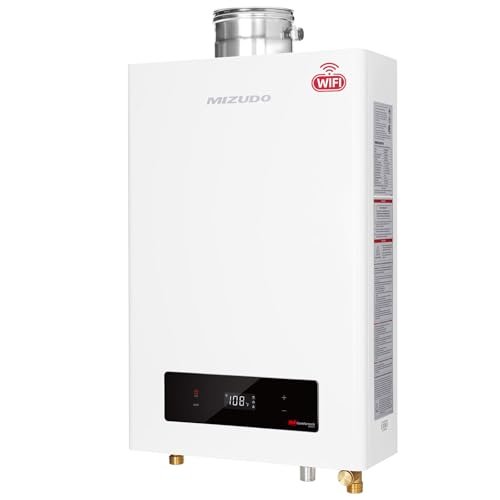
MIZUDO 180,000 BTU Natural Gas Tankless Water Heater Review: 7.9 GPM Whole-House Hot Water with WiFi Control
A tankless water heater can be an excellent upgrade for a household that regularly runs out of stored hot water, but choosing the right unit requires more than looking at a maximum gallons-per-minute rating. Gas input, incoming water temperature, simultaneous fixtures, venting, gas-line capacity, electrical requirements, and minimum activation flow all influence how a tankless system performs in the real world.
The MIZUDO 180,000 BTU natural gas tankless water heater is positioned as an indoor whole-house model for larger households. It offers a stated maximum flow of 7.9 gallons per minute, sealed combustion, Wi-Fi and smartphone app control, a copper heat exchanger, multiple built-in protection systems, and support for several hot-water fixtures operating within the capacity of the unit.
It is potentially a strong fit for homes that want continuous hot water without dedicating floor space to a conventional storage tank. However, the advertised 7.9 GPM figure should be understood as a maximum under favorable conditions rather than a guaranteed flow at every temperature rise.
What Is the MIZUDO 7.9 GPM Tankless Water Heater?
This MIZUDO model is an indoor, natural-gas-fired, non-condensing tankless water heater.
According to the supplied specifications, it provides:
- Up to 180,000 BTU of gas input
- Up to 7.9 GPM maximum hot-water flow
- Natural gas operation
- Indoor installation
- Sealed combustion
- Wi-Fi and app control
- 120V electrical connection
- 3/4-inch NPT plumbing connections
- Minimum activation flow of 0.53 GPM
- Copper heat exchanger
- CSA certification
The unit measures approximately 25 inches high, 16.3 inches wide, and 7.3 inches deep.
What Does 180,000 BTU Mean?
BTU, or British thermal unit, is used to describe the heating capacity of a gas appliance.
A 180,000 BTU tankless water heater has substantially more burner capacity than a small point-of-use unit.
That additional heating power is important when the system needs to raise a large volume of cold incoming water to a comfortable domestic hot-water temperature.
Why BTU Matters With Tankless Water Heaters
Tankless heaters do not store a reservoir of already-heated water.
Instead, water moves through a heat exchanger and must be heated as it flows.
The unit therefore needs enough burner output to support the combination of:
flow rate × required temperature rise
Higher hot-water demand generally requires more heating capacity.
Maximum 7.9 GPM Flow Rate
MIZUDO lists a maximum flow of 7.9 gallons per minute.
That figure can sound like enough for almost any household, but maximum GPM needs context.
The actual hot-water flow available at your desired temperature depends heavily on the temperature of the incoming cold water.
Maximum GPM Is Not the Same as Guaranteed GPM
Suppose incoming water is relatively warm.
The heater needs to add less heat to reach the desired outlet temperature, so it can usually maintain a higher flow rate.
If incoming water is very cold, the heater must produce a much larger temperature rise.
As the required temperature rise increases, the maximum sustainable flow generally falls.
This principle applies to tankless water heaters broadly and is essential when sizing one.
Why Incoming Water Temperature Matters
A household in a warm climate may receive considerably warmer municipal water than a home in a cold northern climate during winter.
If one home receives 70°F inlet water and another receives 40°F inlet water, both may use the same shower temperature, but the second heater has substantially more work to do.
This is why a 7.9 GPM rating should never be treated as a universal simultaneous-use guarantee.
Whole-House Hot Water Capability
The product is marketed for whole-house residential use.
The source describes support for approximately 3 to 5 usage points, although another part of the supplied listing mentions 4 to 6.
Because those figures are inconsistent, the safer way to size the heater is to calculate the expected combined fixture flow rather than rely solely on a fixture-count claim.
What Is a Usage Point?
A usage point simply means a place where hot water may be drawn.
Examples include:
- Shower
- Bathroom faucet
- Kitchen faucet
- Dishwasher
- Washing machine
The actual demand from each fixture can vary significantly.
Two Showers Are Not the Same as Two Faucets
A low-flow bathroom faucet may consume a relatively small amount of hot water.
A shower can require considerably more.
So saying a heater supports five fixtures does not necessarily mean it can supply five showers simultaneously.
What matters is the combined GPM demand.
Example of Simultaneous Demand
Imagine a household using:
- Shower: about 2 GPM
- Second shower: about 2 GPM
- Kitchen faucet: about 1.5 GPM
The combined requirement would be approximately 5.5 GPM.
Whether the heater can maintain that flow at the selected water temperature depends on the incoming water temperature and available heating capacity.
Good Candidate for Larger Households
A 180,000 BTU unit is more appropriate for larger hot-water demand than a small 3- or 4-GPM heater.
It may be suitable for homes where multiple people often use hot water around the same time.
Typical scenarios include:
- Morning showers
- Shower plus dishwasher
- Multiple bathrooms
- Kitchen and laundry use
Proper sizing remains essential.
Continuous Hot Water
The fundamental advantage of tankless technology is that there is no finite tank of stored hot water to exhaust.
As long as:
- Gas supply is available
- Water is flowing above the activation threshold
- Electrical power is available
- Demand remains within heater capacity
the unit can continue heating water.
Continuous Does Not Mean Unlimited Flow
This distinction is important.
A tankless system can provide hot water continuously, but only within its heating capacity.
If several fixtures collectively demand more hot water than the unit can heat, outlet temperature or usable flow may suffer.
Temperature Stability
The product description claims temperature stability within approximately ±1°F.
Stable outlet temperature is desirable because one of the common concerns with tankless systems is fluctuation when fixtures start or stop.
The exact real-world stability will depend on installation conditions, incoming water temperature, flow changes, gas pressure, and system configuration.
Minimum Activation Flow
The stated minimum activation flow is 0.53 GPM, or approximately 2 liters per minute.
This is an important specification.
A tankless heater needs to detect enough water flow before firing the burner.
Why Minimum Flow Matters
If a user opens a hot-water faucet only slightly and the flow remains below the activation threshold, the burner may not start.
This can be noticeable when:
- Washing hands with a trickle
- Using very low-flow fixtures
- Mixing mostly cold water
Understanding the activation threshold helps avoid assuming the unit is malfunctioning when flow is simply too low.
Sealed Combustion System
The MIZUDO unit uses a sealed combustion design.
Instead of using room air for combustion, the system is described as drawing combustion air from outside.
This helps separate the combustion process from the indoor living environment.
Why Sealed Combustion Is Useful
Gas appliances require oxygen for combustion and must safely discharge exhaust gases.
A sealed system can reduce interaction between the appliance and indoor air.
That can be particularly beneficial in modern homes that are relatively airtight.
Indoor Installation
This model is intended for indoor installation.
That means the heater must be installed with the appropriate venting and clearances specified by the manufacturer.
Indoor gas water heaters should never be installed as though they were simple plug-and-play electric appliances.
Non-Condensing Design
The source identifies the unit as non-condensing.
Non-condensing tankless heaters discharge hotter exhaust than condensing units.
That generally affects:
- Venting material
- Vent routing
- Installation requirements
The manufacturer’s venting specifications should be followed exactly.
Non-Condensing vs. Condensing Tankless Heaters
A condensing heater extracts additional heat from exhaust gases before venting them.
That can improve thermal efficiency but also creates condensate that must be drained.
A non-condensing model is mechanically simpler in that respect, but its hotter exhaust may require different venting materials.
Neither design should be installed using assumptions from the other.
Professional Installation Is Strongly Advisable
Gas tankless water heaters involve multiple building systems at once:
- Natural gas
- Combustion air
- Exhaust venting
- Water plumbing
- Electricity
Improper installation can create serious safety risks.
Installation should follow local codes, manufacturer instructions, and applicable inspection requirements.
Gas-Line Sizing Is Critical
A 180,000 BTU appliance can require significantly more gas flow than a conventional storage water heater.
An existing gas line may not automatically be large enough.
The installer should consider:
- Pipe diameter
- Pipe length
- Other gas appliances
- Supply pressure
Installing a high-output tankless unit without verifying gas capacity can cause poor performance.
Existing Gas Service May Need Upgrading
Homes designed around a smaller water heater may have gas piping sized only for the original appliance load.
Adding a 180,000 BTU tankless heater can substantially increase total demand.
The gas meter or regulator may also need evaluation.
3/4-Inch NPT Connections
The unit uses 3/4-inch NPT connections, according to the supplied specifications.
These are common sizes for higher-capacity residential water-heating equipment.
Correct pipe sizing helps maintain adequate flow through the heater.
120V Electrical Supply
Although the heater burns natural gas, it still requires electricity.
The source lists a standard 120V power supply.
Electricity is needed for components such as:
- Ignition
- Electronic controls
- Fan
- Sensors
- Wi-Fi connectivity
This means the heater generally will not function normally during a power outage unless it has an appropriate backup power source.
Tankless Does Not Mean Power-Free
This is an important misconception.
A gas burner supplies the heat, but modern tankless heaters still depend on electronic controls.
No electricity usually means no ignition or normal operation.
Wi-Fi and Smartphone App Control
The MIZUDO includes smart connectivity.
According to the source, homeowners can remotely monitor and control the heater through a smartphone app.
Potential benefits include easier access to settings without needing to stand in front of the unit.
Useful Smart-Control Scenarios
App control may be convenient for:
- Checking heater status
- Adjusting settings
- Monitoring operation
The exact app functions should be verified because not every smart water heater exposes the same controls.
Remote Temperature Adjustment Requires Caution
Changing hot-water temperature remotely should be done carefully.
Very high outlet temperatures can increase scald risk.
A household should choose an appropriate temperature setting based on plumbing design, users, and applicable guidance.
Copper Heat Exchanger
The heater uses an oxygen-free copper heat exchanger.
Copper is widely used in water-heating equipment because it transfers heat efficiently.
That helps move heat from the burner into the flowing water.
Heat Exchanger Durability
The heat exchanger is one of the most important components in any tankless heater.
Its longevity depends not only on the material but also on:
- Water chemistry
- Scale buildup
- Maintenance
- Flow conditions
Even a high-quality copper heat exchanger can experience performance problems if scale is allowed to accumulate.
Hard Water and Scale
Tankless heaters can accumulate mineral deposits inside their heat exchangers.
Hard-water areas deserve particular attention.
Scale buildup may:
- Restrict flow
- Reduce heat transfer
- Lower efficiency
- Shorten service life
Periodic flushing may be required according to the manufacturer’s maintenance schedule.
Water Softening May Be Worth Considering
If local water is very hard, a water-treatment system can help reduce mineral buildup.
Whether a softener is appropriate depends on local water chemistry and household preferences.
At minimum, buyers should understand their water hardness before installing a high-cost tankless system.
Built-In Safety Features
The supplied listing describes several protection systems, including:
- Freeze prevention
- Dry-fire protection
- Automatic relight
- Flue blockage detection
- Emergency shutoff
These features are important because a gas-fired tankless heater continuously monitors operating conditions.
Freeze Protection
The heater includes anti-freezing protection, but the manufacturer still warns that the appliance and water lines must be protected in freezing conditions.
That distinction matters.
Built-in freeze protection does not mean the entire plumbing system is immune to freezing.
Freeze Protection Often Requires Power
Anti-freeze functions commonly rely on powered components.
If electricity fails during freezing weather, protection may be reduced.
Pipes, valves, and exposed plumbing should still be insulated and installed appropriately for the local climate.
Dry-Fire Protection
Dry-fire protection is intended to prevent burner operation when appropriate water-flow conditions are absent.
This helps protect the heater from damaging operating states.
Automatic Relight
If combustion is interrupted under certain conditions, an automatic relight function may attempt to restore operation.
The exact behavior should follow the manufacturer’s control logic and safety limits.
Flue Obstruction Detection
A blocked exhaust path is a serious condition for any gas appliance.
Flue obstruction detection is designed to identify abnormal venting conditions and stop operation when needed.
Proper vent installation remains essential even when protective electronics are present.
Emergency Shutoff
Emergency shutoff functionality provides another layer of protection if unsafe operating conditions are detected.
These systems supplement correct installation; they do not replace it.
CSA Certification
The product is described as CSA certified.
Certification indicates that the appliance has been evaluated against applicable standards associated with the certification.
It does not eliminate the need for code-compliant installation.
Compact Wall-Mounted Design
The heater measures approximately:
25" H × 16.3" W × 7.3" D
This compact wall-mounted footprint is considerably smaller than a conventional storage tank.
That can free valuable floor space.
Where Space Savings Matter
Tankless heaters can be especially useful in:
- Utility rooms
- Garages
- Mechanical closets
- Smaller homes
However, installation clearances and service access still have to be maintained.
Space-Saving Does Not Mean Zero-Clearance
The appliance needs adequate room for:
- Venting
- Pipe connections
- Service
- Maintenance
Never install solely based on cabinet dimensions.
Use the manufacturer's required clearances.
Tankless vs. Storage Water Heater
The biggest difference is how hot water is produced.
Tankless Heater
Heats water on demand.
Advantages can include:
- Continuous hot water within rated capacity
- Compact size
- No large stored tank
Storage Heater
Maintains a tank of heated water.
Advantages can include:
- Simpler operation
- Familiar installation
- Ability to serve short bursts of high flow from stored volume
The best choice depends on household use patterns and infrastructure.
Tankless Water Heater Recovery
A storage heater can run out of hot water and then needs time to recover.
A tankless unit does not recover in the same way.
Instead, it continuously heats incoming water while demand exists.
That is especially useful for back-to-back showers.
Delay Before Hot Water Arrives
A tankless heater does not eliminate the time required for hot water to travel through household piping.
If the heater is far from a bathroom, users may still wait while cooled water in the pipes is displaced.
This is a distribution issue rather than heater capacity.
Recirculation Considerations
Homes with long plumbing runs may benefit from a hot-water recirculation strategy.
The supplied description does not state that this model includes an integrated recirculation pump.
If instant hot water at distant fixtures is important, investigate compatible recirculation options separately.
Is 7.9 GPM Enough for a Large Family?
Potentially, yes—but only after proper sizing.
A large household may have enough total hot-water demand to exceed the heater’s practical output during peak use.
Calculate expected simultaneous flow rather than relying on household size alone.
A Better Sizing Method
List the fixtures likely to operate simultaneously.
Estimate their flow rates.
Then compare that total with the heater's output at the expected temperature rise.
This is more reliable than asking whether a model is simply "good for five people."
Example Peak-Demand Scenario
Suppose the household occasionally runs:
- Two showers
- One bathroom faucet
- Dishwasher
at the same time.
The total flow could approach or exceed the heater's practical capacity depending on fixture flow and incoming water temperature.
If simultaneous demand is unusually high, a larger system or different plumbing strategy may be needed.
Warranty Coverage
The supplied listing states:
5-year warranty on the heat exchanger
and
2-year comprehensive warranty
Warranty coverage is worth considering because the heat exchanger is a major component.
Review the full terms for requirements involving:
- Professional installation
- Maintenance
- Water quality
- Registration
Maintenance Should Be Planned From Day One
Tankless water heaters are sometimes marketed as almost maintenance-free.
That is misleading.
A gas tankless unit may need periodic attention to:
- Heat exchanger scale
- Water filter
- Venting
- Burner
- Connections
Maintenance requirements vary by water quality and usage.
Installing Service Valves
Service isolation valves can make flushing and maintenance much easier.
If not already included, ask the installer whether a tankless service-valve kit is appropriate.
This can simplify future descaling.
Common Buying Mistakes
Choosing by Maximum GPM Alone
Temperature rise determines actual capacity.
Ignoring Gas-Line Capacity
A 180,000 BTU heater may require gas-system modifications.
Assuming Anti-Freeze Protection Makes Plumbing Freeze-Proof
Exposed pipes still need protection.
Expecting Hot Water Instantly at Every Faucet
Pipe distance still creates delivery delay.
Skipping Water-Quality Planning
Hard water can reduce performance over time.
Treating Installation as a Simple DIY Project
Gas, venting, and combustion safety require expertise.
Advantages and Considerations
Advantages
- Up to 180,000 BTU input
- Stated maximum flow up to 7.9 GPM
- Designed for whole-house hot-water use
- Natural gas operation
- Sealed combustion
- Indoor wall-mounted design
- Wi-Fi and smartphone control
- Copper heat exchanger
- 0.53 GPM minimum activation flow
- Multiple built-in safety features
- CSA certified
- 5-year heat-exchanger warranty stated
Potential Considerations
- Actual GPM decreases as required temperature rise increases
- Gas line may require upgrading
- Professional venting is required
- 120V electricity is necessary
- Non-condensing design affects vent requirements
- Hard water may require regular descaling
- Fixture-count claims in the supplied listing are inconsistent
- Freeze protection does not eliminate the need to protect plumbing
Frequently Asked Questions
What fuel does this MIZUDO water heater use?
Natural gas.
Is it designed for indoor installation?
Yes.
How powerful is it?
The supplied specification lists up to 180,000 BTU.
What is the maximum flow rate?
Up to 7.9 GPM under suitable operating conditions.
Will I always get 7.9 GPM?
No. Actual flow depends significantly on the temperature rise required.
Can it supply multiple showers?
Potentially, yes, if the combined demand and required temperature rise stay within the heater’s capacity.
How many fixtures can it support?
The listing gives inconsistent claims ranging from roughly 3–5 to 4–6 usage points. Calculate simultaneous GPM demand instead of relying on fixture count.
What is the minimum activation flow?
Approximately 0.53 GPM, or 2 L/min.
Does it have Wi-Fi?
Yes.
Can it be controlled with a smartphone?
Yes, according to the supplied information.
Does it need electricity?
Yes. It uses a standard 120V electrical supply for controls and related components.
What size are the plumbing connections?
The supplied specification lists 3/4-inch NPT connections.
Does it use sealed combustion?
Yes.
Is it condensing?
No. The model is described as non-condensing.
What material is the heat exchanger?
Oxygen-free copper.
Does it include freeze protection?
Yes, but the heater and connected plumbing still need appropriate protection in freezing climates.
Is it CSA certified?
Yes, according to the supplied information.
What are the dimensions?
Approximately 25 inches high, 16.3 inches wide, and 7.3 inches deep.
What warranty is offered?
The listing states a 5-year heat exchanger warranty and 2-year comprehensive warranty.
Is professional installation recommended?
Yes. Gas supply, venting, electrical power, water piping, and local codes all need to be addressed correctly.
Final Thoughts
The MIZUDO 180,000 BTU 7.9 GPM natural gas tankless water heater is aimed at households that need considerably more hot-water capacity than a small point-of-use heater can provide.
Its strongest features are the high burner output, stated 7.9 GPM maximum flow, sealed combustion, compact wall-mounted design, smart Wi-Fi control, copper heat exchanger, and multiple built-in protection systems. For a properly sized home, it can provide continuous hot water without occupying the floor space of a conventional storage tank.
The critical word, however, is properly sized. Maximum GPM alone is not enough to determine whether the unit will support a particular household. Incoming water temperature, simultaneous fixture demand, desired outlet temperature, gas-line capacity, and plumbing layout all need to be considered.
For homeowners seeking a high-capacity indoor natural gas tankless water heater with whole-house capability, Wi-Fi control, sealed combustion, and a compact 180,000 BTU design, this MIZUDO model is worth considering—provided the installation and real-world flow requirements are evaluated carefully before purchase.