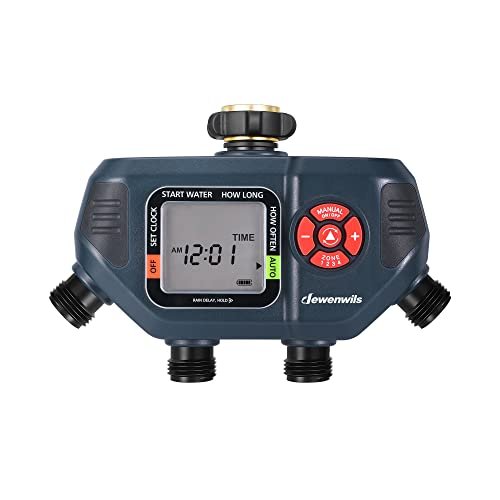
4-Zone Sprinkler Timer Review: Independent Watering Programs, Weekly Scheduling and Rain Delay
Managing several watering areas from one outdoor faucet becomes difficult when every part of the yard needs a different irrigation routine. A lawn may need longer watering sessions every few days, while vegetables, flower beds, greenhouse plants, or a misting system may need completely different timing. A 4-zone programmable sprinkler timer is designed to make that setup manageable without installing a full in-ground irrigation controller.
This model provides four independently controlled outlets, a large 3.4-inch LCD screen, watering durations from 1 to 360 minutes, day-of-week and biweekly scheduling, manual watering, rain delay, and a low-battery warning. Each zone can follow its own program, allowing several hoses or irrigation lines to share one faucet while serving different areas of the property.
The construction also emphasizes outdoor durability. A zinc faucet connector is intended to create a stronger inlet connection, while the ABS housing is designed for outdoor exposure. The source lists support for standard 3/4-inch connections and water pressure up to 120 PSI.
For homeowners who need more flexibility than a single- or dual-zone hose timer but do not necessarily want WiFi, apps, or a permanent sprinkler controller, this four-zone timer occupies a useful middle ground.
What Is a 4-Zone Sprinkler Timer?
A four-zone sprinkler timer attaches to a single outdoor faucet and divides the supply into four separately controlled outlets.
Each outlet becomes an independent watering zone.
For example, the four zones might be configured as:
- Zone 1 for the lawn
- Zone 2 for a vegetable garden
- Zone 3 for flower beds
- Zone 4 for greenhouse or misting irrigation
Each zone can have its own watering schedule rather than forcing all four areas to run for the same duration or on the same days.
This is the main advantage over using a basic four-way hose splitter, which provides multiple outlets but generally requires manual valve operation.
Four Independent Watering Zones
The manufacturer describes Zones 1, 2, 3, and 4 as independently programmed through separate controls.
That allows each outlet to follow a different irrigation routine.
A vegetable garden can receive regular watering even if the lawn is only scheduled a few days per week. Likewise, a greenhouse can have a completely different watering duration from a shrub or flower zone.
This makes the timer particularly useful for mixed landscapes.
Why Independent Programming Matters
Plants do not all use water at the same rate.
Turf, annual flowers, vegetables, established shrubs, and potted plants can have very different moisture requirements. Sun exposure, soil type, mulch depth, and root systems also influence how quickly each area dries.
Giving every zone an identical schedule can therefore lead to unnecessary watering in one area and insufficient moisture in another.
Independent programming gives you the ability to adjust each line according to actual conditions.
A Practical Four-Zone Example
A typical setup might use:
Zone 1: Lawn
A sprinkler waters established grass three mornings per week.
Zone 2: Vegetable Garden
A drip line runs more frequently but with a different duration.
Zone 3: Flower Beds
A soaker hose supplies ornamental beds on selected days.
Zone 4: Greenhouse
A misting or low-flow irrigation line runs according to the needs of plants protected from natural rainfall.
The timer lets all four systems remain connected without requiring constant hose swapping.
Watering Duration From 1 to 360 Minutes
Each irrigation program can reportedly run from 1 minute to 360 minutes, or up to six hours.
That broad range allows the timer to work with very different irrigation methods.
A conventional sprinkler may only need a relatively short cycle, while a low-flow drip or soaker system may need considerably longer.
The ability to program long runtimes is useful, but watering duration should still be based on system output rather than using the maximum simply because it is available.
Different Irrigation Systems Need Different Runtimes
A lawn sprinkler may deliver several gallons of water per minute.
A drip line may release only a small amount through each emitter.
That means a 30-minute sprinkler cycle and a 30-minute drip cycle are not equivalent.
For better scheduling, consider how much water each zone actually delivers.
Day-of-Week Scheduling
One of the more useful features is the ability to assign watering to specific days of the week.
Instead of using only a repeating "every three days" interval, you can build schedules around named weekdays.
For example, Zone 1 might water Monday, Wednesday, and Saturday, while Zone 2 operates every Tuesday and Friday.
This can be especially convenient where local irrigation rules restrict watering to particular days.
Custom Schedules for Individual Zones
Weekly scheduling also makes it easier to match each area to its actual needs.
A shaded flower bed may need water only twice per week, while a sunny vegetable bed may need more frequent irrigation.
Because each zone can be programmed separately, there is no need to compromise by placing all four lines on the same calendar.
Biweekly Watering Option
The timer also supports biweekly scheduling according to the supplied information.
That can be useful for established landscaping that does not require frequent irrigation.
Mature shrubs, certain trees, or low-water plantings may benefit from deeper but more widely spaced watering.
A biweekly option gives the controller more flexibility than basic daily or weekly timers.
When Biweekly Watering Makes Sense
Biweekly irrigation is not appropriate for every plant or climate.
It can work for drought-tolerant landscaping, mature plants with deep roots, or cooler periods when soil remains moist for longer.
Young plants, vegetables, or shallow-rooted turf may require more frequent watering.
The schedule should always follow plant and soil conditions rather than the timer's available settings.
Large 3.4-Inch LCD Display
The timer uses a 3.4-inch LCD screen designed to make programming easier.
A larger display is particularly helpful on a four-zone controller because there is more information to keep track of.
The source describes explanatory text on the left side of the screen and a flashing cursor that indicates which setting is currently being edited.
This can reduce confusion when configuring several independent schedules.
Five Program Buttons
The controller includes five programming buttons.
Combined with the LCD and flashing cursor, these controls are intended to simplify tasks such as choosing a zone, setting watering duration, selecting days, and activating different modes.
A physical interface can be preferable for users who want straightforward local control rather than smartphone-based irrigation.
Why Local Controls Can Be an Advantage
A locally programmed timer does not appear to depend on:
- WiFi coverage
- Internet connectivity
- Cloud services
- Smartphone compatibility
- User accounts
Once programmed, it can operate independently.
For many gardens, that simplicity is enough.
No Confirmed WiFi or App Requirement
The supplied information does not mention WiFi, Bluetooth, or a mobile app.
This appears to be a standalone programmable timer rather than a connected smart irrigation controller.
That makes setup simpler, but it also means remote adjustment is not described.
If changing watering schedules from your phone is important, a WiFi-based four-zone controller may be more appropriate.
Automatic Watering Mode
In Auto mode, the timer follows the programs you have created.
Once watering days, duration, and other schedule settings are configured, each zone operates automatically.
This is particularly useful when you are away from home.
You do not need to manually turn individual hose valves every day.
Rain Delay Mode
The timer includes a rain-delay function designed to temporarily suspend irrigation.
This can help prevent unnecessary watering after rainfall.
Instead of deleting several schedules and rebuilding them later, rain delay pauses the automatic program while preserving the underlying settings.
Once the delay period expires or is cancelled, automatic watering can resume.
Rain Delay Does Not Necessarily Mean Automatic Rain Detection
The source does not specify an integrated rain sensor, internet weather connection, or automatic forecast service.
The safest interpretation is that rain delay is manually activated unless the current product manual states otherwise.
You decide that irrigation should be paused based on local weather conditions and activate the delay.
Why Rain Delay Is Important With Four Zones
A four-zone timer can control a substantial amount of irrigation.
If all four programmed zones continue operating after heavy rainfall, water consumption can add up quickly.
Rain delay provides a simple way to temporarily suspend the entire system and reduce unnecessary watering.
Manual Irrigation Mode
The timer also supports manual watering.
That allows you to activate water outside the normal automatic schedule.
Manual mode is useful when:
- New plants need extra water
- A sprinkler needs testing
- A dry area requires supplemental irrigation
- You want to use a hose temporarily
- A scheduled watering cycle was skipped
A good manual mode lets you do this without erasing the existing automatic programs.
Manual Watering Is Useful for System Testing
Manual mode is also valuable during installation.
Before trusting the automatic schedule, activate each zone individually.
Confirm that the correct hose receives water, the flow rate is adequate, and the valve closes properly afterward.
Testing each outlet can reveal connection or programming problems early.
Low-Battery Reminder
The timer includes a low-battery warning.
This is important because battery-powered irrigation equipment can stop watering once power becomes insufficient.
A visible warning gives you an opportunity to replace batteries before plants begin missing scheduled cycles.
Check the display periodically, especially before leaving the property for several days.
Why Battery Maintenance Matters More With Four Zones
A four-zone controller may actuate its valves more frequently than a simple single-zone timer.
That can increase battery demand depending on how often each schedule runs.
Actual battery life is not specified in the supplied description, so users should avoid assuming a fixed operating period.
Fresh batteries before a vacation are a sensible precaution.
Zinc Integrated Faucet Connector
The source describes the faucet connector as integrated zinc construction.
The intention is to provide a stronger inlet connection and reduce the likelihood of leakage or thread wear.
A multi-zone timer places more mechanical load on the faucet than a small single-outlet controller, so inlet construction matters.
Why the Faucet Connection Is Critical
Four connected hoses can create considerable downward and sideways force.
Even a strong connector can be damaged if the hoses are allowed to hang unsupported.
Route hoses toward the ground and avoid pulling them tight.
The timer should not act as a support bracket for several heavy garden hoses.
Standard 3/4-Inch Connection
The timer is designed for a standard 3/4-inch faucet connection, commonly used with residential garden hoses.
This makes it suitable for many ordinary outdoor spigots and irrigation accessories.
Always confirm the washer is correctly seated before tightening the inlet.
Most garden-hose connections rely on a gasket rather than thread tape to create the seal.
Leak Prevention
A good installation is just as important as the connector material.
Check for leaks at:
- Faucet-to-timer connection
- Individual zone outlets
- Hose couplings
- Downstream fittings
Because the faucet usually remains open while the timer controls irrigation, every connection upstream of the zone valves may remain continuously pressurized.
ABS Outdoor Housing
The controller uses an ABS plastic shell.
ABS is commonly used for outdoor equipment because it is lightweight, impact resistant, and does not rust.
The source also describes the housing as resistant to sunlight and suitable for outdoor exposure.
Still, long-term durability depends on installation conditions and care.
Outdoor Water Resistance
The timer is intended for outdoor garden use and described as waterproof or water resistant by the source.
However, no specific IP rating is supplied in this listing.
It should therefore be treated as weather-resistant outdoor equipment rather than assumed to be submersible.
Do not install it where it can sit in standing water.
Protect It From Freezing
Water inside the valve body can freeze and expand.
This can crack housings, seals, or internal plumbing regardless of whether the exterior is designed for rain exposure.
In freezing climates, remove the timer before winter, drain it thoroughly, and store it in a protected location unless the manufacturer specifically approves year-round use.
Maximum Sustainable Water Pressure of 120 PSI
The source lists a maximum sustainable water pressure of 120 PSI.
That is higher than the pressure used in many typical residential irrigation systems.
The rating suggests the timer is designed to tolerate substantial pressure, but it does not mean 120 PSI is desirable.
Very high household pressure can still shorten the life of hoses, sprinklers, and other irrigation components.
High Pressure Can Create Problems
Excessive pressure may cause:
- Leaking hose fittings
- Misting from sprinklers
- Damaged drip emitters
- Hose failures
- Water waste
If water pressure is unusually high, a regulator may still be appropriate.
Pressurized Water Source Required
The source notes that tap water or another pressurized source is needed for normal operation.
That is particularly important for users considering gravity-fed irrigation.
A low elevated tank may not create enough pressure to operate the internal valve reliably.
If you plan to use rain barrels or gravity irrigation, verify the timer's minimum operating-pressure requirement before purchase.
Sprinkler Irrigation
One outlet can be used with a conventional lawn sprinkler.
A programmed schedule lets the lawn receive consistent watering without someone manually controlling the faucet.
If the other three zones also use high-flow sprinklers, scheduling them sequentially can help preserve water pressure.
Lawn Watering
Established lawns often respond better to deeper, less frequent irrigation than constant shallow watering, although requirements vary by grass type, soil, and climate.
The weekly scheduling feature makes it easy to choose specific days rather than watering automatically every day.
Plant Irrigation
Another zone can supply shrubs, perennials, or other landscape plants.
These plants may need very different irrigation from turf.
Independent control helps avoid running a lawn sprinkler schedule on plants that retain moisture much longer.
Vegetable Gardens
A dedicated garden zone works well with drip tubing or a soaker hose.
Vegetables often need more consistent soil moisture than mature ornamental landscaping.
Because the garden has its own program, its watering routine can change during the growing season without affecting the other three zones.
Greenhouse Irrigation
Greenhouses can benefit substantially from automatic irrigation because plants inside do not receive natural rainfall.
A dedicated zone can feed:
- Drip lines
- Micro-sprinklers
- Misting equipment
The timer's independent weekly schedules make it possible to treat the greenhouse separately from outdoor areas.
Misting Systems
The manufacturer lists water mist systems as a possible application.
Misting generally involves much shorter and potentially more frequent cycles than traditional garden irrigation.
The timer's minimum one-minute duration may work for some systems, but users should verify whether that interval is short enough for the specific misting application.
Landscape Watering
A four-zone arrangement can divide a property according to sun exposure or plant type.
For example, sunny landscaping on the south side may need more water than a shaded bed on the north side.
Independent programs allow those differences to be reflected in irrigation scheduling.
Multiple Hoses From One Faucet
The product is particularly useful when one accessible outdoor faucet must supply several areas.
Instead of manually reconnecting hoses, all four can remain attached.
The timer then determines which zone receives water according to its individual program.
Pay Attention to Available Flow
The timer cannot increase water supply.
If a connected sprinkler needs more gallons per minute than the faucet can provide, performance will remain poor.
A simple bucket test can estimate available flow.
For example, if a five-gallon bucket fills in one minute, the faucet is delivering roughly five gallons per minute under those conditions.
Should Several Zones Run Simultaneously?
The source does not clearly state whether all four valves can run at the same time.
Even if overlapping programs are technically possible, simultaneous operation may substantially reduce pressure because every outlet shares one faucet.
For high-flow systems, staggering the zones is generally more practical.
Drip Irrigation Considerations
Drip irrigation is an excellent application for programmable timers, but it often needs additional components.
Depending on the system, you may need:
- Pressure regulator
- Filter
- Mainline tubing
- Emitters
- Backflow protection
The timer controls when water flows; it does not replace the rest of the drip system.
Soil Type Matters
The timer can automate watering, but soil determines how that water behaves.
Sandy Soil
Sandy soil drains quickly and may require shorter, more frequent irrigation.
Clay Soil
Clay absorbs water slowly but retains moisture longer. Long high-flow cycles can create runoff.
Loamy Soil
Loam generally balances water retention and drainage.
Program each zone according to its specific soil rather than using identical durations everywhere.
Sun Exposure Matters Too
A bed receiving direct afternoon sun may dry much faster than an area shaded by buildings or trees.
Four independent zones make it easier to account for those differences.
This is one of the most useful reasons to divide a landscape into irrigation zones in the first place.
Adjust Programs Throughout the Season
Automatic irrigation should not become "set it and forget it" for the entire year.
Plant water demand changes with:
- Temperature
- Rainfall
- Day length
- Growth stage
- Soil conditions
Review the schedule periodically and adjust duration or frequency when necessary.
Check Local Irrigation Rules
Some municipalities restrict watering to designated days or hours.
The ability to select individual weekdays can make compliance easier.
When managing four zones, make sure the total irrigation sequence fits inside the permitted watering window.
A Good Option for Vacation Watering
One of the major advantages of an automatic timer is maintaining plants while you are away.
Before leaving, run the system for several days under normal conditions.
Confirm that every zone:
- Starts properly
- Has adequate flow
- Stops completely
- Uses the intended schedule
- Has leak-free hose connections
Also install fresh batteries if the existing set is questionable.
Test the Rain Delay Before You Need It
Because rain delay is a mode you may not use often, test it during setup.
Make sure activating the feature pauses the schedules and that automatic watering resumes afterward.
It is better to understand the controls before a major storm arrives.
Common Setup Mistakes
One common mistake is programming all four zones without considering total irrigation time.
If several long cycles overlap, water pressure or controller behavior may become unpredictable.
Another mistake is treating the rain-delay function as automatic weather sensing.
Users may also forget to inspect battery status or assume the timer works reliably with very low-pressure gravity systems.
Another Common Mistake: Unsupported Hoses
Four hoses can become heavy.
If they pull downward on the timer, they place unnecessary stress on the zinc inlet and faucet.
Route them along the ground and provide physical support where needed.
Durable hardware still benefits from proper installation.
4-Zone Timer vs. Single-Zone Timer
A single-zone timer is simpler and often cheaper.
It is appropriate when only one hose or sprinkler needs automation.
The four-zone timer becomes worthwhile when several areas need different schedules.
For a mixed property, the additional control can significantly reduce manual hose management.
4-Zone Timer vs. Dual-Zone Timer
A dual-zone model handles two independent lines.
The four-zone design doubles that capacity.
This can be useful when a property includes a lawn, vegetables, ornamental beds, and greenhouse irrigation.
The tradeoff is additional programming and more hose connections to manage.
4-Zone Timer vs. Basic Four-Way Splitter
A hose splitter only divides the water supply.
You still need to open and close each outlet manually.
A programmable four-zone timer automates the valves according to saved schedules.
That is a substantial improvement if irrigation happens regularly.
4-Zone Timer vs. WiFi Smart Timer
A WiFi model can add remote control and potentially automatic weather data.
This timer appears to emphasize local operation.
The advantage is independence from internet connectivity.
The disadvantage is that remote changes and smart weather automation are not confirmed.
4-Zone Hose Timer vs. Permanent Irrigation Controller
A traditional irrigation controller operates wired solenoid valves installed around a property.
It is better suited to extensive underground sprinkler systems.
This timer is easier to install and does not require electrical wiring or buried valves.
It is designed for hose-based irrigation attached directly to a faucet.
Main Advantages
The biggest strength is four-zone independent programming.
Each outlet can serve a different landscape area with a customized watering duration and weekly schedule.
The 1-to-360-minute watering range, specific-day and biweekly scheduling, manual irrigation, rain delay, 3.4-inch LCD, low-battery warning, zinc faucet connector, outdoor ABS housing, 3/4-inch compatibility, and 120 PSI maximum pressure rating create a versatile package for residential irrigation.
Potential Drawbacks
No WiFi or app control is described.
Automatic rainfall detection is also not established.
The timer may not be suitable for very low-pressure gravity-fed systems.
Four connected hoses can place substantial weight on the faucet, so installation needs more care than with a basic single-zone timer.
And while the housing is intended for outdoor use, a specific waterproof IP rating is not provided in the source.
Who Should Consider This 4-Zone Irrigation Timer?
This timer makes the most sense for homeowners who have one faucet serving several watering areas with different requirements.
It may be particularly useful for:
- Multiple lawn sections
- Vegetable gardens
- Flower beds
- Greenhouses
- Landscape irrigation
- Misting systems
- Drip irrigation
- Soaker hoses
- Vacation watering
It provides considerably more flexibility than a basic hose timer without requiring a professionally installed irrigation controller.
Frequently Asked Questions
How many zones does the timer control?
Four independently programmable zones.
Can each zone have its own watering schedule?
Yes.
What is the watering duration range?
From approximately 1 to 360 minutes.
Can I choose specific watering days?
Yes. The source indicates day-of-week programming.
Does it support biweekly schedules?
Yes.
Does it have automatic watering?
Yes.
Does it support manual watering?
Yes.
Does manual watering require deleting the normal program?
No. Manual irrigation is a separate operating mode.
Does the timer have rain delay?
Yes.
Does it detect rainfall automatically?
Automatic rainfall detection is not stated, so rain delay should be treated as a manually activated function unless the manual specifies otherwise.
How large is the display?
Approximately 3.4 inches.
How many programming buttons are provided?
Five.
Does it provide a low-battery warning?
Yes.
What size faucet does it fit?
Standard 3/4-inch connections.
What material is the faucet connector?
The source describes an integrated zinc connector.
What is the maximum listed pressure?
Approximately 120 PSI.
Can it be used with sprinklers?
Yes.
Can it be used for lawn irrigation?
Yes.
Can it be used with drip systems?
Yes, provided the downstream system is properly configured.
Can it operate a misting system?
Yes, according to the supplied applications.
Can it be used with gravity-fed irrigation?
Only if the water source provides sufficient operating pressure. The source specifically indicates that tap water or a pressurized source is required for normal operation.
Does it require WiFi?
No WiFi requirement is mentioned.
Final Verdict
This 4-zone programmable sprinkler timer is a practical irrigation controller for homeowners who want to manage several watering areas from one outdoor faucet without installing a permanent sprinkler system.
Its strongest features are the four independently controlled outlets, 1-to-360-minute watering duration, specific-day and biweekly scheduling, automatic and manual modes, rain delay, large 3.4-inch LCD screen, low-battery warning, zinc faucet connector, and support for standard 3/4-inch irrigation connections.
The main limitations are the lack of confirmed smart connectivity and automatic weather sensing. Users should also verify available water pressure, support the connected hoses properly, and avoid assuming that outdoor construction means the device can remain installed through freezing conditions.
For a property divided between a lawn, garden, greenhouse, flower beds, drip system, or misting zone, this four-outlet timer offers a flexible way to give each area its own watering routine while dramatically reducing the amount of daily manual irrigation work.