D-Link Wi-Fi Water Leak Sensor Starter Kit Review: Whole-Home Leak Detection Without a Hub
A water leak does not need to be dramatic to become expensive. A slow drip under a sink, a failing washing machine hose, an overflowing sump pump, or water escaping from a refrigerator line can remain unnoticed for hours before anyone realizes there is a problem.
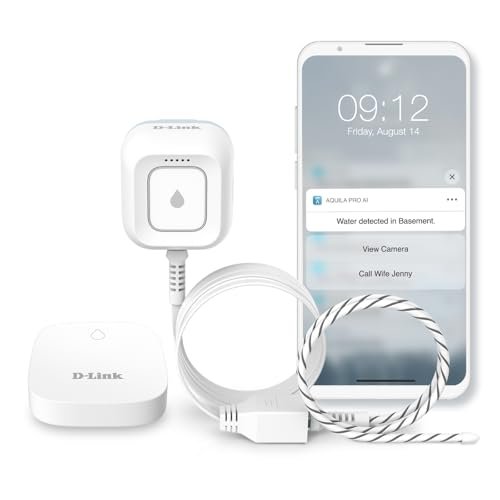
The D-Link Wi-Fi Water Leak Sensor Starter Kit (SW-A11KT) is designed to shorten that response time. It combines a plug-in master unit with a remote battery-powered sensor pod, giving you two monitored areas immediately while also supporting expansion across a larger home or small business.
The system provides several types of alerts at once: smartphone notifications, a loud local siren, a flashing LED strobe, and supported Google Assistant announcements. It also avoids the need for a separate smart-home hub because the master unit connects directly to Wi-Fi.
For homeowners who want broader leak monitoring without installing a whole-house water shutoff valve, the D-Link system offers an interesting middle ground. This guide looks at how it works, where it makes the most sense, what its limitations are, and what to consider before building a larger leak-detection network around it.
What Is the D-Link SW-A11KT Water Leak Sensor Kit?
The D-Link SW-A11KT is a smart water leak detection starter kit intended for monitoring several leak-prone areas around a property.
The kit includes two distinct detection components.
The first is a plug-in master unit with an integrated 100 dB siren, LED strobe, Bluetooth connectivity, and a water-sensing cable. The supplied cable configuration includes approximately 1.5 feet of sensing cable plus a 3-foot extension.
The second component is a compact battery-powered wireless sensor pod that can be placed somewhere else in the home, such as beneath a sink or behind an appliance.
Together, these components allow two areas to be monitored immediately without requiring extra accessories.
Why Use a Smart Water Leak Detector?
A basic water alarm can be useful if someone is nearby when it activates.
The limitation is that many leaks begin when nobody is close enough to hear them.
A smart leak sensor adds remote notification. When water is detected and the system remains connected, an alert can be sent to your smartphone through the associated app.
That changes the usefulness of a leak detector considerably.
Instead of discovering water only when you enter the room, you may be able to react while away from home, contact a neighbor, shut off a supply remotely through another system, or return before the problem becomes more serious.
The D-Link kit adds local alarms as well, which means it does not rely entirely on a phone notification to get attention.
Two Monitoring Locations Out of the Box
One of the strongest aspects of the starter kit is that it covers two areas immediately.
Many smart leak detection systems require users to purchase separate sensors one at a time. Here, the master unit itself includes water-sensing capability, while the remote pod can be placed elsewhere.
For example, the master unit could monitor a utility room or water heater area while the battery pod is placed underneath a kitchen sink.
Alternatively, the master unit could remain near a sump pump while the pod is placed behind a washing machine.
This dual-sensor setup makes the starter kit more useful from day one.
The Plug-In Master Unit
The main unit serves several roles at once.
It connects the system to Wi-Fi, provides local audible and visual alerts, communicates with remote sensor pods, and supports the sensing cable used for water detection.
Because it plugs into a wall outlet, it does not rely on batteries for normal operation.
Its compact design is also intended to avoid covering the second receptacle on a standard dual outlet.
That can be important in utility rooms, garages, basements, and laundry areas where outlets are often limited.
100 dB Siren for Local Alerts
When water is detected, the master unit can sound a 100 dB siren.
A loud alarm matters because smartphone notifications are not always noticed immediately.
A phone may be on silent, in another room, or configured with notification restrictions.
The local siren provides a second alert path for anyone nearby.
It can be especially useful in a basement or utility space where a small leak might otherwise go unnoticed.
LED Strobe for Visual Warning
The master unit also includes an LED strobe.
Visual alerts are useful when an audible alarm is difficult to hear due to background noise, distance, or individual hearing limitations.
The combination of a siren and flashing indicator makes the system more noticeable locally than a sensor that relies on sound alone.
It also helps identify which part of the system is actively reporting a problem.
Water-Sensing Cable Provides Broader Coverage
The master unit uses a sensing cable rather than monitoring only one tiny point on the floor.
This can be useful in areas where water might emerge from several directions.
For example, near a water heater, sump pump, HVAC unit, or utility sink, a longer sensing cable can cover a larger perimeter than a compact puck-style sensor.
The supplied configuration includes approximately 1.5 feet of sensing cable and an additional 3-foot extension.
Correct placement matters more than simply using all available cable length. The cable should follow the path where escaping water is most likely to travel first.
Battery-Powered Remote Sensor Pod
The second detector in the starter kit is a compact wireless pod powered by AAA batteries.
Battery operation gives it significantly more placement flexibility than the plug-in master unit.
It can be positioned:
- Under a kitchen sink
- Beneath a bathroom vanity
- Behind a refrigerator
- Near a dishwasher
- Beside a washing machine
- Near a toilet
- Around a sump pump
- In a basement
- Close to an aquarium
Because no power outlet is required, the pod can fit into spaces where a conventional smart sensor would be inconvenient.
Up to Two Years of Battery Life
D-Link states that the remote sensor pods can operate for up to two years on AAA batteries.
Actual battery life will depend on environmental conditions, communication frequency, alarm events, battery quality, and other factors.
The important benefit is that the pod should not require frequent charging.
For a leak detector installed behind an appliance or under cabinetry, reducing maintenance frequency can make the system easier to live with.
Even so, battery-powered safety devices should be checked periodically rather than forgotten indefinitely.
Wi-Fi Without a Separate Hub
A notable feature of the SW-A11KT is that it does not require a separate smart-home hub.
The master unit connects directly to the home's Wi-Fi network.
This simplifies the initial setup because users do not need to purchase or configure another bridge before receiving remote notifications.
For someone who only wants leak monitoring, avoiding a separate hub can reduce cost and complexity.
The remote pods still communicate through the master unit rather than connecting individually to the home's Wi-Fi.
Sub-GHz Wireless Communication
The system uses sub-GHz wireless communication between the master unit and remote sensor pods.
This is useful because lower-frequency wireless technologies generally provide stronger penetration through walls and better long-range performance than many higher-frequency connections.
According to the supplied specifications, the system can reach approximately 300 feet indoors and up to 1,000 feet in open space under favorable conditions.
Actual range will vary significantly depending on walls, flooring, construction materials, interference, and placement.
Still, this range makes the system suitable for larger homes and areas where standard Wi-Fi coverage may be weak.
Why Long-Range Connectivity Matters
Leak detectors are often needed in the least convenient parts of a building.
Basements, detached garages, crawl spaces, mechanical rooms, and utility areas may not have strong Wi-Fi coverage.
A remote sensor that communicates over a longer-range local wireless link can remain connected even if that location is not ideal for direct Wi-Fi.
The master unit acts as the bridge.
This architecture can make expansion more practical than installing independent Wi-Fi sensors across every corner of a property.
Expandable to 17 Monitoring Areas
The starter kit can be expanded significantly.
According to D-Link's product information, the system supports up to 15 additional SW-A2 wireless sensing pods, for a total of 17 monitored areas when the starter kit's two detection points are included.
That allows the setup to grow from a simple two-location system into broader whole-home monitoring.
This is particularly useful if you want to protect several plumbing fixtures without buying multiple separate smart ecosystems.
Building a Whole-Home Leak Detection Layout
A larger installation could include sensors near the most common water-risk areas:
- Water heater
- Washing machine
- Dishwasher
- Refrigerator water line
- Kitchen sink
- Bathroom sinks
- Toilets
- Bathtub or shower areas
- Sump pump
- Basement plumbing
- Aquarium
- Utility sink
- HVAC condensate equipment
There is little value in adding sensors randomly, however.
The best approach is to identify where a leak is both likely and capable of causing significant damage before being discovered.
Where Should You Place Water Leak Sensors?
Placement is arguably more important than the brand of the sensor itself.
A detector only responds when water reaches the sensing area.
For that reason, the sensor should be placed where leaking water is likely to collect first.
Under a sink, this may be directly beneath shutoff valves, flexible supply lines, and drain connections.
Behind a washing machine, it may be near the supply hoses or drain outlet.
Near a water heater, the sensor should be positioned where escaping water would naturally spread.
Under Kitchen and Bathroom Sinks
Cabinet plumbing is especially vulnerable to slow leaks that remain hidden.
A small drip from a faucet hose or drain connection can soak cabinetry before becoming visible from outside.
A compact battery sensor is well suited to this location because it can sit directly below the plumbing without requiring an outlet.
Keep cleaning bottles or stored objects from blocking water from reaching the sensor.
Behind Washing Machines
Washing machines involve several potential leak sources.
Supply hoses, internal pumps, drain connections, and door seals can all fail.
A sensor behind or beside the machine can provide warning before water spreads across a laundry room.
Because the remote pod is battery powered, it can remain in a location where an outlet is inaccessible.
Near Dishwashers
Dishwashers can leak beneath cabinetry or onto flooring before the problem becomes obvious.
A sensor placed near the front lower edge or underneath an accessible part of the dishwasher area can provide earlier warning.
Placement should reflect where water would exit the appliance rather than simply being close to it.
Around Water Heaters
Water heaters are a strong candidate for leak monitoring because leaks can develop from the tank, pressure-relief valve, fittings, or drain components.
The sensing cable attached to the master unit may be particularly useful here because it can monitor a broader perimeter.
Sump Pumps and Basements
A sump pump problem can allow water to rise rapidly.
Basements are also less frequently visited than kitchens or bathrooms.
The combination of long-range sub-GHz connectivity and smartphone notifications makes the system particularly relevant for these areas.
Smartphone Notifications
When water is detected, the system can send an alert through the AQUILA PRO AI app.
Remote notifications are one of the principal reasons to choose a connected leak detector rather than a conventional audible alarm.
If you are away from home, the app can tell you that attention is required.
The app also serves as the management interface for configuring and monitoring the D-Link leak sensors.
AQUILA PRO AI App Integration
D-Link uses the AQUILA PRO AI app as a broader smart-home management platform.
According to the supplied information, the app can be used for leak sensors, compatible D-Link routers, and certain Matter-enabled smart-home devices.
This creates a more unified control environment for users already invested in D-Link networking products.
The usefulness of this integration depends on how much of your smart-home ecosystem overlaps with the app.
Someone using the kit only for leak detection may primarily interact with alerts and sensor status.
Google Assistant Integration
The system supports Google Assistant alerts.
In a supported configuration, a leak detection event can potentially trigger an announcement through compatible smart speakers or displays.
This adds another local notification channel beyond the siren and flashing LED.
For example, a speaker in an upstairs living area could announce a leak detected in the basement.
Smart-speaker alerts should still be considered supplementary. The physical siren and smartphone notification remain more direct warning methods.
Four Layers of Alerting
One strength of the D-Link system is its multi-alert approach.
A detected leak can potentially generate:
- Smartphone notification
- 100 dB siren
- LED strobe
- Google Assistant announcement
Redundancy matters.
No single alert method is perfect.
A smartphone may be muted, a siren may not be heard from outside the house, and a voice assistant may be offline.
Using several channels increases the chance that someone becomes aware of the problem quickly.
What This System Does Not Do
The D-Link SW-A11KT is a leak detection and alert system, not an automatic water shutoff valve.
That distinction is important.
When a sensor detects water, the system can tell you that a problem exists, but it does not automatically close the home's main water supply based on the supplied product description.
You still need to respond manually unless you have another compatible shutoff system installed.
For users who want automatic intervention, a smart shutoff valve may be a better or complementary solution.
Leak Detector vs. Automatic Shutoff Valve
A leak detector is simpler to install because it does not need to be integrated into the plumbing line.
You place the sensors where water may collect, configure the system, and monitor alerts.
An automatic shutoff valve requires direct plumbing installation but can physically stop water flow.
The two technologies solve different parts of the same problem.
Leak sensors improve detection.
Shutoff valves improve response.
Some homeowners may benefit from using both.
D-Link SW-A11KT vs. Standalone Water Alarms
A basic standalone water alarm is inexpensive and simple.
It needs no app, Wi-Fi, account, or network configuration.
If someone is home, that can be enough.
The D-Link system becomes more useful when remote monitoring matters.
Its smartphone alerts, long-range expansion, and ability to monitor many areas through one system provide significantly more flexibility.
The tradeoff is greater complexity and dependence on networking for remote features.
D-Link SW-A11KT vs. Individual Wi-Fi Leak Sensors
Another approach is to place independent Wi-Fi sensors throughout the house.
This can work, but each device must maintain a connection to the home's wireless network.
That may become less reliable in basements, garages, or distant rooms.
The D-Link architecture instead allows the master unit to handle Wi-Fi while remote pods use sub-GHz wireless connectivity.
For larger homes, that can be a more scalable arrangement.
Compatibility Warning for Older D-Link Sensors
One of the most important details in the source material is that this system is not compatible with several older D-Link water sensors.
The new system should not be assumed to work with legacy models such as:
- DCH-161-US
- DCH-S1621KT
- DCH-S163
This matters particularly for existing D-Link customers who already own older leak detection equipment.
Do not purchase the SW-A11KT expecting to merge all previous generations into one network unless D-Link specifically confirms compatibility.
Why Product Generation Matters
Smart-home products often evolve faster than conventional plumbing equipment.
A new app, wireless protocol, or platform can make older devices incompatible even if they perform the same basic function.
Before expanding the system, verify that any additional sensor pod is explicitly designed for the current SW-A11KT platform.
For the setup described here, the additional remote sensor model is SW-A2.
Easy Setup
The product is designed around straightforward installation.
The process generally involves plugging in the master unit, connecting it to the home network, configuring the system through the app, and placing the sensors where leaks are most likely.
The remote sensors do not require wiring or plumbing modifications.
This makes the kit far easier to deploy than an automatic shutoff system.
However, smart-home setup still depends on the quality of the local network and correct app permissions.
No Plumber Required
Because the sensors do not connect directly to the plumbing, installation generally does not require a plumber.
This is one of the main advantages of leak detection systems.
A homeowner can add monitoring without touching supply lines, valves, drain pipes, or fixtures.
That makes the system particularly attractive for renters or anyone who does not want to alter existing plumbing.
No Dedicated Smart-Home Hub
The absence of a separate hub also simplifies installation.
The master unit itself performs the role of connecting the sensor network to Wi-Fi.
This means fewer devices need to be purchased and powered.
For someone starting from scratch, this can be more convenient than ecosystems requiring a proprietary hub in addition to sensors.
Common Setup Mistakes
One common mistake is placing sensors where water is unlikely to reach them.
A sensor several inches above the lowest point of a cabinet will not detect a small leak pooling on the floor below.
Another mistake is assuming advertised wireless range will be identical inside every home.
Concrete, metal, appliances, multiple floors, and dense walls can all reduce effective range.
Users should also avoid ignoring smartphone notification settings. Even a properly functioning system may appear silent if app notifications are disabled at the operating-system level.
Finally, existing D-Link owners should confirm generation compatibility rather than assuming older leak sensors can be added.
Best Practices for Initial Setup
After installing the system, test each detector before relying on it.
Use a small controlled amount of water according to the manufacturer's instructions and confirm that the sensor reacts.
Then check every alert path.
Verify that the siren sounds, the LED flashes, and the smartphone notification arrives.
If Google Assistant announcements have been configured, test those as well.
The goal is not merely to see the sensor in the app. You want to know that the entire alert chain works.
Name Each Sensor Clearly
Once several sensors are installed, generic labels become confusing.
Use descriptive names such as:
Laundry Washer
Basement Sump Pump
Kitchen Dishwasher
Upstairs Bathroom Sink
Water Heater
A notification that says "water detected by Sensor 7" is far less useful than one that immediately identifies the location.
Clear naming becomes especially important as the system approaches whole-home scale.
Periodic Testing Matters
A leak detector should not be treated as a completely maintenance-free safety device.
Periodically confirm that battery-powered pods remain active, that wireless communication still works, and that alerts are delivered.
Batteries should be replaced when required rather than waiting for complete failure.
The system should also be retested after major router changes, app updates, network reconfiguration, or moving the master unit.
Advantages of the D-Link SW-A11KT
The strongest advantage is flexibility.
The starter kit monitors two areas immediately and can expand to as many as 17 locations.
The plug-in master unit combines a loud siren, LED strobe, network connectivity, and a sensing cable in one device.
Remote pods are battery powered and compact, making them easy to position underneath appliances or inside cabinets.
Sub-GHz communication gives the system longer-range local connectivity than relying solely on Wi-Fi.
The absence of a separate hub also keeps the system comparatively simple.
Potential Drawbacks
The biggest limitation is that the system detects and reports leaks but does not automatically stop the water.
That means someone still needs to intervene.
Remote alerts also depend on the home's internet connection and app configuration.
The new-generation system is not compatible with several older D-Link leak detectors, which may be disappointing for existing users.
Battery-powered pods eventually require maintenance.
Finally, a multi-sensor installation can become more expensive as additional SW-A2 pods are added throughout the property.
Who Is This System Best For?
The D-Link SW-A11KT makes the most sense for homeowners who want broader leak monitoring without modifying their plumbing.
It is particularly suitable for larger homes where several leak-prone areas need coverage.
The long-range communication between the master unit and remote pods can also make it useful for:
- Basements
- Garages
- Multi-story homes
- Utility rooms
- Vacation properties
- Small offices
- Rental units
- Homes with several water-using appliances
It may be less compelling for someone who only needs a single basic alarm in one room.
Is It Suitable for a Vacation Home?
Potentially, yes.
Remote smartphone alerts can be especially useful when a property is frequently unoccupied.
However, the system only provides notification.
If nobody can reach the property quickly, an automatic shutoff valve may provide stronger protection against prolonged leaks.
A vacation property could therefore benefit from combining leak detection with another method of shutting off water remotely or automatically.
Is It Useful for Renters?
Because no plumbing modifications are required, this type of system can be appealing to renters.
The battery-powered sensor pods can be placed without permanent installation.
The main consideration is the plug-in master unit and network configuration.
Renters should also avoid attaching sensing equipment in a way that damages surfaces or interferes with landlord-owned appliances.
Frequently Asked Questions
What comes with the D-Link SW-A11KT starter kit?
The system includes a plug-in master unit with a siren, LED strobe, sensing cable and extension, plus a battery-powered remote water sensor pod.
How many areas can I monitor immediately?
Two.
The master unit provides one sensing location, and the wireless pod provides another.
Can the system be expanded?
Yes.
The supplied specifications state that up to 15 additional SW-A2 sensor pods can be added, providing up to 17 monitored areas in total.
Does it require a hub?
No separate smart-home hub is required.
The master unit connects directly to Wi-Fi and communicates with the remote sensors.
What happens when water is detected?
The system can send a smartphone notification, sound a 100 dB siren, flash the LED strobe, and provide supported Google Assistant announcements.
How far can the remote sensors communicate?
D-Link lists approximately 300 feet of indoor range and up to 1,000 feet in open space under favorable conditions.
Actual performance will vary according to the building and environment.
Are the remote sensors battery powered?
Yes.
The wireless sensor pods use AAA batteries.
How long do the batteries last?
The product information states up to approximately two years of battery life.
Actual runtime can vary.
Can I put a sensor behind a washing machine?
Yes. The compact, battery-powered pod is well suited to locations behind or beneath appliances where no convenient outlet is available.
Can I use it near a sump pump?
Yes. Sump pumps and basements are among the more useful areas to monitor with a water leak detector.
Does it automatically shut off the water?
No automatic shutoff capability is described for this kit.
The system is designed to detect water and generate alerts.
Does it work with Google Assistant?
Yes. The supplied specifications include support for Google Assistant notifications or announcements.
Which app does it use?
The system is managed through D-Link's AQUILA PRO AI app.
Does it work with older D-Link water sensors?
Not with the legacy models specifically identified as incompatible, including DCH-161-US, DCH-S1621KT, and DCH-S163.
Which sensor should I buy to expand the system?
The supplied product information identifies the SW-A2 wireless sensing pod as the compatible expansion sensor.
Do I need a plumber to install it?
Normally, no.
The system does not require plumbing modifications and is intended for straightforward consumer setup.
Final Verdict
The D-Link Wi-Fi Water Leak Sensor Starter Kit SW-A11KT is a practical option for homeowners who want smart leak monitoring across more than one location without installing a separate hub or modifying the plumbing.
Its strongest feature is scalability. Two locations can be monitored immediately, while additional SW-A2 sensor pods can expand the system to as many as 17 areas.
The combination of smartphone notifications, a 100 dB siren, LED strobe, and Google Assistant support provides several ways to make a leak difficult to overlook.
Sub-GHz communication also gives the battery-powered pods useful reach in basements, garages, utility rooms, and larger homes where direct Wi-Fi connectivity may be less dependable.
The primary limitation is that this is an alerting system rather than an automatic shutoff system. It can tell you where water has been detected, but someone still needs to stop the source.
For homeowners primarily looking for easy-to-install, expandable whole-home leak detection with remote alerts, the D-Link SW-A11KT offers a strong balance between simplicity and coverage. For properties where automatic water shutdown is the priority, it is better viewed as one layer of protection rather than a complete leak-response solution.