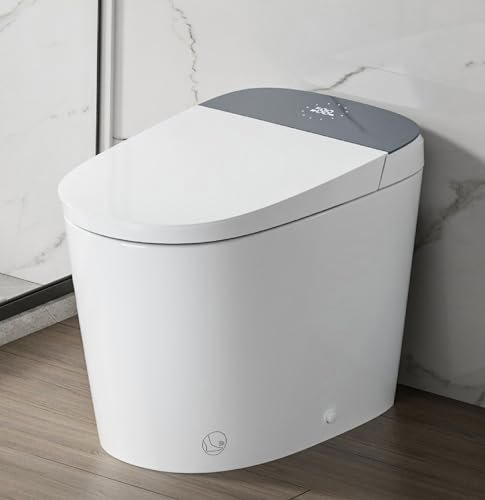
CASTA DIVA Smart Toilet Review: 1000g MaP Flush, ADA Height, Built-In Tank and Bidet Features
Smart toilets are often marketed around comfort features such as heated seats, warm-water cleansing, automatic lids, and remote controls. Those upgrades can be appealing, but none of them matter much if the toilet does not flush reliably.
The CASTA DIVA smart toilet with integrated bidet is built around a more performance-focused design. According to the supplied specifications, it combines a 1000-gram MaP-rated flush, a built-in water tank, pump-assisted flushing for low-pressure homes, dual-flush operation, pre-wetting, ADA-style comfort height, automatic lid functions, and a full electronic bidet system.
That combination makes it different from many tankless smart toilets that rely heavily on household water pressure. By incorporating both stored water and pump assistance, the CASTA DIVA aims to deliver consistent flushing even where supply conditions are less than ideal.
It also includes many of the convenience features expected from a premium bidet toilet: rear and feminine washing, oscillation, massage mode, adjustable water pressure and temperature, instant warm water, five heated-seat levels, a warm-air dryer, nightlight, LED display, automatic flushing, foot controls, and remote operation.
This guide looks at the toilet from a practical buyer's perspective, including flushing performance, accessibility, low-pressure operation, bidet comfort, installation, maintenance, and the compromises that come with a highly integrated fixture.
What Is the CASTA DIVA Smart Toilet?
The CASTA DIVA is an elongated smart toilet with an integrated electronic bidet, built-in tank, and pump-assisted flushing system.
Rather than depending entirely on direct household pressure, the toilet incorporates stored water and additional flushing assistance.
That design is particularly relevant for homes where water pressure is low, inconsistent, or otherwise unsuitable for some conventional tankless smart toilets.
The toilet also uses electronic sensors and controls to automate several everyday functions.
Depending on how it is configured, the lid can open when a user approaches, the toilet can flush after use, and the lid can close after the user leaves.
A foot sensor provides additional hands-free control.
Flushing Performance Is the Main Selling Point
The supplied product information states that the toilet achieves a 1000-gram MaP flush performance rating.
MaP, or Maximum Performance testing, is commonly used to evaluate how much standardized solid material a toilet can remove in a single flush under controlled test conditions.
A 1000-gram result represents the upper end of the MaP test scale.
That does not guarantee that a toilet will never clog in real-world use, but it is a useful indication that flushing performance was a design priority.
For a smart toilet, this matters because buyers should not have to sacrifice core toilet functionality in exchange for electronics and comfort features.
Why MaP Performance Matters
Gallons per flush tell you how much water a toilet uses.
They do not tell you how effectively that water is used.
Two toilets can consume the same amount of water and perform very differently because of differences in bowl geometry, trapway design, jet placement, flush timing, and water velocity.
A strong MaP rating provides another data point when judging whether a water-efficient toilet can still remove waste reliably.
The goal is not simply to use less water. It is to clear the bowl efficiently without needing a second flush.
Vortex-Style Flushing
The product description refers to an advanced water-saving vortex flushing system.
A vortex flush directs water around the bowl in a circular movement.
This can serve two purposes.
First, the rotating flow helps rinse a larger area of the bowl surface.
Second, water movement can help drive waste toward the trapway.
The effectiveness of any vortex design still depends on the rest of the toilet's hydraulic engineering, but it can contribute to both bowl cleaning and waste evacuation.
Built-In Water Tank
One of the more unusual aspects of the CASTA DIVA is its integrated water tank.
Many modern smart toilets are marketed as completely tankless.
That creates a sleek profile, but it can make flushing more dependent on household water pressure and flow.
A built-in tank stores water so the toilet has a more predictable supply available when flushing begins.
The tank is incorporated into the smart toilet body rather than appearing as a large conventional rear tank.
Why a Built-In Tank Can Improve Reliability
Stored water provides a buffer.
Instead of needing the plumbing supply to deliver the entire flush volume almost instantly, the toilet can use water that has already accumulated internally.
This can be particularly valuable in homes where pressure varies throughout the day.
It may also reduce the sensitivity of flushing performance to temporary pressure drops caused by other fixtures being used simultaneously.
The result is a hybrid approach: modern integrated styling without relying entirely on direct-pressure flushing.
Pump-Assisted Flushing
The toilet also includes a pump-assisted flush system.
The product description specifically positions this as a solution for very low-pressure or effectively zero-pressure flushing conditions.
A pump provides additional force to move stored water through the bowl.
This can help the toilet produce a strong flush even where supply pressure alone would not be sufficient for a standard tankless model.
Built-In Tank Plus Pump: Why the Combination Matters
The combination of stored water and pump assistance is more important than either feature alone.
The tank provides a reserve.
The pump helps deliver that reserve with force.
That gives the toilet more control over its own flushing performance instead of relying entirely on conditions elsewhere in the plumbing system.
For buyers who have avoided smart toilets because of low water pressure, this architecture may be particularly appealing.
However, the toilet still needs an adequate water supply to refill its internal tank over time.
Pump assistance does not eliminate plumbing requirements altogether.
Pre-Wetting the Bowl
Before use, the toilet can apply a layer of water to the bowl surface.
This pre-wetting function is intended to reduce adhesion and make waste easier to rinse away.
That can be especially useful with lower-volume flushes because a damp surface is generally easier to clean than a dry one.
Pre-wetting can also reduce the amount of residue left behind after flushing.
It does not replace routine toilet cleaning, but it can improve everyday bowl cleanliness.
Dual Flush: 1.1 and 1.6 GPF
The CASTA DIVA includes two flushing volumes.
The supplied figures are:
Half flush: approximately 1.1 gallons per flush
Full flush: approximately 1.6 gallons per flush
Dual flushing allows users to choose a lower volume when less water is needed and a stronger full flush when greater clearing power is appropriate.
This is a practical way to balance water efficiency with performance.
The important point is that the lower-volume mode must still work reliably under normal conditions. If it frequently requires a second flush, the expected water savings diminish.
Water Efficiency Without Sacrificing Performance
The combination of dual flush, vortex movement, pre-wetting, stored water, and pump assistance is designed to avoid a common compromise.
A toilet can conserve water and still perform well if that water is directed efficiently.
The listed 1000-gram MaP rating suggests that CASTA DIVA has emphasized this balance.
For many buyers, that is more meaningful than simply choosing the toilet with the lowest advertised GPF.
ADA-Style Comfort Height
The toilet is listed with a seat height of approximately 17-3/8 inches.
That places it in the comfort-height or ADA-height range commonly preferred by users who find lower conventional toilets more difficult to use.
A taller seat reduces the distance the body must travel when sitting down or standing up.
This can be useful for older adults, taller users, and some people with limited mobility.
Why Seat Height Matters
Toilet height is often overlooked when people shop online.
A few inches can significantly change how the fixture feels.
Lower toilets may be comfortable for shorter users but can require deeper knee and hip flexion.
A taller seat can feel more like sitting in a standard chair.
That does not mean a higher toilet is automatically better for everyone.
Shorter users may find a very tall seat less comfortable if their feet do not rest securely on the floor.
Accessibility Benefits and Limits
Automatic flushing, remote controls, bidet washing, drying, and a higher seat can all make bathroom use easier for some people.
However, those features alone do not guarantee that a bathroom meets accessibility standards.
True accessibility also depends on factors such as clear floor space, transfer room, grab-bar placement, doorway dimensions, and the surrounding bathroom layout.
Anyone selecting the toilet specifically for accessibility should consider the complete installation rather than the fixture alone.
Automatic Lid Opening
The toilet can automatically open its lid when a user approaches.
This is primarily a convenience feature, but it also reduces the number of surfaces that need to be touched.
For households that appreciate automation, it can make the bathroom experience feel more seamless.
Automatic lid systems rely on proximity sensors, so performance can depend on bathroom layout and sensitivity.
If the toilet is installed in a very small room or near a frequently traveled path, sensor behavior should be evaluated carefully.
Automatic Lid Closing
After use, the toilet can close its lid automatically.
That helps keep the bathroom looking tidy and can reduce the likelihood of the lid simply being left open.
Automatic closing should occur gently enough to avoid slamming.
The exact timing may vary according to the toilet's programming.
Automatic Flushing
The toilet can also flush automatically when the user leaves.
This hands-free operation removes the need to operate a traditional flush lever.
It is convenient, but it is important that the toilet also provide reliable manual controls.
Sensors are helpful, but basic functions should never become difficult simply because automation does not behave as expected.
Foot-Sensor Control
The foot sensor provides another hands-free way to operate the toilet.
According to the product description, it can be used to control functions such as lid or seat movement and flushing.
Foot controls are particularly convenient for male users who want to lift the seat without touching it.
They can also provide direct control over flushing without relying entirely on automatic detection.
Remote Control
The supplied remote gives users access to bidet settings and other electronic functions.
A wall-mounted remote is usually easier to use than a large control panel attached to the side of the toilet.
It also allows more settings to be displayed clearly.
For households with several users, a remote makes adjustments to temperature, pressure, and washing mode more convenient.
Integrated Bidet System
The CASTA DIVA includes a self-cleaning bidet wand with several cleaning modes.
The product description identifies:
- Rear wash
- Feminine wash
- Oscillating wash
- Massage wash
It also allows adjustment of water pressure, temperature, and nozzle position.
That makes the system significantly more customizable than a non-electric bidet attachment.
Rear Wash
Rear wash provides the primary bidet cleansing function after toilet use.
Adjustable nozzle position allows the spray to be aligned more accurately.
Water-pressure adjustment lets each user choose a comfortable intensity.
This is important because a bidet that feels comfortable to one person may feel too strong or too weak to another.
Feminine Wash
Feminine wash uses a forward-positioned spray intended for gentler cleansing.
This separate mode is more practical than forcing all users to rely on one universal nozzle position.
Temperature and pressure adjustment also allow the experience to be tailored more carefully.
Oscillating Wash
Oscillation moves the spray back and forth rather than keeping it in one fixed location.
This can increase cleaning coverage.
It may also reduce the need for the user to shift position on the seat.
For many people, oscillation is one of the more useful advanced bidet features.
Massage Mode
Massage washing changes the spray pattern or intensity rhythmically.
This is mainly a comfort feature.
Some users prefer a steady spray, while others find a changing pattern more pleasant.
The value is customization rather than necessity.
Self-Cleaning Wand
The bidet nozzle includes a self-cleaning function.
That is especially important because the wand operates within the toilet environment.
Automatic rinsing helps reduce residue on the nozzle between uses.
However, it should not be interpreted as maintenance-free.
The nozzle and surrounding area should still be inspected and cleaned periodically according to the manufacturer's instructions.
Instant Warm-Water Cleaning
The toilet provides instant warm-water bidet washing.
This is a significant comfort improvement over basic cold-water attachments.
On-demand heating also means the user does not have to wait for a small reservoir to warm before washing begins.
Depending on the heating system, it may provide a more consistent temperature during longer wash cycles.
The exact heating limits and duration should be confirmed in the current product manual if continuous warm-water performance is important.
Heated Elongated Seat
The elongated seat includes five temperature levels according to the supplied specifications.
A heated seat can be particularly comfortable during winter or in heavily air-conditioned homes.
Five levels provide enough adjustment for different users rather than forcing one fixed setting.
The elongated shape also offers more seating area than a round-front toilet.
Warm-Air Dryer
After washing, the integrated warm-air dryer can reduce the amount of toilet paper required.
Drying performance varies between smart toilets and depends on airflow, temperature, and user expectations.
Some people may use the dryer almost exclusively.
Others may still prefer a small amount of toilet paper afterward.
It is more realistic to view the dryer as a way to reduce paper use rather than guarantee complete elimination.
LED Display
The smart toilet includes an LED display.
Displays are helpful on feature-rich toilets because they provide visible information about current settings.
Depending on the implementation, this may include seat temperature, water temperature, or operating status.
A clear display can make the toilet easier for new users to understand.
Nightlight
An integrated nightlight provides soft illumination for nighttime bathroom visits.
This can make the toilet easier to locate without switching on bright overhead lights.
It is a small feature, but one that may be used every night.
In ensuite bathrooms, it can also reduce disturbance to someone sleeping nearby.
Smart Toilet vs. Conventional Toilet
A conventional toilet has one major advantage: simplicity.
It does not need electricity, uses familiar mechanical parts, and can often be repaired cheaply with components from a hardware store.
The CASTA DIVA offers a very different experience.
It combines strong flushing performance with bidet washing, heating, drying, automation, lighting, and hands-free controls.
The tradeoff is additional complexity.
More functions mean more pumps, sensors, heaters, actuators, and electronics that may eventually need service.
Smart Toilet vs. Electronic Bidet Seat
An electronic bidet seat can add many comfort features to an existing toilet.
That may include warm water, seat heating, nozzle adjustment, drying, and remote operation.
This approach can be much less expensive than replacing the entire toilet.
The CASTA DIVA becomes more compelling when you want features that a replacement seat cannot provide easily, such as integrated automatic flushing, pump-assisted hydraulics, a built-in tank, automatic lid operation, and a unified one-piece design.
For a full remodel, the integrated solution may look cleaner.
For an otherwise functional bathroom, a premium bidet seat may provide better value.
Built-In Tank vs. Fully Tankless Smart Toilet
A fully tankless smart toilet can look extremely sleek.
The downside is greater reliance on supply pressure.
The CASTA DIVA's hidden tank provides stored water for flushing.
This may slightly increase internal complexity, but it gives the toilet more control over flush consistency.
Buyers who prioritize dependable flushing over the purest tankless architecture may prefer this hybrid approach.
Low Water Pressure Homes
This toilet is specifically marketed toward users with weak or inconsistent water pressure.
The combination of a stored-water tank and pump assistance can help maintain flush power when the home's supply cannot provide a strong instantaneous flow.
This makes it particularly interesting for upper floors, older plumbing systems, well-water properties, or homes where pressure fluctuates.
That said, the plumbing still needs to meet the manufacturer's refill and supply requirements.
A severely restricted line or failing pressure system should be repaired rather than relying on the toilet to compensate for the underlying problem.
Electrical Requirements
The toilet requires electricity for its pump, heated seat, instant water heater, dryer, sensors, display, automatic lid, and controls.
That means a suitable electrical receptacle must be available near the installation location.
Bathroom electrical work must comply with local safety codes.
Appropriate ground-fault protection may be required depending on jurisdiction and installation.
A permanent extension cord should not be considered a substitute for a correctly installed bathroom receptacle.
Plumbing Requirements
Before ordering, verify the toilet's:
- Rough-in dimension
- Drain location
- Water supply position
- Supply-line size
- Shutoff-valve condition
- Installation clearance
Pump assistance makes the toilet more forgiving of pressure problems, but it does not make physical plumbing compatibility irrelevant.
Measure carefully before purchasing.
Why Rough-In Measurement Matters
The rough-in is the distance between the finished wall and the center of the toilet drain.
Smart toilets often have less installation flexibility than conventional models because the base contains additional equipment.
A mismatch can make installation difficult or impossible without moving plumbing.
Always confirm the exact requirement for the specific model.
One-Piece Smart Toilet Installation
Integrated smart toilets can be heavy.
Unlike a conventional two-piece toilet, they often contain pumps, electronics, motors, bidet components, and hidden tanks inside one shell.
Two-person handling may be advisable.
Care should also be taken not to damage wiring, hoses, sensors, or internal components while positioning the fixture over the drain.
Certifications
The supplied information states that the toilet is EGS certified, CEC compliant, and cUPC listed.
These are relevant specifications for a fixture that combines electrical and plumbing systems.
Current certification should be confirmed for the exact model being purchased, particularly if local inspectors require documentation.
Certification also does not replace correct installation.
Local electrical, plumbing, and building codes still apply.
Cleaning and Maintenance
The bowl can be cleaned similarly to other toilets, but care is needed around the electronic seat, sensors, nozzle, display, and moving components.
Harsh abrasives should generally be avoided on plastic and coated surfaces.
Do not spray excessive water directly into electronic housings.
The self-cleaning nozzle should still be inspected periodically.
The automatic lid mechanism and sensors should also be kept free of buildup that could interfere with movement or detection.
Common Cleaning Mistakes
One common mistake is using aggressive bowl chemicals without checking whether they are safe for the smart toilet's internal components.
Another is treating the seat assembly as though it were completely waterproof.
Smart toilets are designed for humid bathroom environments, but that does not mean electronic parts should be soaked during cleaning.
Follow the manufacturer's cleaning recommendations to avoid damaging seals, sensors, or finishes.
Common Buying Mistakes
The first mistake is focusing entirely on smart features while ignoring installation requirements.
Check the rough-in, outlet, room dimensions, supply line, and service access first.
Another mistake is assuming the 1000-gram MaP rating means clogging is impossible.
No residential toilet is completely immune to improper use or unsuitable waste.
Buyers should also consider serviceability.
A highly integrated smart toilet may require manufacturer-specific parts for the pump, remote, lid motor, control board, or bidet system.
Replacement Parts and Long-Term Ownership
Long-term support matters more with a smart toilet than with a basic fixture.
A conventional fill valve can often be replaced with a generic component.
A smart toilet pump or control board may be proprietary.
Before buying, consider whether replacement parts, technical support, manuals, and warranty service are readily available.
The quality of after-sales support can be just as important as the feature list.
Who Is the CASTA DIVA Smart Toilet Best For?
This model is particularly well suited to buyers who want strong flushing performance and bidet functionality in the same fixture.
It may be especially attractive for:
- Primary bathrooms
- Modern remodels
- Homes with low water pressure
- Older users who prefer comfort height
- Households wanting automatic flushing
- Buyers seeking hands-free operation
- Users who value heated bidet features
- People who prioritize a strong MaP-tested flush
For a basic guest bathroom or budget renovation, it may be more technology than necessary.
Is It a Good Choice for Older Adults?
Potentially.
The 17-3/8-inch seat height can make sitting and standing easier for many adults.
Automatic lid operation, hands-free flushing, remote controls, bidet washing, and drying may also reduce some physical effort.
However, anyone choosing a toilet for a specific mobility limitation should evaluate the complete bathroom setup and individual needs.
Grab bars, floor clearance, seat stability, and transfer space may be just as important as toilet height.
Is It Good for Low-Pressure Plumbing?
That is one of its primary selling points.
The integrated tank and pump-assisted system are specifically intended to provide consistent flushing even when incoming pressure is low or unstable.
This can be a meaningful advantage over fully tankless pressure-dependent models.
Advantages of the CASTA DIVA Smart Toilet
Its strongest advantage is that it prioritizes both flushing and comfort.
The listed 1000-gram MaP rating is impressive for buyers concerned about waste removal.
The built-in tank and pump-assisted system reduce dependence on household pressure.
Pre-wetting and vortex flushing improve bowl rinsing, while dual 1.1/1.6 GPF operation provides flexibility.
The 17-3/8-inch seat height improves comfort for many users.
Automatic lid movement, foot sensing, rear and feminine washing, oscillation, massage mode, instant warm water, a five-level heated seat, warm-air drying, night lighting, LED controls, and remote operation create a comprehensive smart-toilet experience.
Potential Drawbacks
The primary disadvantage is complexity.
A built-in tank, flushing pump, water heater, seat heater, dryer, sensors, lid motor, remote control, and bidet system create many more service points than a conventional toilet.
Electrical power is required.
Installation may be more involved.
Replacement components may be proprietary.
The higher seat may also not be ideal for very short users.
Finally, anyone who does not care about bidet or automation features may find a simpler high-performance toilet more economical.
Frequently Asked Questions
What is the MaP rating of the CASTA DIVA smart toilet?
The supplied specifications list a 1000-gram MaP flush performance rating.
What does a 1000g MaP rating mean?
It indicates that the toilet reached the upper end of the standardized MaP solid-waste removal test under controlled conditions.
It does not guarantee that the toilet can never clog.
Does the toilet have a built-in tank?
Yes. It includes an internal water tank designed to help stabilize flushing performance.
Does it have a flushing pump?
Yes. The pump-assisted system is intended to improve flushing in low or unstable water-pressure conditions.
Can it work with very low water pressure?
That is one of the design goals of the built-in tank and pump-assisted flush.
The home's supply still needs to meet the manufacturer's installation requirements.
How much water does it use?
The listed dual-flush volumes are approximately 1.1 GPF for the half flush and 1.6 GPF for the full flush.
Does it pre-wet the bowl?
Yes. A pre-wetting function moistens the bowl surface before use.
How high is the seat?
The listed height is approximately 17-3/8 inches.
Is it an ADA-height toilet?
The product is marketed as ADA height. Actual compliance in a particular installation can depend on more than seat height alone.
Does the lid open automatically?
Yes. The toilet is designed to automatically open its lid as the user approaches.
Does it flush automatically?
Yes. It can flush automatically after the user leaves.
Can it be controlled with your foot?
Yes. A foot sensor can operate lid, seat, and flushing functions according to the supplied description.
Does it have a bidet?
Yes. It includes an integrated electronic bidet.
What wash modes are available?
The supplied specifications include rear, feminine, oscillating, and massage cleaning modes.
Can water pressure and temperature be adjusted?
Yes. Bidet water pressure, temperature, and nozzle position are adjustable.
Is the seat heated?
Yes. The elongated seat supports five temperature levels.
Does it provide instant warm water?
Yes. Instant warm-water cleansing is included.
Does it have a dryer?
Yes. A warm-air dryer is built in.
Does it include a nightlight?
Yes. An integrated nightlight is included.
Does it require electricity?
Yes. Power is required for the pump, bidet, heating, drying, automatic lid, sensors, display, and other smart functions.
Is it certified?
The supplied product information states that it is EGS certified, CEC compliant, and cUPC listed.
Final Verdict
The CASTA DIVA smart toilet stands out because it combines premium bidet features with a stronger emphasis on flushing performance than many smart toilets.
Its listed 1000-gram MaP rating, internal tank, pump-assisted flush, vortex technology, pre-wetting system, and dual 1.1/1.6 GPF operation address the fundamental job of a toilet first: clearing the bowl reliably.
At the same time, it delivers the conveniences buyers expect from a modern bidet toilet, including automatic lid opening and closing, hands-free flushing, foot controls, instant warm water, a five-level heated seat, adjustable rear and feminine washing, oscillation, massage mode, drying, a nightlight, LED display, and remote control.
The 17-3/8-inch comfort-height seat also makes it particularly interesting for buyers who prefer a taller sitting position.
Its biggest tradeoff is complexity. The same integrated technology that provides convenience also creates more components to install, power, maintain, and potentially repair.
For homeowners who want strong flush performance, low-pressure compatibility, comfort-height seating, and a full smart-bidet experience in one fixture, the CASTA DIVA is the type of smart toilet that deserves serious consideration. For buyers who prioritize simplicity and inexpensive long-term repairs above automation, a conventional high-performance toilet with a separate bidet seat may still be the more practical solution.