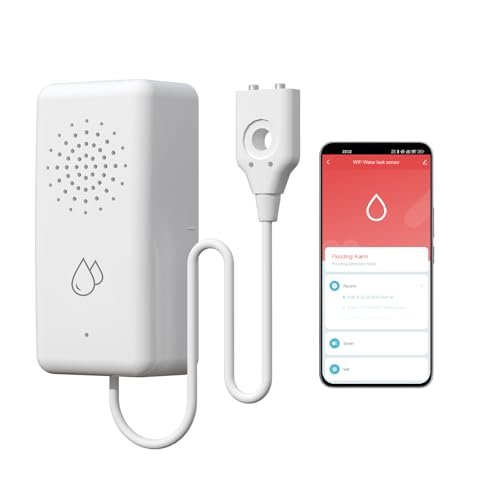
BSEED WiFi Water Leak Detector Review: Real-Time Alerts, 2.6-Foot Probe and No Hub Required
A water leak detector is one of those devices that can seem unnecessary—right up until a washing machine hose starts dripping, a water heater begins leaking, or a basement pipe releases water while nobody is home. The earlier a leak is detected, the sooner someone can investigate and limit the spread of water.
The BSEED WiFi water leak detector is designed as a standalone smart sensor that connects directly to a 2.4GHz WiFi network. Unlike gateway-based leak detection systems, it does not require a separate hub. When water is detected, the sensor can trigger an 85dB local alarm while also sending remote notifications through its app. The supplied information also lists optional email and SMS alerts, although those services may require payment.
One of its most interesting features is a 2.6-foot extended probe. Instead of limiting detection to the area immediately beneath the sensor body, the probe can be positioned in narrow or difficult-to-reach locations and can also be used for water-level monitoring.
For homeowners who want simple remote leak monitoring without building an entire smart-home sensor network, this combination of direct WiFi connectivity, local alerts, IP65 protection, and flexible probe placement makes the BSEED an interesting option.
What Is the BSEED WiFi Water Leak Detector?
The BSEED is a battery-powered smart water sensor designed to detect leaks, dripping water, flooding, and changing water levels.
Once connected to a compatible WiFi network, it communicates directly with the associated mobile app.
This means the communication path is relatively simple:
BSEED sensor → WiFi router → app notification
There is no separate bridge or gateway to install between the sensor and your home network.
That simplicity can be especially attractive when you only need one or a few sensors rather than a large whole-home detection network.
No Hub Required
Many smart leak-detection systems use a dedicated gateway. Each sensor communicates with that gateway, which then connects to the internet.
The BSEED takes a different approach.
It connects directly to WiFi, eliminating one piece of hardware.
That can make initial installation easier and reduce the number of devices that need power outlets.
For a single basement, utility room, water heater, or washing machine, this direct-connect architecture may be all you need.
When a Hub-Free Design Makes Sense
A hub-free leak detector is particularly convenient when monitoring:
- One water heater
- One washing machine
- A basement
- A kitchen sink
- A vacation property
- A fish tank
- A sump area
- A refrigerator water line
If you eventually want 20 or 30 sensors throughout a large home, a gateway-based system may be easier to manage at scale. But for smaller deployments, direct WiFi can be simpler.
2.4GHz WiFi Only
The sensor supports 2.4GHz WiFi according to the supplied specifications.
It does not support a 5GHz-only network.
That is common among smart-home sensors because 2.4GHz offers longer range and generally penetrates walls better than 5GHz.
The device does not need high bandwidth. Leak alerts contain very little data, so range and energy efficiency matter more than speed.
Check Your Router Before Buying
Most modern routers provide 2.4GHz and 5GHz connectivity.
However, some mesh systems combine both frequencies under one network name, which can occasionally complicate pairing.
If setup fails, you may need to temporarily force the phone or router onto the 2.4GHz band during installation.
Once connected, the sensor should remain on 2.4GHz.
Real-Time Leak Alerts
When the detector senses water, it can send a remote notification to your phone.
This is the main advantage over a traditional standalone water alarm.
A local buzzer only helps if someone is within hearing range.
A phone notification can alert you when you are:
- At work
- Traveling
- Shopping
- Sleeping on another floor
- Away from a vacation home
- Managing a rental property
That can reduce the amount of time a leak remains unnoticed.
App Notifications
App alerts appear to be the primary remote-notification method.
Once the detector is connected and online, a water event can trigger a push notification.
For this feature to work reliably, several systems must remain available: the sensor batteries, home WiFi, internet connection, smart-home service, and phone notification permissions.
A smart sensor should therefore be considered an additional layer of protection rather than an infallible alarm system.
Email and SMS Alerts May Cost Extra
The supplied information states that email and SMS notifications are chargeable.
That is an important detail.
App push notifications appear to be the basic alert method, while users who want text-message or email escalation may need to subscribe to additional services.
Before buying specifically for SMS alerts, check the current pricing and availability in the app.
Device Sharing for Family Members
The BSEED system includes device-sharing functionality.
This allows other family members or authorized users to view the sensor's status.
Shared access can improve response time because the alert does not depend on a single person's phone.
For example, if one household member is in a meeting, another may still see the notification and investigate.
Why Shared Access Is Useful
Device sharing can be particularly valuable for:
- Couples
- Families
- Landlords
- Property managers
- Vacation homes
- Elderly relatives' homes
- Shared apartments
When setting up shared access, make sure each person understands which location the sensor is monitoring.
A clearly named device such as "Basement Water Heater" is much more useful than "Sensor 1."
Water Leak Detection
The sensor is designed to detect dripping, leaking, or flooding.
That gives it several practical applications.
Some plumbing failures release large amounts of water rapidly, while others begin with a barely visible drip.
Early detection is particularly useful for slow leaks because they can damage cabinets, drywall, insulation, or flooring before they become obvious.
2.6-Foot Extended Probe
One of the BSEED's most distinctive features is the approximately 2.6-foot detection probe.
This probe allows the sensing point to be positioned away from the main electronic body.
That is useful in spaces where placing the entire sensor would be difficult.
For example, the sensor body might remain mounted in an accessible location while the probe extends beneath an appliance or inside a narrow gap.
Why an Extended Probe Can Be Better Than a Floor Sensor
A conventional puck-style sensor only detects water that reaches the bottom of the sensor itself.
That can be limiting.
If a leak begins behind a refrigerator or beneath a washing machine, water may need to spread several feet before it reaches the detector.
An extended probe can be positioned much closer to the actual risk point.
That may allow earlier detection.
Water-Level Monitoring
The source also describes the probe as suitable for water-level detection.
That expands the device beyond ordinary floor-leak monitoring.
The probe could potentially be positioned to detect when water reaches a specific level in a tank or basin.
Suggested applications include:
- Swimming pools
- Bathtubs
- Fish tanks
- Water tanks
- Sump areas
This function should be used within the manufacturer's placement and immersion limits.
Water-Level Monitoring Is Not the Same as Measurement
The product description suggests level detection, but it does not specify that the device measures an exact water depth.
It should therefore be treated as a threshold detector rather than a precision level gauge unless the manual states otherwise.
In practice, the probe can alert you when water reaches the sensing point.
That is useful for overflow monitoring even without a numerical depth reading.
Monitoring a Bathtub
A probe can potentially serve as an overflow warning by being positioned near a chosen maximum level.
However, a leak sensor should not replace active supervision when filling a bathtub.
If an app notification is delayed or the network is unavailable, water could continue rising.
Use the detector as a backup alert, not the primary control system.
Monitoring a Fish Tank
Aquariums can leak from seams, filters, hoses, or external equipment.
The extended probe may be placed beneath or around the aquarium to detect escaping water.
If used for level detection, make sure the sensor is positioned exactly as the manufacturer permits.
The main electronics should not be treated as submersible simply because the sensor has an IP rating.
Behind a Washing Machine
Washing machines are one of the best places for a leak detector.
They combine pressurized hot and cold supply hoses, drain lines, internal pumps, and significant water volume.
The extended probe can be positioned behind or beneath the machine while leaving the sensor body accessible.
This can be much more practical than placing a conventional detector where the appliance might crush or block it.
Near a Refrigerator
Refrigerators with water dispensers and ice makers have pressurized supply tubing that can develop leaks.
The probe can potentially reach behind the refrigerator where the supply line connects.
That allows the main sensor to remain visible and accessible.
Under Sinks
Kitchen and bathroom sink cabinets contain several possible leak sources:
- Faucet supply lines
- Shutoff valves
- Drain traps
- Garbage disposals
- Water filters
- Dishwasher connections
The extended probe can be positioned near the lowest point in the cabinet.
That increases the chance of detecting water before it spreads outside the cabinet.
Water Heater Monitoring
Water heaters can leak from several locations, including connections, relief valves, drain valves, or the tank itself.
A probe near the base can detect water that reaches the floor.
For storage water heaters, a properly installed drain pan may provide additional protection.
A leak alarm detects the problem; it does not contain the water.
Basement Monitoring
Basements are another strong use case.
Water can enter from plumbing leaks, sump failures, groundwater, appliance failures, or foundation seepage.
The probe can be placed at a known low point where water tends to collect first.
Because basements may be far from living spaces, both the local buzzer and remote phone notification are useful.
85dB Local Alarm
The BSEED includes an 85dB audible alarm.
That provides an immediate warning for anyone nearby.
The manufacturer describes the sound level as intended to be noticeable without being excessively disruptive.
Whether 85dB is sufficient depends on sensor location and the building.
A basement alarm behind a closed utility-room door may sound much quieter upstairs.
Local Alarm Plus Remote Alert Is Better Than Either Alone
The two alert methods complement each other.
The audible alarm is useful if someone is home but does not have their phone.
The remote notification is useful when nobody is home or the sensor is too far away to hear.
This redundancy is one of the key benefits of a smart leak detector.
Manual Mute Function
Once the source of water has been located, the alarm can be manually muted.
That is useful during cleanup.
Without a mute function, an alarm might continue sounding while you are trying to shut off a valve, dry the floor, or repair the leak.
Muting the buzzer should not be confused with resolving the underlying water problem.
IP65 Water Resistance
The sensor is listed as IP65 rated.
That means the enclosure is designed to resist dust and water jets under specified testing conditions.
This is useful for a device whose entire purpose is to operate around water.
However, IP65 does not mean the electronics should be submerged indefinitely.
After a significant leak, dry the unit thoroughly and inspect it before returning it to service.
ABS Construction
The housing is made from ABS according to the supplied description.
ABS is commonly used for consumer electronics because it is lightweight, durable, and resistant to corrosion.
Unlike metal housings, it will not rust when exposed to humidity.
The real long-term durability will still depend on seals, battery compartment design, and environmental exposure.
Low-Battery Alerts
The app can notify users when battery power becomes low.
That is an important feature.
Battery-powered leak sensors are easy to forget because they may sit silently for months or years.
A low-battery notification reduces the chance that a sensor becomes useless without anyone realizing it.
Do Not Ignore Battery Warnings
The sensor's value depends entirely on being operational during an unexpected leak.
Replace batteries promptly when warned.
For critical locations, such as a vacation home or basement with expensive equipment, it may be worth replacing batteries proactively on a regular schedule rather than waiting until they are nearly empty.
What Happens During a Power Outage?
Because the sensor itself is battery powered, its local alarm may still operate during a household power outage.
However, remote notifications depend on the WiFi router and internet equipment.
If those devices lose power, app alerts may stop unless the network equipment has backup power.
This is an important limitation of direct WiFi leak monitoring.
UPS Backup for Network Equipment
For users who require stronger remote reliability, connecting the router and internet modem to a small uninterruptible power supply can help maintain connectivity during short outages.
This is particularly useful in properties where power failures and water problems may occur together, such as during storms.
The leak sensor itself still needs healthy batteries.
Direct WiFi vs. Gateway-Based Leak Sensors
Direct WiFi systems and gateway systems each have advantages.
The BSEED's direct connection reduces hardware and simplifies setup for one or a few sensors.
A gateway system may be more efficient when dozens of battery-powered sensors are installed throughout a large property.
With a gateway, each detector can often use a low-power local radio instead of maintaining its own WiFi connection.
Direct WiFi Advantages
A hub-free system means:
- Fewer devices to purchase
- No separate gateway outlet
- Simpler small-scale deployment
- Direct app integration
For a single water heater or basement, this simplicity can be valuable.
Direct WiFi Limitations
Every sensor needs adequate WiFi coverage.
A detector placed in a concrete basement or behind large appliances may have difficulty maintaining a reliable connection.
Before relying on remote alerts, verify connectivity from the actual installation location.
WiFi Signal Strength Matters
The sensor should be installed where the 2.4GHz signal is stable.
Basements, garages, utility closets, and metal cabinets can all reduce wireless performance.
If the signal is poor, moving the router or adding a properly configured mesh access point may help.
Do not assume that because your phone occasionally works in the area, the sensor will maintain a reliable connection indefinitely.
Does It Automatically Shut Off the Water?
No automatic shutoff valve is described in the supplied information.
This is therefore best understood as a detection and alert device.
It can tell you that water is present, but someone still needs to investigate and stop the leak.
If automatic shutoff is a priority, look for systems that integrate sensors with a motorized main-water valve.
Why Automatic Shutoff Can Matter
A phone notification is useful only if someone can respond.
If a pipe bursts while you are on an airplane, knowing about the leak may not stop thousands of gallons from escaping.
For high-risk properties, combining leak sensors with automatic shutoff can provide a more complete protection strategy.
Best Places to Install the BSEED Sensor
A strong placement strategy focuses on locations where pressurized plumbing, appliances, or stored water could cause significant damage.
Good candidates include:
- Washing machine
- Water heater
- Under kitchen sink
- Under bathroom sink
- Refrigerator
- Dishwasher
- Sump pump
- Basement low point
- Aquarium
- Water tank
If you own only one sensor, prioritize the location where a leak would be both likely and costly.
How to Place the Probe Correctly
The sensing section should be positioned where water is likely to reach it early.
Do not place it on a high ledge while the floor below remains unmonitored.
Likewise, avoid areas that become wet during normal use unless you want frequent false alarms.
A good installation detects abnormal water while ignoring routine splashes.
Use Screws or Adhesive Mounting Thoughtfully
The package includes screws and adhesive tapes according to the source.
Adhesive mounting can be convenient when drilling is undesirable.
However, damp or dusty surfaces may reduce adhesive strength.
If the main sensor is wall mounted, make sure the probe can still reach the intended detection point without being stretched or pinched.
Test the Detector Before Relying on It
After installation, test the complete system.
Use a small controlled amount of water on the sensing probe and confirm:
- The local alarm sounds
- The app registers the event
- A phone notification appears
- The correct sensor name is shown
- Shared users receive access as expected
A successful WiFi connection alone does not prove that leak detection works.
Test Notifications While Away From WiFi
It is also worth disabling WiFi on your phone and testing using cellular data.
That confirms that alerts are actually coming through the internet rather than only within the local network.
If the sensor is intended to protect the home while you travel, remote notification testing is essential.
Retest Periodically
A leak sensor may remain unused for a long time.
During that period, batteries, WiFi credentials, router configurations, app permissions, or cloud services may change.
Periodic testing confirms the system remains operational.
A sensor that worked perfectly when installed two years ago should not automatically be assumed to work today.
Common Mistakes to Avoid
One mistake is installing the device where WiFi is unreliable.
Another is placing the probe too far from the likely leak source.
Users may also assume IP65 means the entire device can remain submerged.
Another common error is relying on paid SMS alerts without checking current subscription terms.
Finally, a detection alarm should not be mistaken for an automatic shutoff system.
Main Advantages
The BSEED's biggest strength is simplicity.
There is no hub to install, and direct 2.4GHz WiFi allows remote monitoring through the app.
The 2.6-foot extended probe, real-time push notifications, optional email and SMS alerts, 85dB local alarm, manual mute, low-battery warnings, device sharing, and IP65-rated enclosure make the unit versatile for several leak and water-level monitoring scenarios.
The extended probe is particularly useful because it allows detection in locations where a conventional floor sensor may not fit.
Potential Drawbacks
Remote functionality depends on WiFi and internet availability.
The device only supports 2.4GHz networks.
Email and SMS alerts may require additional payment.
The 85dB alarm is less powerful than some 100dB-plus leak alarms.
The product also appears to provide notification only rather than automatic water shutoff.
Finally, water-level detection appears to be threshold-based rather than a precise depth measurement system.
Who Should Consider the BSEED WiFi Leak Detector?
This sensor is a good fit for homeowners who want a straightforward smart leak alarm without purchasing a separate gateway.
It may be particularly useful for:
- Water heaters
- Washing machines
- Basements
- Under-sink cabinets
- Refrigerators
- Aquariums
- Sump areas
- Vacation homes
- Rental properties
- Water tanks
- Tight spaces where an extended probe is helpful
For large homes requiring many sensors, comparing the total cost and complexity with a gateway-based system is worthwhile.
Frequently Asked Questions
Does the BSEED leak detector require a hub?
No. It connects directly to WiFi.
What WiFi frequency does it support?
2.4GHz.
Does it support 5GHz WiFi?
No.
Can it send phone notifications?
Yes.
Can it send email alerts?
The source states that email alerts are available, but they require a paid service.
Can it send SMS alerts?
Yes, according to the supplied information, but SMS functionality is also chargeable.
Does it have a local audible alarm?
Yes.
How loud is the alarm?
Approximately 85dB according to the source.
Can the alarm be muted?
Yes, manually.
How long is the detection probe?
Approximately 2.6 feet.
Can the probe detect water levels?
Yes. The source describes it as suitable for water-level monitoring.
Can it be used near a swimming pool?
It can be used for water-level monitoring according to the supplied information, but the main electronics should still be installed within the manufacturer's environmental limits.
Can it monitor an aquarium?
Yes, potentially.
Is the sensor waterproof?
It is listed as IP65, which means water resistant rather than permanently submersible.
Does the app provide low-battery alerts?
Yes.
Can family members access the sensor?
Yes. Device sharing is supported.
Does it automatically turn off the home's water supply?
No automatic shutoff capability is described.
Will remote alerts work during an internet outage?
No. Remote notifications depend on a working WiFi and internet connection.
Will the audible alarm still work if the internet fails?
Because the sensor is battery powered and the alarm is local, it may continue to detect and sound locally, though exact offline behavior should be confirmed in the manual.
Final Verdict
The BSEED WiFi Water Leak Detector is a flexible option for homeowners who want remote leak monitoring without adding a separate smart-home gateway.
Its strongest features are the direct 2.4GHz WiFi connection, real-time app notifications, 2.6-foot extended detection probe, water-level monitoring capability, 85dB local alarm, IP65 water-resistant construction, device sharing, and low-battery alerts.
The extended probe gives it an advantage in awkward locations such as behind washing machines, beneath refrigerators, inside narrow utility spaces, or around tanks where a traditional puck-style sensor might not detect water quickly enough.
Its main limitations are dependence on WiFi for remote alerts, paid email and SMS options, and the absence of automatic water shutoff.
For monitoring a washing machine, water heater, basement, aquarium, sink cabinet, refrigerator, or other high-risk plumbing location, the BSEED provides a practical combination of local warning and remote notification without requiring a hub.