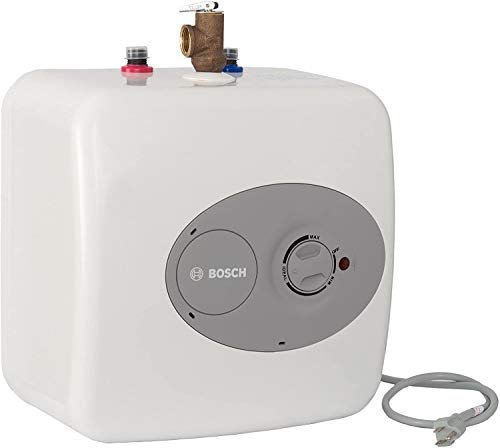
Bosch Tronic 3000 T ES2.5 Review: Compact 2.5-Gallon Under-Sink Water Heater for Faster Hot Water
Waiting for hot water at a distant sink is a common plumbing annoyance, especially in homes where the main water heater is far from a bathroom, kitchen, garage, or utility area. A compact point-of-use water heater can solve that problem without replacing the central system or installing a high-amperage tankless unit.
The Bosch Tronic 3000 T ES2.5 is a 2.5-gallon electric mini-tank water heater designed to sit close to the fixture that needs hot water. It runs on 120V power, draws about 12 amps, uses a 1,440-watt heating element, and can be installed independently on a cold-water line or in-line with an existing hot-water system.
Its biggest strength is simplicity. Instead of demanding a large dedicated electrical circuit, the ES2.5 plugs into a suitable 120V receptacle. It also offers a glass-lined tank, adjustable thermostat, temperature-and-pressure relief valve, and several mounting options.
For bathroom vanities, remote sinks, workshops, offices, garages, and similar low-demand locations, the Bosch ES2.5 is the kind of appliance that can dramatically reduce the wait for hot water while remaining much easier to install than a full-size water heater.
What Is the Bosch Tronic 3000 T ES2.5?
The Bosch ES2.5 is a 2.5-gallon electric point-of-use storage water heater.
Unlike a tankless heater, it stores a small reserve of hot water inside an insulated tank. Because the heater is installed close to the faucet, hot water only has to travel through a short section of pipe before reaching the fixture.
That is what makes the system feel nearly immediate at the sink.
The unit can also be installed in-line with an existing central water heater. In that configuration, it acts as a local buffer, keeping hot water available near a distant fixture instead of forcing the user to wait for a long plumbing run to warm up.
Key Bosch ES2.5 Specifications
The supplied specifications list the following core details:
- Tank capacity: 2.5 gallons
- Power: 1,440 watts
- Voltage: 120V
- Current: approximately 12 amps
- Dimensions: about 13.75 x 13.75 x 10.75 inches
- Installation: floor, shelf, or wall mounted
- Power cord: approximately 36–37 inches
- Tank: glass lined
- Thermal efficiency: listed at 98%
- Temperature control: external adjustable dial
- Safety: temperature-and-pressure relief valve
- Application: point-of-use or in-line installation
These specifications make it clear that the ES2.5 is intended for sinks and other modest hot-water loads rather than showers or whole-house service.
Why a 2.5-Gallon Mini-Tank Can Be Useful
A conventional central water heater may be perfectly capable of producing enough hot water, but distance can still create a frustrating delay.
If 30 or 40 feet of pipe separate the water heater from a bathroom sink, all the cooled water inside that pipe must be pushed out before hot water arrives.
The Bosch ES2.5 eliminates most of that delay by storing hot water directly at the point of use.
For tasks such as handwashing, shaving, rinsing dishes, or cleaning, a few gallons stored locally can be more useful than a much larger tank located far away.
How Much Hot Water Does 2.5 Gallons Really Provide?
A 2.5-gallon tank is modest, but it can go farther than the raw number suggests.
The stored hot water is normally mixed with cold water at the faucet. That means the usable volume at a comfortable handwashing temperature can exceed the tank's nominal capacity.
For a bathroom sink, 2.5 gallons may be plenty for several short uses.
For sustained dishwashing or higher-flow applications, the reserve can be depleted more quickly.
Can It Supply Two Sinks?
The manufacturer describes the ES2.5 as capable of serving up to two sinks under appropriate conditions.
That does not mean it can deliver unlimited hot water to both simultaneously.
It means the small stored volume can support light use across two nearby fixtures, especially when demand is brief and recovery time is available between uses.
If both sinks are used heavily at the same time, the 2.5-gallon reserve will run down much faster.
Fast Recovery Rate
The ES2.5 uses a 1,440-watt heating element to recover after hot water has been used.
Because the tank is small, it can reheat more quickly than a large 40- or 50-gallon electric water heater.
That makes it well suited to intermittent use.
The exact recovery time depends on incoming water temperature and thermostat setting.
Colder inlet water requires more heating and therefore more recovery time.
This Is Not Truly Tankless Hot Water
Product descriptions sometimes use phrases such as "on-demand" because the hot water is available close to the faucet.
Technically, however, the Bosch ES2.5 is a storage water heater, not a tankless system.
It holds 2.5 gallons of heated water continuously.
That distinction matters because once the stored reserve is depleted, the heater needs time to reheat incoming cold water.
120V Plug-In Operation
One of the ES2.5's strongest advantages is electrical simplicity.
It runs on standard 120V power and draws around 12 amps.
The supplied unit includes a roughly three-foot power cord, allowing it to connect to a suitable receptacle rather than requiring a high-current 240V installation.
This can make the ES2.5 much easier to retrofit into an existing bathroom or kitchen than an electric tankless heater.
Check the Circuit Before Installation
A 1,440-watt heater still represents a significant continuous electrical load.
At around 12 amps, it can consume most of the available capacity on a typical 15-amp circuit.
The outlet should therefore not share a heavily loaded branch circuit with other high-wattage appliances.
Depending on the installation location and local electrical code, GFCI protection may also be required.
Why a Mini-Tank Can Be Easier Than a Small Tankless Heater
A small 120V tankless heater may look appealing because it has no storage tank.
The problem is power.
At 120V, even a high-current point-of-use tankless unit may only be able to heat a very small flow rate.
A storage heater such as the Bosch ES2.5 solves that differently. It heats the water gradually in advance, then releases the stored hot water at normal sink flow.
For many handwashing and sink applications, that feels more natural.
Glass-Lined Tank Construction
The ES2.5 uses a glass-lined tank.
The lining helps protect the underlying metal tank from direct contact with water.
That can slow corrosion and extend service life.
Glass-lined construction is widely used in conventional storage water heaters for this reason.
Why Water Quality Still Matters
A glass lining does not make the tank immune to corrosion or mineral buildup.
Water chemistry, hardness, temperature, and maintenance all influence service life.
Hard-water minerals can accumulate inside the tank and around the heating element over time.
Periodic maintenance remains important, especially in areas with mineral-heavy water.
Anode Rod Maintenance
The troubleshooting information supplied with the product specifically mentions checking the anode rod.
An anode rod is a sacrificial metal component designed to corrode instead of the steel tank.
As it is consumed, it helps protect exposed tank surfaces.
Ignoring the anode until it is completely depleted can reduce the effective life of a storage water heater.
If the Bosch maintenance schedule recommends inspection or replacement, it is worth following.
Adjustable Temperature Dial
The heater includes an external thermostat dial.
That allows users to change stored water temperature without opening the appliance.
For a bathroom sink, moderate settings are generally adequate.
Higher storage temperatures can increase the effective amount of mixed warm water available, but they also increase scalding risk.
Avoid Excessively Hot Settings
Very hot stored water can cause burns quickly.
This is particularly important in households with children, older adults, or anyone with reduced heat sensitivity.
If the unit is operated at a higher storage temperature, a thermostatic mixing valve may be appropriate depending on plumbing configuration and local requirements.
Temperature-and-Pressure Relief Valve
The ES2.5 includes a temperature-and-pressure relief valve, commonly called a T&P valve.
This is a critical safety component on any storage water heater.
If pressure or temperature rises beyond safe limits, the valve opens to relieve the excess.
It should never be capped, blocked, or removed from service.
The Relief Valve Needs Proper Discharge Piping
The T&P valve should discharge to a safe location according to the manufacturer's instructions and applicable plumbing code.
The outlet should not be plugged or reduced in a way that prevents flow.
If the valve begins dripping frequently, the underlying cause should be investigated rather than simply sealing the valve.
Thermal Expansion Can Matter
Heating stored water causes it to expand.
In an open plumbing system, some of that expansion may move backward into the water supply.
In a closed system with a backflow preventer or check valve, pressure can build.
Depending on the installation, an expansion tank or other pressure-control solution may be needed.
A plumber can determine whether thermal expansion needs to be addressed.
Independent Point-of-Use Installation
The simplest setup is to feed the ES2.5 directly from a cold-water line.
The heater then supplies hot water to the nearby faucet.
This works well when the fixture otherwise has no convenient hot-water source.
Bathrooms, offices, garages, workshops, and remote sinks are common examples.
In-Line Installation With a Central Water Heater
The Bosch can also be installed in-line with an existing hot-water system.
This configuration is useful when the main heater works well but the faucet is far away.
The ES2.5 stores hot water close to the fixture, reducing the wait caused by cooled water sitting in long pipes.
Once the local tank begins to refill, the incoming water may already be warm from the central system.
That can reduce recovery time.
Floor, Shelf, or Wall Mounting
The ES2.5 can be installed on the floor, on a sturdy shelf, or on a wall using the appropriate mounting hardware.
That provides flexibility in small cabinets.
Wall mounting can preserve cabinet-floor space, while floor installation may be simpler if structural mounting is inconvenient.
Whatever method is used, the installed weight must be considered.
Remember the Weight of the Water
Two and a half gallons of water weigh roughly 21 pounds.
That weight must be added to the heater itself.
A wall mount therefore needs to support the filled appliance safely, not just the empty tank.
Mounting into appropriate framing is far better than relying on weak drywall anchors.
Under-Sink Installation
Under-sink placement is one of the ES2.5's most common uses.
Its roughly 13.75-inch-square face and 10.75-inch depth allow it to fit inside many vanity or kitchen cabinets.
Still, dimensions should be checked carefully.
The heater needs enough space for plumbing connections, relief-valve piping, power cord clearance, and future service.
Do Not Sacrifice Service Access
A common mistake is packing the heater into the smallest possible corner.
That can make future inspection or maintenance difficult.
Leave enough room to reach the thermostat, plumbing fittings, heating-element access, and anode components as required.
A compact installation should still be serviceable.
First-Time Startup
A storage water heater should be completely full of water before power is applied.
This is critical.
The heating element relies on surrounding water to absorb heat.
Energizing the heater while empty can damage the element quickly.
How to Fill the Heater Safely
After the plumbing is connected, open the cold-water supply and then open a nearby hot-water faucet.
Allow water to flow until air stops sputtering from the line.
Once a steady stream is present and the tank is confirmed full, electrical power can be applied according to the manufacturer's instructions.
Troubleshooting: Water Does Not Get Hot
The supplied Bosch troubleshooting information recommends first confirming that electrical power is available.
If the indicator appears normal but hot water does not reach the faucet, a plumbing crossover may be the cause.
A crossover occurs when cold water unintentionally enters the hot-water piping through a faulty fixture or plumbing connection.
That can dilute heated water and make the heater appear ineffective.
How to Check for a Plumbing Crossover
Bosch's supplied troubleshooting procedure suggests shutting off the cold-water supply to the heater and opening a hot-water faucet.
If water continues to flow, there may be another path allowing cold water into the hot side.
That crossover needs to be corrected before the mini-tank can deliver its expected temperature.
This is a useful diagnostic because not every "heater problem" is actually caused by the heater.
Heating Element Testing
The supplied troubleshooting information mentions testing the heating-element resistance.
That is electrical service work and should be handled by a qualified technician unless the user is properly trained.
The source references a resistance range of approximately 8–10 ohms for diagnostic purposes.
If measurements fall outside the manufacturer's specified range, the element may require replacement.
Troubleshooting Leaks
If water appears around the unit, first identify where it originates.
Possible sources include:
- Water-supply fittings
- Hot-water fittings
- T&P relief-valve connection
- Heating-element gasket
- Tank itself
A fitting leak is very different from a leaking tank.
The repair approach depends on the source.
Heating Element Gasket Leaks
The supplied troubleshooting instructions mention removing the front cover to inspect the heating-element gasket.
A gasket can deteriorate or become improperly seated.
If water is appearing around the element flange rather than from the tank body, gasket service may resolve the issue.
Electrical power should be disconnected before any internal inspection.
What If the Tank Itself Leaks?
A leaking tank is generally much more serious.
Unlike a loose plumbing connection, a corroded or failed tank is typically not repaired in place.
If the tank is leaking and the unit remains under warranty, the source advises contacting Bosch regarding a warranty claim.
Anode Rod Inspection
The Bosch troubleshooting guidance also mentions checking the anode rod when evaluating leaks or tank condition.
A depleted anode can accelerate internal corrosion.
Periodic inspection can therefore be an important part of preventive maintenance.
Hard-Water Sediment
Minerals can settle inside a storage water heater over time.
Because the tank is small, even moderate deposits can affect usable volume and heat transfer.
If local water is hard, periodic flushing may help maintain performance.
Follow Bosch's maintenance instructions rather than using aggressive chemicals without approval.
Thermal Efficiency
The product information lists thermal efficiency at 98%.
Electric resistance heating is highly efficient at converting electrical energy into heat at the appliance.
However, storage heaters still experience standby heat loss through the tank walls.
So a high heating efficiency rating does not mean the unit consumes zero energy while idle.
Standby Heat Loss
The ES2.5 keeps its stored water hot even when nobody is using the sink.
Some heat inevitably escapes through insulation.
The thermostat periodically activates the heating element to replace that lost heat.
The small tank size limits total standby loss, but it does not eliminate it.
Where a Mini-Tank Can Improve Efficiency
A local tank can still reduce waste in systems with very long plumbing runs.
Without a point-of-use heater, hot water may travel dozens of feet just to support a 20-second handwash.
Much of the heat left in that pipe is then lost to the surrounding building.
Keeping a small hot-water reserve close to the faucet can avoid repeatedly heating long plumbing runs.
Bosch ES2.5 vs. 4-Gallon Mini-Tank
A larger 4-gallon mini-tank provides more stored hot water.
That can make it better for kitchen sinks or heavier use.
The 2.5-gallon Bosch is smaller and easier to fit in tight cabinets.
If the main goal is handwashing or shaving at one sink, the smaller capacity may be sufficient.
If several gallons are needed consecutively, a larger model may be more practical.
Bosch ES2.5 vs. Point-of-Use Tankless Heater
A tankless heater occupies less volume and does not maintain stored hot water.
But a small 120V tankless model may require very low flow to achieve a useful temperature rise.
The ES2.5 can release stored hot water at ordinary faucet flow until its tank is depleted.
For many sink applications, that provides a more satisfying experience.
Bosch ES2.5 vs. Hot-Water Recirculation
A recirculation system can also eliminate long hot-water waits.
Instead of adding a local storage heater, it moves hot water through the home's plumbing so the line stays warm.
Recirculation can serve several fixtures, but installation may be more complex and can increase piping heat loss.
A mini-tank is often simpler when only one remote sink needs improvement.
Is It Good for a Bathroom Sink?
Yes. This is one of the strongest applications for the ES2.5.
Handwashing and shaving usually require relatively little hot water.
The 2.5-gallon reserve can provide quick local delivery without occupying much cabinet space.
Is It Good for a Kitchen Sink?
It can be, particularly for light use.
For short rinsing tasks or a secondary prep sink, the ES2.5 may work well.
For sustained dishwashing or filling large containers, the 2.5-gallon capacity may feel limiting.
A larger mini-tank could be a better fit for heavier kitchen demand.
Is It Good for an Office?
Yes.
Office restrooms and break-room sinks often have intermittent, low-volume hot-water demand.
The Bosch can provide local hot water without a full-size water heater.
Its plug-in design also simplifies installation compared with high-amperage tankless systems.
Is It Good for a Garage or Workshop?
Yes.
A garage sink used for handwashing or light cleanup is an excellent point-of-use application.
The heater can eliminate the need to run a long hot-water line from the house.
Protection from freezing is important if the space becomes very cold.
Is It Good for a Shower?
No, not as a normal primary shower heater.
Two and a half gallons would be depleted quickly at typical shower flow.
The ES2.5 is fundamentally a sink and point-of-use appliance.
Common Installation Mistakes
One major mistake is plugging the heater in before filling it with water.
Another is placing it where the T&P relief valve cannot discharge safely.
Users may also overlook the electrical load on the existing outlet circuit.
Improper wall mounting is another concern because the filled unit weighs significantly more than the empty appliance.
Finally, do not ignore thermal expansion in a closed plumbing system.
Common Buying Mistakes
Some buyers expect a 2.5-gallon mini-tank to act like a tankless whole-house heater.
Others underestimate how quickly the tank can be depleted during sustained kitchen use.
Another mistake is assuming that "plug-in" means any nearby receptacle is automatically suitable.
Buyers should also consider service access, mounting strength, and plumbing layout before ordering.
Main Advantages
The Bosch ES2.5's biggest advantage is convenience.
It brings a small reserve of hot water directly to a remote sink without requiring high-amperage electrical infrastructure.
The 2.5-gallon glass-lined tank, 1,440-watt heater, 120V plug-in connection, compact dimensions, adjustable thermostat, multiple mounting options, and T&P relief valve make it well suited to point-of-use installation.
Bosch's published troubleshooting guidance also provides useful information for diagnosing common issues such as plumbing crossovers, element faults, and leaks.
Potential Drawbacks
The 2.5-gallon capacity is limited.
Heavy use can exhaust the stored supply.
The tank consumes some standby electricity because it maintains temperature between uses.
Wall mounting requires adequate structural support.
Maintenance of the tank, anode, and heating element may be required over time.
It is also not suitable for high-flow applications such as showers or bathtubs.
Who Should Consider the Bosch ES2.5?
The Bosch Tronic 3000 T ES2.5 makes the most sense for:
- Bathroom sinks
- Remote kitchen or prep sinks
- Office washrooms
- Garages
- Workshops
- Utility sinks
- Secondary fixtures far from the main heater
- Homes where electrical upgrades are undesirable
- Installations where cabinet space is limited
It is best viewed as a targeted point-of-use solution rather than a replacement for a conventional household water heater.
Frequently Asked Questions
How much water does the Bosch ES2.5 hold?
Approximately 2.5 gallons.
What voltage does it use?
120V.
Does it plug into a standard outlet?
The supplied unit includes a 36–37-inch cord for 120V plug-in installation. The outlet and branch circuit still need to be suitable for the approximately 12A load.
How much power does it use?
Approximately 1,440 watts while heating.
How much current does it draw?
Approximately 12 amps.
What are the dimensions?
About 13.75 inches wide x 13.75 inches high x 10.75 inches deep.
Is it tankless?
No. It is a 2.5-gallon mini storage water heater.
Can it provide immediate hot water?
Yes, when installed close to the faucet because hot water is stored locally.
Can it serve two sinks?
The manufacturer states that it can support up to two sinks for appropriate light-use applications.
Can it run a shower?
It is not designed as a normal shower water heater.
Can it be installed under a sink?
Yes. That is one of its intended applications.
Can it be wall mounted?
Yes. It can also be shelf or floor mounted.
Does it have an adjustable thermostat?
Yes. An external temperature-control dial is included.
Does it have a glass-lined tank?
Yes.
Does it have a T&P relief valve?
Yes.
Can it be installed with an existing central water heater?
Yes. It can be installed in-line to provide faster local hot-water delivery.
Why might hot water stay cool even when the heater is working?
A plumbing crossover can allow cold water into the hot line and dilute the heated water.
What should I check if it leaks?
Check plumbing fittings, the T&P connection, heating-element gasket, and tank condition.
Does it have an anode rod?
The supplied Bosch troubleshooting instructions specifically mention checking the anode rod, indicating that anode maintenance is relevant to the unit.
What is the thermal efficiency?
The supplied specifications list 98% thermal efficiency.
Final Verdict
The Bosch Tronic 3000 T ES2.5 is a practical point-of-use water heater for anyone who wants faster hot water at a sink without installing a large storage tank or high-amperage tankless system.
Its strongest qualities are the 2.5-gallon capacity, 1,440-watt heating element, standard 120V plug-in operation, compact 13.75-inch footprint, glass-lined tank, adjustable thermostat, multiple mounting options, and ability to work either independently or in-line with an existing hot-water system.
The main tradeoff is capacity. Two and a half gallons is excellent for handwashing, shaving, light rinsing, and similar sink tasks, but it is not intended for showers or sustained high-flow demand.
For a bathroom vanity, office sink, workshop, garage, or remote fixture where long hot-water waits are the real problem, the Bosch ES2.5 is a well-matched solution that prioritizes convenience, straightforward installation, and local hot-water availability.