Dual-Zone Sprinkler Timer Review: Independent Watering Programs, Rain Delay, Large LCD and Battery-Powered Control
A two-zone sprinkler timer can be a practical upgrade for anyone who waters more than one area from the same outdoor faucet. Instead of manually switching hoses or giving every part of the yard the same schedule, a dual-outlet timer lets you create separate watering programs for different zones.
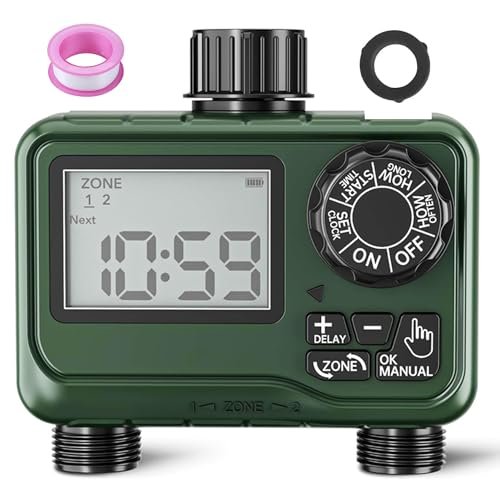
This dual-zone programmable sprinkler timer is designed for lawns, gardens, greenhouses, flower beds, and other hose-based irrigation setups. Each outlet can be programmed independently, with adjustable watering duration, frequency, and start timing. It also includes manual watering, a 24-, 48-, or 72-hour rain-delay function, a large LCD display, 3/4-inch hose compatibility, and battery-powered operation.
The biggest advantage is flexibility. A lawn and a vegetable garden rarely need the same watering schedule. With independent zone control, one outlet can run briefly every morning while the other operates less frequently but for longer periods.
For homeowners who want more control than a basic single-outlet hose timer but do not need a full underground irrigation controller, this type of dual-zone timer fills a useful middle ground.
What Is a Dual-Zone Sprinkler Timer?
A dual-zone sprinkler timer is an automatic valve controller that connects to an outdoor faucet and splits the water supply into two independently controlled outlets.
Each outlet acts as its own irrigation zone.
That means Zone 1 can follow one schedule while Zone 2 follows another.
For example, one outlet might serve a lawn sprinkler, while the other feeds a drip line for vegetables or flower beds.
The timer opens and closes each valve automatically according to the schedule you program.
Why Two Independent Zones Matter
Different areas of a yard often have very different watering requirements.
Grass may need broader, deeper irrigation.
Container plants may dry out faster.
Vegetables may benefit from regular root-zone watering.
Established shrubs may need much less frequent irrigation.
If all of those areas are connected to one schedule, some plants may receive too much water while others receive too little.
Independent programming allows the irrigation routine to reflect those differences.
Dual-Zone Independent Programming
The timer allows each outlet to be programmed separately.
That means you can independently control:
- Start time
- Watering duration
- Frequency
- Manual watering
The two zones do not have to mirror each other.
This is the main feature that separates a dual-zone timer from a simple hose splitter paired with a single schedule.
Real-World Example: Lawn and Vegetable Garden
Imagine one faucet serving both a lawn and a raised vegetable bed.
Zone 1 might power a sprinkler for the lawn.
Zone 2 might feed a soaker hose or drip system.
The lawn could be scheduled for a longer watering session every few days, while vegetables could receive shorter, more frequent irrigation.
That is much easier than manually switching valves each day.
Adjustable Watering Duration
The supplied specifications state that watering duration can be programmed from approximately 1 minute up to 12 hours.
That is a very broad range.
Short durations are useful for:
- Seedlings
- Patio containers
- Small drip zones
- Short sprinkler cycles
Longer durations can work for:
- Low-flow drip irrigation
- Soaker hoses
- Large beds
- Slow irrigation systems
Most residential watering will fall well below the 12-hour maximum, but having the option gives the controller flexibility.
Watering Frequency Options
The timer supports several frequency patterns.
According to the supplied description, watering can be programmed from every 1 to 12 hours or from every 1 to 7 days.
That allows both frequent and widely spaced irrigation.
For example, you might run a greenhouse drip line several times per day while watering established landscaping only every few days.
12-Hour and 24-Hour Clock Formats
The display supports both 12-hour and 24-hour time formats.
This is a small convenience, but useful for avoiding AM/PM mistakes.
Users accustomed to military or international time can use the 24-hour format, while others can stick with a standard 12-hour clock.
Manual Watering Mode
Manual watering lets you open a zone without changing its normal schedule.
That is useful when plants need extra water unexpectedly.
For example, after transplanting new flowers, you may want to run the irrigation immediately rather than wait until the next programmed cycle.
A good manual mode should preserve the automatic schedule once the temporary watering session ends.
Why Manual Mode Matters
Automated irrigation works best when users can override it easily.
Weather changes.
New plants get added.
A dry patch may need extra attention.
Without manual control, users may be tempted to alter the entire schedule for one temporary situation.
A dedicated manual mode avoids that problem.
Rain Delay for 24, 48, or 72 Hours
The timer includes a rain-delay function that pauses scheduled watering for 24, 48, or 72 hours.
This can reduce unnecessary irrigation after rainfall.
Instead of deleting or reprogramming the schedule, you simply delay watering temporarily.
Once the selected delay expires, normal programming resumes.
Important: Rain Delay Is Manual, Not Automatic Weather Detection
The description says the timer offers rain delay, but it does not establish that the timer automatically detects rainfall or pulls weather data from the internet.
That distinction matters.
A basic programmable hose timer with rain delay usually requires the user to activate the delay manually.
If automatic weather-based skipping is important, check whether the exact model includes a rain sensor or weather connectivity.
Do not assume that "rain delay" means automatic rain detection.
Why Rain Delay Can Save Water
Running sprinklers immediately after meaningful rainfall wastes water and can oversaturate soil.
Temporarily pausing irrigation can help avoid:
- Runoff
- Waterlogging
- Root stress
- Unnecessary water use
The correct delay depends on how much rain fell, local temperature, soil type, and plant needs.
Large LCD Display
The timer includes an oversized LCD screen designed to show:
- Time
- Date
- Day of the week
- Watering settings
- Zone information
A large display is useful on outdoor equipment because small screens can be difficult to read in bright light.
It also makes programming easier for users who do not want to manage irrigation through a smartphone app.
Why Physical Controls Are Still Valuable
Smart WiFi irrigation systems offer remote control, but a local programmable timer has advantages too.
It does not depend on:
- WiFi coverage
- Internet service
- Mobile apps
- Cloud accounts
- Smart-home platforms
Once programmed, it can operate locally.
For users who value simplicity and reliability, that can be preferable.
Standard 3/4-Inch Hose Compatibility
The timer is designed for standard 3/4-inch garden hose threads.
That makes it compatible with common outdoor faucets, hoses, sprinklers, and irrigation accessories.
Typical applications include:
- Lawn sprinklers
- Soaker hoses
- Drip systems
- Greenhouse lines
- Flower-bed irrigation
- Garden hoses
Before installation, inspect the faucet threads and washers to make sure the connection seals correctly.
Easy Faucet Installation
Installation is generally straightforward.
The timer attaches directly to the hose bib or outdoor faucet.
Hoses then connect to the two outlets.
Because the valves and controller are integrated, no electrical wiring or underground control cable is required.
This makes it much simpler than a traditional multi-zone sprinkler controller.
Battery-Powered Operation
The unit runs on two AAA batteries, which are included according to the source.
That means no outdoor outlet is required.
Battery operation also makes the timer easy to relocate.
The main maintenance responsibility is replacing batteries before they become too weak to operate the valves reliably.
Battery Maintenance Matters
A watering timer can fail silently if the batteries die.
That can result in missed watering rather than an obvious problem.
Check the display periodically and replace batteries when the indicator becomes weak or according to the manufacturer's recommendations.
If you are leaving home for an extended trip, fresh batteries are a sensible precaution.
IP54 Weather Resistance
The timer carries an IP54 rating according to the supplied information.
IP54 means the enclosure is protected against limited dust ingress and splashing water from various directions under specified conditions.
That is suitable for ordinary outdoor use.
However, it does not mean the timer can be submerged or exposed indefinitely to extreme conditions.
IP54 Is Weather Resistant, Not Waterproof
The timer should still be installed sensibly.
Avoid locations where it sits in standing water or where sprinkler jets continuously hit the control panel.
If freezing temperatures occur, the unit should typically be removed and stored indoors unless the manufacturer explicitly approves winter operation.
Water trapped inside valves can freeze and damage the housing.
Sealing Gaskets Help Prevent Leaks
The kit includes sealing gaskets.
These washers help create watertight connections between the timer, faucet, and hoses.
Many garden hose leaks come from missing, damaged, or misaligned washers rather than defective threads.
If a connection drips, check the gasket before overtightening the fitting.
Do Not Overtighten Connections
Garden hose threads generally seal with rubber washers.
Excessive force can deform the gasket or damage plastic fittings.
Hand-tightening is often sufficient.
If the connection still leaks, inspect the washer and thread alignment rather than applying more force immediately.
Water Pressure and Flow Still Matter
A two-zone timer controls water but does not create pressure.
If household water pressure is low, sprinkler performance may remain weak.
There is another important consideration: if both zones operate simultaneously, total flow demand may exceed what the faucet can supply effectively.
The source does not specify whether both outlets can run at exactly the same time under all programming conditions, so this should be confirmed if simultaneous operation is important.
Should Both Zones Run at the Same Time?
In many installations, staggering the zones is better.
If one sprinkler requires 4 GPM and another requires 4 GPM, running both at once may require 8 GPM from the same faucet.
If the supply cannot provide that, pressure will drop.
Scheduling Zone 1 first and Zone 2 afterward can maintain stronger sprinkler performance.
Best Use for Lawn Irrigation
A dual timer works well when different parts of a lawn need separate sprinkler positions.
For example, one outlet could feed the front lawn while the other supplies the side yard.
Each can run at a different time.
This is particularly useful for homeowners who do not have an underground irrigation system.
Vegetable Gardens
Vegetable beds are another good application.
A drip line or soaker hose can be connected to one zone while the second zone handles grass or ornamental plants.
Because vegetables may need more frequent watering than mature landscaping, independent schedules are valuable.
Greenhouses
Greenhouses often require more frequent irrigation because temperatures can rise quickly.
A timer can automate daily or multiple-times-per-day watering.
The wide frequency range makes this model potentially useful for greenhouse drip systems, provided the flow requirements are appropriate.
Flower Beds
Flower beds can be watered independently from the lawn.
That is helpful because flowers, shrubs, and turf often have different root depths and moisture needs.
A dual-zone system makes it easier to avoid giving everything the same amount of water.
Drip Irrigation
The long maximum watering duration is particularly useful for low-flow drip irrigation.
A drip system may deliver water much more slowly than a conventional sprinkler.
That means it can run longer without applying excessive water too quickly.
The actual schedule should still be based on emitter flow and plant needs.
Soaker Hoses
Soaker hoses also work well with programmable timers.
They release water slowly along their length.
A timer lets them run for a controlled period without requiring someone to remember to turn the faucet off.
This is useful for hedges, garden rows, and foundation plantings.
Cycle-and-Soak Considerations
The supplied description does not explicitly mention a dedicated cycle-and-soak function.
However, the frequency options may allow repeated irrigation intervals depending on how the programming is implemented.
For clay soil or slopes, breaking watering into shorter sessions can help reduce runoff.
Check the manual to see whether multiple starts per day can be configured independently for each zone.
Understanding Soil Type
Different soils absorb water at different rates.
Sandy soil drains quickly and may need more frequent irrigation.
Clay soil holds water longer but absorbs it more slowly.
Loam usually provides a more balanced combination.
A programmable timer gives you control, but the schedule still needs to match the soil.
Water in the Morning When Practical
For many gardens and lawns, early-morning watering is practical because temperatures are lower and wind may be lighter.
That can reduce evaporation compared with midday irrigation.
It also allows foliage time to dry during the day.
Exact timing still depends on climate, local restrictions, and plant type.
Avoid Overwatering Just Because It Is Automated
Automation makes watering easier, but it can also hide poor scheduling.
A timer will faithfully run an excessive program every day if that is what you set.
Check soil moisture periodically.
If the ground remains saturated, reduce duration or frequency.
Healthy irrigation is about supplying what plants need, not simply maximizing runtime.
Dual-Zone Timer vs. Single-Zone Timer
A single-zone timer is cheaper and sufficient when one faucet serves only one irrigation area.
The dual-zone model becomes worthwhile when two hose lines need different schedules.
Instead of purchasing two separate timers or manually switching hoses, one device manages both outlets.
That keeps the setup cleaner.
Dual-Zone Timer vs. Hose Splitter
A basic Y-splitter creates two hose connections but does not automate them independently.
Each valve must be opened manually.
The dual-zone timer performs that switching automatically according to programmed schedules.
For regular irrigation, this can save considerable effort.
Dual-Zone Timer vs. Smart WiFi Timer
A WiFi timer provides remote app control and may offer weather integration.
This timer is more traditional.
Its strengths are local programming, battery operation, and independence from internet connectivity.
The better choice depends on priorities.
If you frequently travel and want remote changes, WiFi may be preferable.
If you want straightforward automation without another app, this model may be the better fit.
Dual-Zone Timer vs. Underground Irrigation Controller
A full irrigation controller is designed for permanent multi-zone sprinkler systems with electrically operated valves.
It can manage many zones and often supports advanced weather features.
This hose timer is much simpler.
It is best for one outdoor faucet serving one or two hose-based irrigation areas.
For a large property with six or eight underground zones, a dedicated controller is more appropriate.
Good Choice for Renters
A hose timer is usually easy to remove.
It does not require permanent changes to the property.
That makes it practical for renters who have access to an outdoor faucet and permission to use irrigation equipment.
It can move with you later.
Good Choice for Vacation Watering
Automatic irrigation is especially valuable while away.
Before traveling, test both zones for several days.
Confirm that:
- Each zone starts correctly
- Each valve shuts off fully
- Hoses do not leak
- Batteries are healthy
- Sprinklers remain positioned properly
- Rain delay works as expected
Testing before departure is much safer than assuming the schedule is correct.
Watch for Hose Failures During Long Absences
A timer leaves the outdoor faucet pressurized.
If a downstream hose bursts while you are away, water may flow whenever the timer opens.
Use good-quality hoses and fittings, inspect them regularly, and replace damaged components.
Automation does not eliminate plumbing risk.
Winterization
If freezing temperatures are possible, remove the timer from the outdoor faucet unless the manufacturer explicitly states it can remain installed.
Drain all water from the device.
Store it in a dry location.
Freeze damage is one of the most common reasons outdoor watering equipment fails.
Cleaning the Inlet
Outdoor faucets can carry sand, rust, or debris.
If the timer includes an inlet screen or filter, inspect it periodically.
A partially clogged inlet can reduce sprinkler performance.
Cleaning the screen may restore flow without any valve repair.
Common Setup Mistakes
One common mistake is programming both zones at overlapping times without checking available water flow.
Another is forgetting to set the correct clock time before programming irrigation.
Users may also misunderstand rain delay as automatic weather detection.
Another mistake is overtightening hose fittings.
Finally, leaving the timer outside during freezing weather can shorten its life significantly.
Main Advantages
The strongest advantage is independent dual-zone control.
Two separate outlets allow lawn, garden, greenhouse, and flower-bed irrigation to follow different schedules from the same faucet.
The 1-minute-to-12-hour watering duration, flexible hourly or daily frequency, manual watering, 24/48/72-hour rain delay, large LCD display, 3/4-inch hose compatibility, battery operation, and IP54 weather resistance provide a useful set of features without requiring WiFi.
Potential Drawbacks
The timer does not appear to include automatic weather detection.
Remote app control is not mentioned.
Battery replacement is required.
IP54 protection is suitable for outdoor splashes but not submersion.
If both zones require high flow, they may need to be scheduled separately.
For complex landscapes with many irrigation areas, a dedicated multi-zone sprinkler controller would provide more flexibility.
Who Should Consider This Dual-Zone Sprinkler Timer?
This model is a good fit for homeowners who have one faucet but two areas with different irrigation needs.
It may be particularly useful for:
- Front and back lawns
- Lawn plus vegetable garden
- Lawn plus flower beds
- Greenhouses
- Drip irrigation
- Soaker hoses
- Patio gardens
- Rental properties
- Vacation watering
- Homes without built-in irrigation systems
Frequently Asked Questions
How many outlets does the timer have?
Two independently programmable outlets.
Can each outlet have a different schedule?
Yes.
What is the shortest watering duration?
Approximately 1 minute.
What is the longest watering duration?
Up to 12 hours according to the supplied description.
How often can it water?
The source describes intervals from every 1 to 12 hours or every 1 to 7 days.
Does it support manual watering?
Yes.
Does it have rain delay?
Yes.
What rain-delay options are available?
24, 48, or 72 hours.
Does it automatically detect rain?
Automatic rainfall detection is not established by the supplied information. The rain-delay feature should be treated as a manual pause unless the current manual states otherwise.
Does it have an LCD screen?
Yes. It includes a large LCD display.
Can the display use 24-hour time?
Yes. Both 12-hour and 24-hour formats are supported.
What hose size does it fit?
Standard 3/4-inch garden hose threads.
Does it require electricity?
No external power connection is required.
What batteries does it use?
Two AAA batteries.
Are batteries included?
Yes, according to the source.
Is it waterproof?
It is rated IP54, meaning weather resistant rather than fully waterproof.
Can I use it with sprinklers?
Yes.
Can I use it with drip irrigation?
Yes.
Can I use it in a greenhouse?
Yes.
Can I use both zones for different plants?
Yes. Independent programming is the main purpose of the dual-zone design.
What warranty is listed?
The source states a two-year warranty.
Final Verdict
This dual-zone programmable sprinkler timer is a practical irrigation upgrade for homeowners who want to control two hose-based watering areas independently from a single outdoor faucet.
Its strongest features are the two independently programmable outlets, flexible 1-minute-to-12-hour watering duration, hourly or daily frequency options, manual watering, 24/48/72-hour rain delay, large LCD display, standard 3/4-inch connections, battery operation, and IP54 outdoor protection.
The biggest limitation is that it appears to be a conventional programmable timer rather than a connected smart controller. Rain delay is useful, but automatic weather-based adjustment is not confirmed, and there is no stated WiFi or app control.
For a lawn, vegetable garden, greenhouse, flower bed, drip system, or two separate sprinkler areas, it offers a straightforward way to automate watering without installing a permanent irrigation controller or relying on a smartphone app.