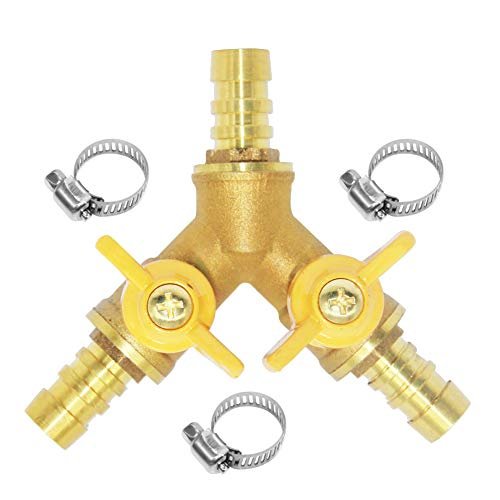
Brass Y-Shaped 3-Way Shutoff Ball Valve: Dual-Channel Control for Pneumatic and Utility Tubing Systems
A compact 3-way ball valve can make a simple tubing system much easier to control. Instead of disconnecting hoses or adding multiple separate valves, a Y-shaped shutoff fitting lets you divide one line into two branches and control each outlet independently.
This brass 3-way valve is designed around that idea. It combines a central inlet with two individually controlled outlets, barbed hose connections, and included clamps for a tighter mechanical fit. The upgraded barb measures approximately 7/16 inch (about 11 mm) outside diameter, which is intended to grip compatible flexible tubing more securely.
One important limitation deserves attention from the start: the supplied product information states that this fitting is not lead-free and should not be used on drinking-water lines. Its more appropriate uses are pneumatic, workshop, utility, and other non-potable tubing systems where the materials and pressure requirements are compatible.
What Is a Y-Shaped 3-Way Ball Valve?
A Y-shaped valve takes one incoming line and divides it into two separate branches.
Each branch has its own shutoff control, allowing the user to decide which outlet receives flow. Depending on the setup, you can:
- Open both outlets.
- Open only the left outlet.
- Open only the right outlet.
- Close both outlets.
This gives the fitting more flexibility than a simple Y-connector, which permanently splits flow without providing individual shutoff control.
In practical terms, the valve can function as both a three-way flow splitter and a two-way shutoff valve when only one branch is needed.
Independent Control of Two Outlet Lines
The two handles are one of the most useful features of this design.
Each valve operates independently, so one branch can remain active while the other is closed. This is helpful when a system feeds two different tools, hoses, or accessories that do not always need to operate at the same time.
For example, one branch could supply a pneumatic accessory while the second remains isolated until required.
Independent control also makes maintenance easier. A downstream section can sometimes be isolated without dismantling the entire tubing arrangement.
Upgraded 7/16-Inch Barb Diameter
The upgraded version uses hose barbs with an outside diameter of approximately 7/16 inch, or 11 mm.
Barbed fittings work by creating friction between the raised ridges of the fitting and the inside surface of flexible tubing.
A slightly larger barb can create a tighter fit, but only when the tubing material and inside diameter are appropriate.
This matters because tubing that is too stiff, too small, or too thick-walled may be difficult to push over the fitting.
Why Tubing Flexibility Matters
Flexible tubing stretches slightly as it passes over the barbed connection.
Softer materials typically install more easily because they can expand enough to move over the raised ridges before contracting around the fitting.
Very rigid tubing may resist insertion, leading users to apply excessive force.
That can create several problems:
- Damaged tubing
- Split tube ends
- Incomplete insertion
- Distorted fitting alignment
- Unsafe connections
Before installation, confirm that the tubing's inside diameter, wall thickness, hardness, and material are suitable for the 11 mm barb.
Brass Construction
The valve body is made from brass.
Brass is commonly used in valves and fittings because it combines mechanical strength with useful corrosion resistance in many environments.
It also offers good dimensional stability and can tolerate a range of operating temperatures better than many lightweight plastics.
However, material compatibility still matters. Brass is not automatically suitable for every gas, liquid, chemical, or pressure condition.
The valve should only be used with media and environments compatible with its construction.
Barbed Connections for Flexible Hose
Each connection point uses a barbed profile rather than threaded tubing connectors.
Barbed fittings are commonly used with flexible hose because they provide a simple mechanical grip without requiring a separate threaded adapter.
As the tubing slides over the ridges, the barb resists pull-off.
This type of connection is frequently used in:
- Pneumatic systems
- Vacuum lines
- Workshop equipment
- Low-pressure fluid transfer
- Utility tubing
- Laboratory setups
- Hobby systems
Actual suitability depends on tubing type and pressure.
Included Hose Clamps Improve Retention
The package includes three clamps, allowing each barbed connection to be mechanically secured.
Clamps are particularly important when the line is pressurized or exposed to vibration.
A properly positioned clamp helps prevent:
- Hose movement
- Accidental pull-off
- Leaks around the barb
- Connection loosening over time
The clamp should sit over the section of tubing positioned on the barb rather than beyond the end of the fitting.
Avoid overtightening, which can cut into soft tubing or deform it.
Suitable for Pneumatic Systems
The product description specifically identifies pneumatic systems as a potential application.
In a pneumatic setup, the Y-valve can divide compressed air into two controlled branches.
Possible uses include:
- Small workshop air lines
- Airbrush systems
- Pneumatic accessories
- Bench equipment
- Test setups
- Hobby air systems
Before connecting the valve to compressed air, verify the pressure rating of every component, including the valve, tubing, clamps, downstream fittings, and connected devices.
The source does not provide a working pressure specification, so it should not be assumed to be suitable for high-pressure compressed-air systems.
Not for Potable Water
The most important safety limitation is that this brass fitting is described as not lead-free.
That means it should not be installed in potable-water systems or any line supplying water for:
- Drinking
- Cooking
- Food preparation
- Ice making
- Beverage equipment
For those applications, use a fitting specifically certified and labeled for potable water and compliant with applicable lead-content requirements.
This valve may still be suitable for certain non-potable water or utility applications if material compatibility and local requirements allow, but drinking-water use should be avoided.
Possible Non-Potable Applications
Depending on compatibility, the valve may be useful in systems such as:
- Pneumatic air lines
- Workshop utility tubing
- Non-potable water transfer
- Equipment cooling loops
- Hobby systems
- Test benches
- Certain laboratory setups
The medium being transferred should always be checked against the valve and tubing materials before use.
Do not assume that because brass tolerates one fluid it will tolerate all others.
How to Install the Valve on Flexible Tubing
Installation is relatively straightforward when the tubing matches the barb correctly.
1. Shut Down and Depressurize the System
Never cut or disconnect a pressurized line.
Shut off the supply and verify that pressure has been fully released.
2. Cut the Tubing Squarely
Use a proper tubing cutter or sharp blade to create a clean, perpendicular edge.
Uneven cuts can make insertion more difficult and may reduce sealing quality.
3. Slide the Clamp Onto the Tubing
Place the clamp over the tube before installing the barb.
This is easy to forget once the tubing has already been pushed onto the fitting.
4. Insert the Barb Fully
Push the tubing over the barbed fitting until it reaches the intended seating position.
Do not leave the tube resting only on the first ridge.
5. Position the Clamp
Move the clamp over the barbed section.
6. Tighten Carefully
Tighten until the tubing is held securely without being crushed or cut.
7. Repeat for All Three Connections
Install the inlet and both outlet branches.
8. Test the System
Restore pressure gradually and inspect every connection for leaks.
If the Tubing Is Difficult to Install
Do not immediately assume more force is the solution.
Difficulty usually indicates one of several issues:
- Tubing is too hard.
- Inside diameter is too small.
- Wall thickness is excessive.
- Tubing material has limited elasticity.
- The cut end is damaged.
Using the wrong tubing can create an unreliable connection even if it is eventually forced onto the barb.
Choose tubing that matches the fitting instead of deforming incompatible material.
How the Two Shutoff Handles Work
Each branch has a separate ball-valve control.
Ball valves use a rotating internal sphere with a passage through the center.
When the passage aligns with the tubing path, flow can pass through. Rotating the handle turns the ball and blocks the channel.
This provides fast on/off operation compared with multi-turn valves.
Because the two outlet valves are independent, the configuration can be changed quickly without disconnecting hoses.
Flow Splitting and Pressure Considerations
Opening both branches does not mean each branch will receive the same flow as the original single line.
When one supply is split into two outlets, flow depends on:
- Supply pressure
- Tubing diameter
- Hose length
- Downstream resistance
- Connected equipment
- Valve opening
- Fitting restrictions
If one outlet has significantly less resistance than the other, more flow may naturally travel through that branch.
A Y-valve provides control, but it is not necessarily a precision flow-balancing device.
Ball Valve vs. Simple Y-Connector
A basic Y-connector splits one line into two but offers no individual shutoff.
A Y-shaped ball-valve assembly adds control.
This is useful when:
- Only one branch is needed at a time.
- Equipment needs to be isolated.
- One downstream line requires maintenance.
- Flow needs to be manually switched.
- Both lines occasionally operate together.
The added valves make the system more flexible, although they also create slightly more resistance and complexity.
Barbed Fitting vs. Push-to-Connect Fitting
Barbed fittings are simple and inexpensive, but they require compatible flexible tubing and often a clamp.
Push-to-connect fittings are faster to install on compatible rigid or semi-rigid tubing but typically cost more and depend heavily on precise tube dimensions.
Barbed fittings are often preferred when:
- Flexible hose is used.
- Vibration is present.
- Cost matters.
- A clamp provides additional security.
The best connection method depends on the tubing system.
Common Installation Mistakes
Using Tubing That Is Too Rigid
This can make the barb nearly impossible to insert and may split the tubing.
Skipping the Clamps
A friction fit alone may not be adequate for pressurized or vibrating systems.
Overtightening Clamps
Too much force can damage soft hose.
Failing to Seat the Tubing Fully
Partial insertion reduces retention and may cause leakage.
Using It for Drinking Water
The manufacturer specifically states that the fitting is not lead-free.
Assuming Unlimited Pressure Capacity
No pressure rating is provided in the source description. Never assume suitability for high-pressure service.
Maintenance and Inspection
Even simple valves should be inspected periodically.
Check for:
- Loose clamps
- Cracked tubing
- Corrosion
- Valve stiffness
- Leakage
- Hose movement
- Damaged handles
If the system experiences regular vibration, inspect it more frequently.
Operate both shutoff valves periodically to prevent them from remaining in one position for extended periods.
Advantages and Considerations
Advantages
- Y-shaped three-way layout
- Two independently controlled outlet valves
- Can operate as a splitter or single-branch shutoff
- Brass body
- Approximately 7/16-inch (11 mm) barb OD
- Barbed connections provide strong hose retention
- Three clamps included
- Useful for compatible pneumatic and utility applications
- Compact alternative to multiple separate valves
Potential Considerations
The fitting is explicitly described as not lead-free, so it should not be used in potable-water systems.
The source does not provide a pressure rating, which makes verification essential before use with compressed air or other pressurized media.
Tubing must be flexible enough to fit securely over the upgraded 11 mm barbs.
The valve is designed for manual shutoff and distribution rather than precise flow regulation.
Frequently Asked Questions
What size are the hose barbs?
The upgraded version is described as having an outside barb diameter of approximately 7/16 inch, or 11 mm.
Does the package include clamps?
Yes. Three hose clamps are included.
Can both outlets be controlled separately?
Yes. Each branch has its own shutoff valve.
Can I use only one outlet?
Yes. One outlet can be closed while the other remains open.
Can both outlets run at the same time?
Yes, provided the upstream system can supply the required flow.
Can it be used with compressed air?
The product is marketed for pneumatic systems, but the actual pressure rating should be confirmed before use.
Can it be used for drinking water?
No. The manufacturer states that the fitting is not lead-free and should not be used on potable-water lines.
Why is the barb difficult to insert?
The tubing may be too hard, too small internally, or otherwise incompatible with the approximately 11 mm barb.
Are clamps necessary?
They are strongly recommended for secure retention, especially in pressurized or vibrating systems.
Does it regulate flow precisely?
No. It is primarily an on/off shutoff valve rather than a precision flow-control valve.
Final Thoughts
This brass Y-shaped 3-way shutoff ball valve provides a compact way to split one compatible tubing line into two independently controlled branches.
Its upgraded approximately 7/16-inch barbs are intended to create a tighter hose connection, while the included clamps add mechanical security. The two separate ball valves make it possible to operate either outlet individually or both together, giving the fitting more flexibility than a standard passive Y-connector.
Its strongest applications are likely to be pneumatic, workshop, utility, and other non-potable tubing systems where the materials, tubing dimensions, and operating pressure are appropriate.
The key limitation should not be overlooked: because the manufacturer states that the brass fitting is not lead-free, it should not be used for drinking-water plumbing.
When matched with suitably flexible tubing and installed with the included clamps, the valve offers a practical solution for manually controlling two branches from a single supply line.