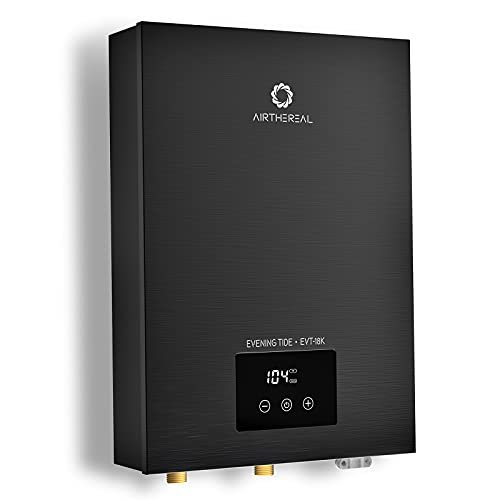
Airthereal 18kW Electric Tankless Water Heater Review: On-Demand Hot Water, Compact Design, and 240V Whole-Home Power
Running out of hot water is one of the most common frustrations with a traditional storage-tank water heater. Once the tank is depleted, everyone else has to wait while another batch of water heats. A properly sized tankless system approaches the problem differently by heating water only while it is being used.
The Airthereal 18kW electric tankless water heater is designed to provide continuous on-demand hot water without storing a large reservoir. Its 18kW electric heating system, self-modulating power control, wall-mounted construction, and multiple built-in safety protections make it a potentially attractive option for households that want to replace a bulky storage heater or supply several compatible fixtures.
The important qualifier is sizing. An 18kW tankless water heater can provide substantial heating power, but its actual hot-water flow depends on incoming water temperature and the temperature rise required. Its electrical requirements are also significant: the supplied specifications call for 240V service, two 40A double-pole breakers, and two sets of 8 AWG wiring. Before buying, homeowners should determine both whether the heater can meet their hot-water demand and whether their electrical panel can support it.
What Is the Airthereal 18kW Electric Tankless Water Heater?
The Airthereal 18kW model is an electrically powered on-demand water heater. Instead of filling and maintaining a storage tank, it heats water as it passes through the unit.
According to the supplied information, its main features include:
- 18kW electric heating capacity
- 240V operation
- Tankless, on-demand heating
- Self-modulating power control
- Wall-mounted compact design
- High-temperature protection
- Dry-heating protection
- Electrical leakage protection
- Separation of electrical and water systems
- Two 40A double-pole breaker requirement
- Two sets of 8 AWG conductors
The main benefit is continuous hot-water production within the heater's actual flow and temperature-rise limits.
How an Electric Tankless Water Heater Works
When a hot-water fixture opens, water begins flowing through the heater. Internal sensors detect the demand and activate the heating elements.
Electricity is converted directly into heat, which is transferred into the moving water before it continues to the shower, faucet, or other fixture.
When flow stops, the heater stops drawing its full heating load.
This is fundamentally different from a storage heater, which repeatedly reheats a tank of water even when nobody is using it.
What “Endless Hot Water” Really Means
Tankless water heaters are often advertised as providing endless hot water.
That description is accurate only within the appliance's capacity.
Unlike a storage tank, an electric tankless heater does not run out because a fixed volume of hot water has been consumed. It can continue heating for an extended period as long as water and electricity remain available.
However, the heater cannot supply unlimited flow.
If household demand exceeds the 18kW system's ability to raise the water to the selected temperature, performance will be limited.
Tank Capacity Is Replaced by Heating Capacity
With a traditional water heater, capacity is measured largely by tank volume.
With a tankless heater, the critical measurement becomes how many gallons per minute can be heated through a specific temperature increase.
That difference is essential when comparing the two technologies.
Understanding the 18kW Power Rating
An 18kW heating system is substantially more powerful than small point-of-use electric tankless heaters.
It may support showers and multiple household fixtures under suitable conditions.
But the 18kW figure alone does not tell you how many fixtures the heater can handle.
You also need to know the required temperature rise.
Temperature Rise Determines Real-World Performance
Temperature rise is the difference between incoming cold-water temperature and the desired outlet temperature.
For example, if inlet water enters at 65°F and you want 105°F water, the heater needs to provide a 40°F rise.
If inlet water is only 40°F, the same outlet temperature requires a 65°F rise.
The colder-water scenario requires considerably more heating energy.
As temperature rise increases, the maximum practical flow from the heater decreases.
Why Climate Matters
An 18kW electric tankless heater can perform very differently in a warm region than in a cold northern climate.
In warmer areas, groundwater may enter the home at a relatively mild temperature, allowing the heater to support more gallons per minute.
In colder regions, incoming water can be much colder during winter, forcing the heater to dedicate more of its available power to every gallon.
This reduces simultaneous fixture capacity.
Can the Airthereal 18kW Run a Shower?
Potentially, yes.
A typical efficient shower may require roughly 1.5 to 2.0 gallons per minute, depending on the showerhead.
An 18kW heater can potentially provide enough temperature rise for a shower under many residential conditions.
However, the exact result should be confirmed using Airthereal's official flow-versus-temperature-rise specifications.
Can It Run Two Showers at Once?
This depends on:
- Showerhead flow rates
- Incoming water temperature
- Desired shower temperature
Two efficient showers may be possible under favorable conditions, while two higher-flow showers during a cold winter may exceed the heater's capacity.
Counting fixtures alone is therefore not enough.
Add the Flow of Simultaneous Fixtures
A better way to size a tankless heater is to estimate everything likely to operate at the same time.
For example:
- Shower: 1.8 GPM
- Bathroom faucet: 0.7 GPM
- Kitchen faucet: 1.0 GPM
Total simultaneous demand would be approximately 3.5 GPM.
That total then needs to be compared with the heater's output at your required temperature rise.
Why Self-Modulation Matters
The source states that the Airthereal uses self-modulating temperature technology.
This means the heater can adjust how much electrical power it uses based on current water-flow and temperature requirements.
Instead of always operating at the full 18kW load, the system can reduce power when less heat is needed.
Benefits of Self-Modulating Heating
Self-modulation may help provide:
- More stable water temperature
- Lower power consumption during light demand
- Better matching of energy use to actual water flow
For example, washing hands at a sink usually requires far less heating power than operating a shower.
A self-modulating heater can respond accordingly.
Energy Use Compared With a Tank Water Heater
A conventional storage heater maintains a large volume of water at a selected temperature.
Even when no hot water is being used, some heat escapes through the tank insulation and must eventually be replaced.
A tankless system largely avoids this standby storage loss.
The “Up to 50% Savings” Claim Needs Context
The source states that the heater can save up to 50% on water-heating energy compared with a typical tank system.
That should be interpreted as a manufacturer claim rather than a guaranteed household outcome.
Actual energy savings depend on:
- Hot-water consumption
- Existing heater efficiency
- Electricity prices
- Incoming water temperature
- Usage patterns
- Installation
Some households may see meaningful savings, while others may see a smaller difference.
Tankless Does Not Mean Free Hot Water
An 18kW heater consumes substantial electricity when operating at high output.
Its efficiency advantage comes primarily from heating only when needed and avoiding continuous tank standby losses.
The more hot water a household uses, the more electricity the heater will still consume.
Space-Saving Wall-Mounted Design
One of the clearest advantages of an electric tankless system is physical size.
The manufacturer claims that the wall-mounted unit occupies substantially less space than a conventional tank water heater.
Eliminating the storage tank can free valuable floor area in:
- Utility rooms
- Basements
- Closets
- Garages
This can be especially useful in smaller homes or renovation projects.
Wall Mounting Does Not Eliminate Clearance Requirements
The heater may be compact, but it still needs adequate space around it for:
- Plumbing connections
- Electrical connections
- Inspection
- Maintenance
- Removal or service
Avoid placing it in a location where future access becomes difficult.
Electrical Requirements Are a Major Consideration
The supplied installation requirements are substantial.
The heater requires:
240V electrical service
Two 40A double-pole circuit breakers
Two sets of 8 AWG wiring
These requirements should be evaluated before purchase.
Why Two 40A Breakers?
An 18kW electric tankless heater draws a large amount of current.
Rather than supplying the entire load through one branch circuit, the unit uses two separate high-current circuits according to the manufacturer's specifications.
Each circuit must be installed correctly and connected to the appropriate heater terminals.
Electrical Panel Capacity Matters
Two 40A double-pole breakers occupy significant panel capacity.
Before installing the heater, a qualified electrician should evaluate whether the home's electrical service can support the additional load.
This is especially important if the property already has major electric appliances such as:
- Electric range
- Clothes dryer
- Heat pump
- Air-conditioning system
- EV charger
- Electric heating
A service or panel upgrade may be necessary in some homes.
Breaker Size Is Only Part of the Equation
Do not assume that simply installing two 40A breakers makes the circuit suitable.
The complete installation must also account for:
- Wire gauge
- Conductor material
- Cable type
- Terminations
- Grounding
- Electrical panel capacity
- Applicable electrical code
The manufacturer's installation manual should govern the final configuration.
8 AWG Wiring Requirement
The source specifies two sets of 8 AWG wiring.
Because this is a high-current fixed appliance, wiring should be installed and terminated carefully.
Loose connections or incorrectly sized conductors can generate excessive heat.
Professional electrical installation is strongly recommended.
This Is Not a Plug-In Appliance
An 18kW tankless water heater should not be treated like a countertop appliance or small under-sink heater.
It requires permanent high-voltage wiring.
The electrical installation is a significant part of the overall project cost and should be considered before purchasing the heater.
Safety Protections
The Airthereal includes several safety systems according to the supplied description.
These include:
- High-temperature protection
- Dry-heating protection
- Electrical leakage protection
Each addresses a different potential operating problem.
High-Temperature Protection
Overtemperature protection is designed to stop or limit heating if internal or outlet temperatures exceed safe operating parameters.
This provides an additional safeguard beyond normal temperature regulation.
Dry-Heating Protection
Electric heating elements depend on water to absorb the heat they generate.
If the heater operates without adequate water flow, internal temperatures can rise rapidly.
Dry-heating protection is intended to help prevent damage under those conditions.
It should still be viewed as a backup safety measure rather than permission to energize the heater before the plumbing has been properly filled and commissioned.
Electrical Leakage Protection
The heater is described as including electrical leakage protection.
Because the appliance combines high-current electricity and water, protective electrical systems are particularly important.
The unit must still be:
- Properly grounded
- Installed according to code
- Connected through manufacturer-specified protection
Built-in safety features complement correct installation; they do not replace it.
Separated Electrical and Water Systems
The source states that the electrical and fluid systems are physically separated.
This design is intended to reduce the risk of electrical leakage and help protect the heating components from water-related corrosion.
Separation can also improve long-term reliability by limiting direct interaction between water and electrical components.
Mineral Scale Is Still Possible
Even when electrical heating elements are isolated from the water, mineral deposits can still accumulate in internal plumbing passages.
Hard water contains dissolved calcium and magnesium that may precipitate when heated.
Over time, scale can affect:
- Water flow
- Heating performance
- Temperature stability
Routine maintenance may still be required.
Hard-Water Maintenance
If the home has hard water, consult the Airthereal maintenance instructions for recommended flushing or descaling intervals.
Depending on local water quality, a water-softening or scale-reduction system may also be beneficial.
Tankless vs. Traditional Storage Water Heater
A traditional storage heater and an 18kW tankless system solve the same basic problem in very different ways.
Storage-Tank Water Heater
A conventional unit heats and stores a reserve of hot water.
This provides strong short-term flow, but once the stored supply is exhausted, users must wait for recovery.
Tankless Water Heater
The Airthereal heats continuously as water is used.
There is no fixed tank to empty, but maximum simultaneous flow is limited by the heater's 18kW power capacity.
Advantages of Tankless Heating
Potential benefits include:
- Continuous hot water within capacity
- Compact wall-mounted installation
- Reduced standby heat loss
- No large storage tank
- Self-modulating power use
These advantages can make tankless technology appealing for modern homes.
Advantages of Storage Heating
A tank system can still make sense when:
- Electrical service is limited
- Household demand occasionally peaks very high
- Installation simplicity is important
- A large stored reserve is desirable
Tankless is not automatically better for every property.
Electric Tankless vs. Gas Tankless
Electric and gas tankless heaters differ substantially.
Electric Tankless Advantages
Electric models do not require:
- Gas supply
- Combustion air
- Exhaust venting
This can simplify installation in certain homes.
Electric Tankless Considerations
The tradeoff is electrical demand.
An 18kW heater places a substantial load on the electrical panel.
Gas tankless heaters may support higher flow without requiring enormous electrical service, but they introduce gas and venting requirements instead.
Does It Provide Instant Hot Water?
Tankless systems begin heating as soon as sufficient water flow is detected.
However, hot water may not reach the faucet literally instantly.
Water already sitting in the pipe between the heater and fixture must still be displaced.
The delay depends on:
- Pipe length
- Pipe diameter
- Fixture flow
Installing the heater closer to major fixtures can shorten that wait.
Recirculation Is a Separate Issue
If the home has long plumbing runs, even a powerful tankless heater can have delayed delivery.
A hot-water recirculation system may address that issue.
The source does not mention integrated recirculation, so homeowners concerned about delivery delay should investigate compatible solutions separately.
Seasonal Performance Changes
Tankless water heaters experience seasonal differences because incoming water temperature changes.
During warmer months, less energy is required to reach the selected outlet temperature.
During cold months, the heater must work harder.
This can reduce the maximum flow available in winter.
Water-Saving Fixtures Can Help
Low-flow faucets and showerheads can make an 18kW heater more capable.
Reducing each fixture's demand allows more of the heater's output to remain available for simultaneous use elsewhere.
For households near the heater's capacity limit, efficient fixtures can make a noticeable difference.
Choosing the Right Temperature
Higher outlet temperatures require more energy.
A heater that can supply a certain flow at 105°F may provide less flow if asked to maintain 120°F from the same inlet temperature.
Select an appropriate temperature rather than automatically choosing the highest setting.
Avoid Excessive Hot-Water Temperatures
Very hot water increases burn risk.
Homes with children, older adults, or people with reduced mobility should take particular care when selecting outlet temperatures.
Follow Airthereal's recommendations and any applicable plumbing safety practices.
Installation Planning
Before ordering the heater, evaluate:
- Required simultaneous hot-water flow
- Winter inlet-water temperature
- Main electrical service capacity
- Available breaker space
- Wiring route
- Plumbing location
- Maintenance access
Doing this planning first can prevent an expensive mismatch.
Professional Installation Is Strongly Recommended
Although some experienced homeowners perform electrical and plumbing work themselves, this installation involves two high-current 240V circuits.
A qualified electrician should verify the electrical design.
A plumber can help ensure correct water connections, pressure, valves, and leak testing.
Test the Plumbing Before Energizing
Water connections should be completed and checked before electrical power is applied.
Any leaks should be corrected first.
Follow the manufacturer's startup procedure to ensure the unit contains proper water flow before enabling the heating elements.
Common Buying Mistakes
Assuming “Endless” Means Unlimited Capacity
Hot water can continue indefinitely, but flow remains limited by 18kW of heating power.
Ignoring Winter Inlet Temperature
Cold incoming water can substantially reduce maximum hot-water flow.
Buying Before Checking the Electrical Panel
Two 40A double-pole circuits represent a major installation requirement.
Assuming Tankless Automatically Cuts Bills in Half
Actual savings vary substantially.
Forgetting About Scale
Hard water can still affect performance.
Choosing by Household Size Alone
Sizing should be based on simultaneous flow and required temperature rise.
Who Is the Airthereal 18kW Best For?
This heater may make sense for:
- Small to medium households
- Homes with suitable 240V electrical capacity
- Owners who want to eliminate a storage tank
- Properties where space is limited
- Households with moderate simultaneous hot-water demand
It can be particularly attractive where electric service is strong but natural gas is unavailable.
Who May Need a Larger Unit?
A higher-capacity tankless heater may be appropriate for homes with:
- Multiple simultaneous showers
- Large soaking tubs
- High-flow fixtures
- Very cold groundwater
Larger electric heaters will also require even more electrical capacity.
Who May Prefer a Smaller Unit?
If only one sink or remote fixture needs hot water, an 18kW heater may be unnecessarily large.
A smaller point-of-use heater could reduce installation complexity and electrical requirements.
Pros and Cons
Advantages
The Airthereal 18kW offers continuous hot-water production within its rated capacity, eliminates the need for a bulky storage tank, uses self-modulating electrical power, and includes high-temperature, dry-heating, and electrical leakage protections.
Its wall-mounted format can also free substantial floor space compared with a conventional storage heater.
Considerations
The biggest drawback is electrical demand. The stated requirement for two 40A double-pole breakers and two sets of 8 AWG wiring may require significant electrical work.
Actual hot-water capacity also depends heavily on incoming water temperature, so buyers should not select the unit based only on the 18kW rating.
Frequently Asked Questions
What type of water heater is this?
It is an 18kW electric tankless water heater.
Does it have a storage tank?
No. It heats water as needed.
Does it provide endless hot water?
It can provide continuous hot water as long as demand stays within its heating capacity.
Can it run out of hot water?
There is no stored tank to empty, but exceeding the heater's flow capacity can reduce outlet temperature.
Does it need gas?
No.
Does it require venting?
No combustion vent is required because the heater is electric.
What voltage does it require?
240V, according to the supplied specifications.
What breakers are required?
The source specifies two 40A double-pole breakers.
What wire size is required?
The manufacturer specifies two sets of 8 AWG wiring.
Do I need to check my electrical panel first?
Yes. This is one of the most important pre-purchase checks.
Can an 18kW tankless heater run a shower?
Potentially yes, provided the required flow and temperature rise are within the heater's capacity.
Can it run multiple fixtures?
Potentially, but simultaneous flow must be compared with the unit's performance at your local inlet-water temperature.
Does it save energy?
Tankless operation avoids most storage-tank standby losses. Actual savings vary with usage and the system being replaced.
Does it really save 50%?
The supplied material says up to 50%, but that should be treated as a best-case manufacturer claim rather than a guaranteed household result.
Does it have temperature protection?
Yes. High-temperature protection is listed.
Does it have dry-heating protection?
Yes.
Does it include electrical leakage protection?
Yes, according to the source.
Are the electrical and water systems separated?
Yes. The supplied description states that the fluid and electrical systems are separated.
Can hard water affect it?
Yes. Mineral deposits may still accumulate within water passages.
Is professional installation recommended?
Yes, particularly because the heater requires two high-current 240V circuits.
Final Thoughts
The Airthereal 18kW electric tankless water heater is designed for homeowners who want to move away from a bulky storage tank and toward continuous, on-demand electric hot water.
Its strongest attributes are its 18kW heating capacity, self-modulating power control, compact wall-mounted construction, and built-in protections against excessive temperature, dry heating, and electrical leakage. For a correctly sized household, it can eliminate the familiar problem of waiting for a storage tank to recover after several people use hot water.
The key question is whether the home can support it. The requirement for 240V service, two 40A double-pole breakers, and two sets of 8 AWG wiring makes electrical planning essential. Buyers should also calculate realistic hot-water demand based on fixture flow and winter inlet-water temperature rather than assuming that “endless hot water” means unlimited simultaneous use.
For a home with adequate electrical capacity, moderate hot-water demand, and a desire to save space, the Airthereal 18kW can provide a compelling combination of continuous on-demand heating, self-modulating energy use, compact installation, and tankless convenience.