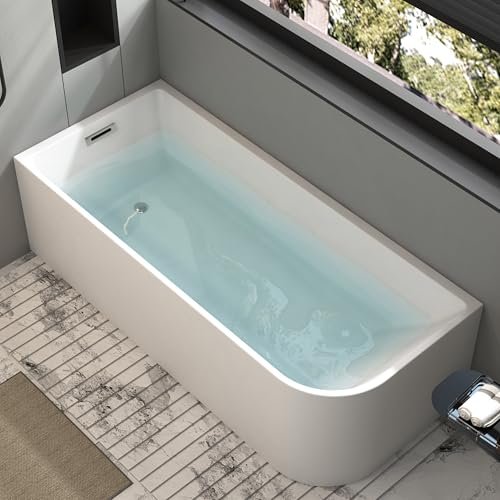
WHALEKING 59-Inch Corner Freestanding Bathtub Review: Deep Soaking Acrylic Tub With Right Drain
A freestanding bathtub can completely change the character of a bathroom, but appearance is only part of the decision. The most important factors are whether the tub actually fits the room, how deep it allows you to soak, how well it retains heat, how easy the surface is to maintain, and whether the drain orientation works with the existing plumbing.
The WHALEKING 59-inch corner freestanding bathtub is designed for homeowners who want a modern soaking tub without requiring the open floor space of a fully centered freestanding model. Its rounded corner apron, glossy white acrylic construction, approximately 14-inch soaking depth, and large 58.64-gallon capacity make it suitable for long baths while still fitting against or near a bathroom corner.
It is also built with a double-wall, multi-layer acrylic structure intended to improve insulation and includes a textured slip-resistant bottom for safer entry and exit. For a bathroom remodel focused on comfort, visual simplicity, and relatively easy maintenance, this tub offers a practical alternative to both alcove tubs and traditional clawfoot designs.
What Is the WHALEKING Corner Freestanding Bathtub?
This model is a 59-inch acrylic soaking bathtub with a corner-oriented freestanding design.
Its supplied specifications include:
- 59-inch length
- 28.75-inch width
- 20-inch overall height
- Approximately 14-inch soaking depth
- 58.64-gallon capacity
- Maximum listed load capacity of 1,000 pounds
- High-gloss white acrylic
- Double-wall, multi-layer construction
- Slip-resistant textured bottom
- Integrated rounded apron
- Corner-oriented drain configuration
The source text refers to both a right drain and a left-hand drain in different places, so the exact drain orientation should be confirmed before purchase.
Modern Corner Freestanding Design
Traditional freestanding tubs are usually positioned with open space around most or all sides.
A corner freestanding tub takes a different approach.
It retains the sculptural appearance of a freestanding bathtub while allowing one side or corner to sit closer to surrounding walls.
This can make it easier to fit into:
- Medium-size bathrooms
- Remodels with limited floor area
- Bathrooms replacing an older corner tub
- Primary bathrooms where a centered tub would consume too much space
The integrated apron also creates a cleaner exterior than tubs with exposed framing or separate panels.
Why Corner Placement Can Save Space
A fully freestanding bathtub often needs generous clearance around the fixture.
In contrast, a corner-oriented design can make better use of otherwise underutilized floor area.
That can leave more room for:
- Vanity
- Shower
- Toilet
- Walkway
- Storage
It can also simplify the visual layout by anchoring the tub to one side of the room.
Glossy White Contemporary Finish
The tub uses a glossy white finish.
White acrylic remains popular because it coordinates easily with:
- White toilets
- Marble-look tile
- Grey stone
- Matte black fixtures
- Brushed nickel hardware
- Chrome faucets
The simple finish also helps emphasize the shape of the tub instead of competing with the rest of the room.
59-Inch Length
The tub measures approximately 59 inches long.
That makes it somewhat shorter than many 60- to 67-inch freestanding tubs.
The difference may seem small, but one inch can matter in a tightly planned bathroom.
Before purchase, compare the full exterior dimensions with:
- Wall spacing
- Door swing
- Vanity clearance
- Faucet placement
- Plumbing location
Do not rely on nominal length alone.
28.75-Inch Width
The listed width is approximately 28-3/4 inches.
This is relatively narrow for a freestanding soaking tub.
A narrower tub can help save floor space, but it also affects interior shoulder and hip room.
If comfort is a priority, compare the interior basin dimensions rather than judging only by the exterior measurements.
The supplied description does not clearly state the internal bottom dimensions.
20-Inch Overall Height
The overall height is approximately 20 inches.
This determines how far users need to step over the tub wall.
For many adults, that is manageable, but users with mobility limitations should consider:
- Entry height
- Grab-bar placement
- Slip resistance
- Bathroom floor conditions
A deep soaking tub is not automatically the easiest tub to enter.
14-Inch Soaking Depth
One of the most important specifications is the approximately 14-inch soaking depth.
Soaking depth is generally more useful than overall tub height because it indicates how much of the body can be submerged before water reaches the overflow level.
A deeper tub can provide better coverage for:
- Legs
- Hips
- Lower torso
This makes it more suitable for long relaxation baths than a shallow standard tub.
Is 14 Inches Deep Enough for a Soaking Tub?
For many users, yes.
A 14-inch water depth provides a noticeably deeper bathing experience than many standard alcove tubs.
However, comfort depends on more than depth.
Also consider:
- Interior length
- Backrest angle
- Shoulder room
- User height
A tall user may still prefer a longer tub even if the water depth is generous.
58.64-Gallon Capacity
The source lists a maximum tub capacity of approximately 58.64 gallons.
That is a substantial amount of water.
Actual fill volume during normal use will usually be lower because the bather displaces water and the tub should not be filled to the absolute rim.
Still, the stated capacity gives useful context for:
- Water-heater sizing
- Floor loading
- Fill time
- Water consumption
Check Your Water Heater Capacity
A deep soaking tub can require significantly more hot water than a standard bath.
Before installation, consider whether the home's water heater can supply enough hot water to fill the tub at the desired temperature.
This is especially important with:
- Smaller tank water heaters
- Large households
- Back-to-back bathing
A tankless system may behave differently and should be evaluated based on flow rate and temperature rise.
Acrylic Construction
The tub is described as being made from high-quality acrylic.
Acrylic is common in modern freestanding bathtubs because it offers several practical advantages.
It is:
- Lighter than cast iron
- Warm to the touch
- Smooth
- Relatively easy to clean
- Available in sculpted shapes
Its lower weight can also simplify delivery and installation compared with much heavier materials.
Acrylic vs. Cast Iron
Cast iron offers excellent durability and heat retention, but it is extremely heavy.
Acrylic is much easier to move and typically places less structural demand on the floor.
Acrylic Advantages
- Lower weight
- Easier installation
- Smooth modern forms
- Warmer initial surface feel
Cast Iron Advantages
- Very durable
- Excellent heat retention
- Strong resistance to flex
The right material depends on budget, floor structure, and design priorities.
Double-Wall Multi-Layer Construction
The tub uses a double-wall, multi-layer design.
The purpose is primarily structural and thermal.
A multi-layer acrylic shell can improve rigidity while reducing heat loss compared with a very thin single-layer tub.
This can help bathwater remain comfortable longer, although actual heat retention also depends on:
- Room temperature
- Water temperature
- Tub fill level
- Bathroom ventilation
The source does not provide a measured heat-retention value, so no specific performance duration should be assumed.
High-Gloss Surface and Maintenance
The glossy acrylic surface is designed for relatively simple cleaning.
For routine maintenance, use:
- Warm water
- Mild non-abrasive cleaner
- Soft sponge
- Microfiber cloth
Avoid harsh abrasive pads that may scratch or dull the finish.
Acrylic is durable for normal bathroom use but can be more susceptible to surface scratching than porcelain enamel.
Avoid Aggressive Solvents
Certain strong solvents can damage acrylic.
Avoid using chemicals unless they are specifically labeled as safe for acrylic bathtubs.
If in doubt, follow the manufacturer's cleaning instructions.
Slip-Resistant Bottom
The tub includes a textured bottom intended to improve traction.
This is an important feature because bathtubs are naturally slippery environments.
A textured surface can reduce the likelihood of slipping during:
- Entry
- Exit
- Standing briefly in the tub
It does not eliminate risk entirely.
Users should still move carefully when the surface is wet.
Slip Resistance and Cleaning
Textured bottoms can sometimes trap more residue than perfectly smooth surfaces.
Regular cleaning helps prevent:
- Soap film
- Body-oil buildup
- Mineral deposits
A soft brush may help clean textured areas without damaging the acrylic.
Maximum Load Capacity
The source lists a maximum load capacity of 1,000 pounds.
That figure should be interpreted as a product specification rather than a structural guarantee for the bathroom floor.
The floor must support:
- Tub weight
- Water weight
- User weight
A full 58-gallon bath alone can represent several hundred pounds of water.
For upper-floor installations or older homes, structural verification may be worthwhile.
Drain Orientation Must Be Confirmed
The supplied text contains a contradiction.
The title refers to a right drain, while the product description later refers to a left-hand drain.
This is a material purchasing detail.
Before ordering, verify:
- Exact model number
- Drain side
- Product diagram
- Plumbing layout
A wrong-side drain can turn a straightforward installation into a major plumbing modification.
Why Drain Location Matters
The drain must align with or be adaptable to the home's waste plumbing.
Relocating a bathtub drain can require:
- Floor access
- Pipe cutting
- Structural work
- Additional labor
Always confirm orientation before the tub arrives.
Freestanding Tub Faucet Planning
A freestanding or corner freestanding tub typically requires a faucet configuration planned separately from the tub itself.
Possible options include:
- Floor-mounted tub filler
- Wall-mounted tub filler
- Deck-mounted fixture if the tub supports it
The source does not indicate that a faucet is included.
Faucet placement should be planned together with the final tub position.
Floor-Mounted Faucet Considerations
Floor-mounted tub fillers create a dramatic freestanding look but require plumbing through the floor.
They also need enough clearance around the tub for:
- Handle operation
- Hand shower access
- Maintenance
The fixture should not interfere with entry into the bath.
Wall-Mounted Faucet Considerations
A wall-mounted filler can save floor space and may work especially well with a corner tub.
However, spout reach must be sufficient to extend over the tub wall.
Measure carefully before purchasing the faucet.
Installation Access
Freestanding tubs often require access to:
- Drain connection
- Overflow assembly
- Floor plumbing
The exact installation method varies by model.
Professional installation is generally advisable because leaks under a finished freestanding tub can be difficult to correct later.
Check the Floor Before Installation
Before installing the tub, verify that the floor is:
- Level
- Stable
- Structurally sound
- Properly waterproofed where required
An uneven floor can cause rocking or stress on the drain connection.
Tub Placement and Clearance
Do not push the tub into place without accounting for maintenance access.
Check:
- Distance from walls
- Faucet reach
- Cleaning access
- Drain connection
- Entry clearance
Even a corner-oriented tub should leave enough space to clean the visible sides.
Is It Good for Small Bathrooms?
It can be, but "small" is relative.
At 59 by 28.75 inches, this is still a full-size bathtub.
It is more space-efficient than some larger freestanding tubs, but it will not fit every small bathroom.
Measure the room carefully before purchase.
Freestanding Tub vs. Alcove Tub
Freestanding Tub Advantages
- Strong visual presence
- More design flexibility
- Easier exterior access
- Spa-like appearance
Alcove Tub Advantages
- Better space efficiency
- Usually easier shower integration
- Often lower installation cost
A corner freestanding tub sits somewhere between these two approaches.
Freestanding Tub vs. Drop-In Tub
A drop-in tub requires a surrounding deck or platform.
That can consume more space and add construction complexity.
A freestanding tub eliminates the need for a large built-in surround, which can make the room feel more open.
Who Is This Bathtub Best For?
This model may be a strong fit for:
- Primary bathroom remodels
- Homeowners who want deep soaking
- Modern bathroom designs
- Medium-size bathrooms
- Buyers who want acrylic instead of cast iron
- Corner installations
It may be less suitable for users who need easy step-in access or bathrooms that require a shower-tub combination.
Common Buying Mistakes
Not Confirming Drain Orientation
The supplied description conflicts on left vs. right drain.
Measuring Only Tub Length
Width, height, and faucet clearance also matter.
Ignoring Water-Heater Capacity
A deep tub requires significant hot water.
Assuming the Floor Can Handle the Load
Check structural conditions where appropriate.
Choosing a Faucet Too Late
Tub and faucet placement should be planned together.
Using Abrasive Cleaners
Acrylic requires gentler maintenance than some harder surfaces.
Advantages and Considerations
Advantages
- 59-inch compact freestanding length
- Approximately 14-inch soaking depth
- Large 58.64-gallon capacity
- Glossy white acrylic construction
- Double-wall multi-layer design
- Modern rounded apron
- Corner-friendly layout
- Slip-resistant bottom
- Easier to handle than cast iron
Potential Considerations
Drain orientation must be verified.
Large water capacity requires adequate hot-water supply.
Acrylic can scratch if cleaned aggressively.
Professional installation may be advisable.
A full tub creates significant floor load.
Not necessarily ideal for users with limited mobility.
Frequently Asked Questions
What are the exterior dimensions?
Approximately 59 inches long x 28.75 inches wide x 20 inches high.
What is the soaking depth?
Approximately 14 inches.
What is the capacity?
The source lists approximately 58.64 gallons.
What is the tub made from?
Acrylic with multi-layer, double-wall construction.
Is the bottom slip resistant?
Yes, according to the supplied description.
Is this a freestanding bathtub?
Yes, with a corner-oriented freestanding design.
Does it retain heat well?
The double-wall construction is intended to improve insulation, but the source does not provide measured heat-retention performance.
What is the maximum listed load capacity?
The source lists 1,000 pounds.
Is the drain on the right or left?
The supplied text is inconsistent. Confirm the exact model and drain orientation before purchase.
Is a faucet included?
The supplied description does not state that a faucet is included.
Is professional installation recommended?
For a freestanding tub, professional installation is generally a sensible choice, particularly when plumbing or floor adjustments are required.
Final Thoughts
The WHALEKING 59-inch corner freestanding soaking bathtub is designed for homeowners who want the look and comfort of a modern freestanding tub without moving to an oversized 65- or 67-inch model.
Its strongest features are the approximately 14-inch soaking depth, generous capacity, double-wall acrylic construction, slip-resistant bottom, and corner-friendly shape. Those characteristics make it particularly appealing for primary bathrooms where comfort and contemporary design are priorities.
The biggest issue to resolve before purchase is drain orientation, because the supplied product information references both right- and left-hand configurations. That should be verified against the exact model before any plumbing decisions are made.
For buyers looking for a 59-inch acrylic corner freestanding bathtub with deep soaking capacity, a glossy white finish, insulated double-wall construction, and a textured non-slip bottom, this model offers a practical balance between modern styling, relaxation, and space-conscious placement.