40A Smart Water Heater Switch Review: WiFi App Control, Scheduling, Voice Commands, and High-Power Appliance Management
A smart switch can make an electric water heater much easier to manage, particularly when the goal is to reduce unnecessary runtime, automate heating schedules, or control the appliance remotely. Standard smart plugs are rarely appropriate for large fixed appliances because water heaters and air conditioners can draw far more current than ordinary household electronics.
This 40A smart water heater switch is designed specifically for higher-power loads. The supplied specifications list support for AC 100–240V, up to 40 amps, and a maximum claimed load of 8,000 watts. It connects to the Smart Life app and supports Alexa and Google Home, allowing remote switching, timers, recurring schedules, group control, and shared access between household members.
Those capabilities can be useful, but the electrical side deserves more attention than the smart-home features. A 40A load is substantial. Correct conductor sizing, breaker protection, terminal ratings, enclosure selection, local electrical code, and appliance compatibility all need to be verified before installation.
What Is a 40A Smart Water Heater Switch?
This device is a WiFi-connected electrical switch intended to control relatively high-power appliances.
Rather than plugging into a conventional outlet, it is designed to be wired into the electrical circuit controlling the appliance.
Potential applications described by the manufacturer include:
- Electric water heaters
- Air conditioners
- Other compatible high-power appliances
The switch then provides remote and scheduled control through the Smart Life platform.
High-Power Capacity
The supplied specifications list:
Maximum current: 40A
Voltage: AC 100–240V
Maximum claimed load: 8,000W
These ratings place the device well above the capacity of typical consumer smart plugs.
However, the actual permissible load should always be determined from the product's certified electrical rating and installation documentation.
Understanding the 8,000W Claim
Power is related to voltage and current.
At 200V, a 40A load corresponds to approximately 8,000W.
At 240V, 40A would mathematically correspond to 9,600W.
That means the stated 8,000W maximum should be treated as the manufacturer's device limit rather than assuming the switch can always be loaded to 40A at every supported voltage.
The lower applicable rating should govern installation.
Continuous Loads Need Special Attention
Water heaters often operate for extended periods.
Electrical codes may treat long-duration loads differently from short intermittent loads, which can affect:
- Breaker sizing
- Conductor sizing
- Maximum permissible current
Do not assume that a switch marked 40A should routinely carry a continuous 40A appliance load.
A licensed electrician should verify the final design.
Suitable for Electric Water Heaters
A smart switch can be useful for electric storage water heaters because these appliances often cycle automatically to maintain tank temperature.
Adding scheduling allows the heater to be disabled during periods when hot water is rarely needed and enabled before expected use.
Whether this saves meaningful energy depends on the household and heater insulation.
It Does Not Make the Water Heater More Efficient
The switch does not change how efficiently the heating elements convert electricity into heat.
Its benefit comes from controlling when the appliance is allowed to operate.
For example, it may reduce standby reheating if the water heater is intentionally turned off for long unused periods.
Remote App Control
The switch works with the Smart Life app according to the source.
That allows users to turn the connected appliance on or off remotely when internet connectivity is available.
This can be convenient when:
- Returning home from travel
- Changing routines
- Checking whether the heater was left enabled
- Preparing hot water before expected use
Remote Control Requires Care
A remotely controlled high-power appliance may energize when nobody is standing near it.
That makes correct installation and appliance condition especially important.
Remote switching should never be used to bypass:
- Safety controls
- Thermostats
- Overtemperature protection
- Required disconnects
The smart switch should control power only in a manner permitted by the appliance manufacturer and electrical installation.
Alexa and Google Home Support
The switch can reportedly integrate with:
- Amazon Alexa
- Google Home
This allows basic voice control.
A user may be able to issue commands to turn the water heater or another connected load on or off.
Voice Control Is Convenient but Not Essential
Voice control is best viewed as an interface feature rather than the main reason to install the switch.
For water heating, scheduling and remote status control are often more useful because the appliance usually runs automatically without frequent manual interaction.
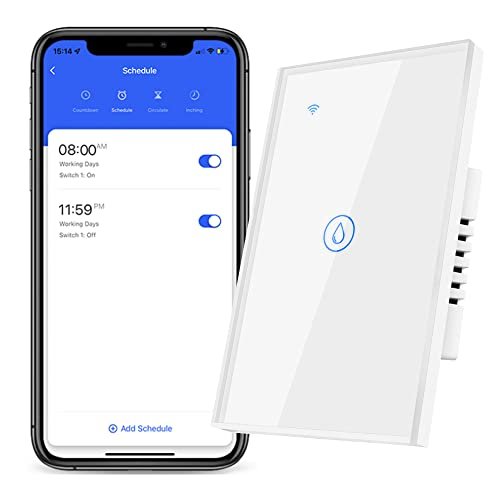
Scheduling Through Smart Life
The supplied description includes several timing modes.
These include:
- Schedule
- Countdown
- Circulate
- Inching
Together, these options provide more flexibility than a basic mechanical timer.
Standard Scheduling
A schedule can automatically switch the appliance at predefined times.
For example:
- ON at 5:00 a.m.
- OFF at 8:00 a.m.
- ON again in the evening
This may suit households with predictable hot-water routines.
Countdown Timer
A countdown can keep the heater energized for a fixed period and then switch it off automatically.
This can be useful when temporary heating is needed without leaving the appliance enabled indefinitely.
Circulate Mode
The product description lists a circulate function.
Depending on the Smart Life implementation, this generally refers to repeated on/off cycling according to configured intervals.
Before using this mode with a water heater, confirm that frequent power cycling is appropriate for the appliance.
Inching Mode
Inching typically means the switch turns on and then automatically turns off after a short configured duration.
That functionality can be useful for some equipment, although it may have limited relevance for conventional storage water heaters.
Scheduling Can Reduce Forgetfulness
One practical advantage of automation is consistency.
Instead of relying on someone to remember to turn the heater off every day, the app can handle the routine automatically.
That may be especially useful in:
- Vacation homes
- Rental properties
- Workshops
- Offices
where occupancy is predictable.
Power-Outage Memory
The switch includes a memory function.
According to the source, after electrical power is restored, the unit can return to its previous operating state.
This can be convenient, but the preferred restoration behavior should be considered carefully.
Is Returning to the Previous State Always Best?
Suppose the appliance was ON before an outage.
If the switch automatically restores that state, the appliance may energize immediately when utility power returns.
For some applications, that is desirable.
For others, a safer default might be OFF.
If the Smart Life settings allow users to configure power-restoration behavior, choose the option appropriate for the connected appliance.
Offline Notifications
The device reportedly sends an app notification if it remains offline for more than approximately 30 minutes.
This can help identify:
- Internet outages
- Router problems
- Device power loss
- Connectivity failures
However, an offline notification does not necessarily mean the appliance itself has failed.
WiFi Dependency
Smart features require a working network connection.
If WiFi or internet access is unavailable, remote commands and app notifications may stop functioning.
The product's local scheduling behavior during network outages should be confirmed if reliable automation is important.
Neutral Wire Required
The supplied installation information states that a neutral wire is required.
This is important because many older switch boxes contain only a switched live conductor and no neutral.
Before purchasing, inspect or professionally verify the wiring configuration.
Why the Neutral Is Needed
Smart electronics need continuous power for:
- WiFi radio
- Internal control circuitry
- Relay or switching electronics
The neutral provides a return path for that electronics supply.
Without the required neutral conductor, the switch should not be improvised into the circuit.
Ground Wire Is Not Routed Through the Switch
The source states that the upgraded version does not require the equipment grounding conductor to pass through the smart switch.
If the installation contains a ground wire, it should remain properly bonded through the approved grounding path.
That does not mean grounding is unnecessary for the appliance or electrical box.
It simply means the smart switch itself may not provide a dedicated ground terminal in the described configuration.
“No Ground Wire Required” Needs Careful Interpretation
A high-power switch not requiring a ground connection should never be interpreted as permission to remove or ignore the grounding system.
The connected appliance, metal enclosure, junction box, and branch circuit may still require grounding under applicable electrical rules.
A qualified electrician should preserve the existing protective grounding arrangement.
Standard Wall-Plate Format
The source states that the unit uses a standard wall-plate size.
That may simplify installation in a conventional electrical box compared with larger external contactor systems.
However, physical fit is only one requirement.
The box must also have enough:
- Wire space
- Temperature rating
- Conductor capacity
- Mechanical support
for the actual circuit.
High Current Creates Heat
At higher loads, poor terminal connections can generate substantial heat.
All conductors should be:
- Correctly stripped
- Fully inserted
- Tightened to specified torque
- Rated for the current
Loose terminals are a common cause of overheating in high-current electrical equipment.
Do Not Reuse Undersized Wiring
A smart switch does not increase the capacity of the existing branch circuit.
If the water heater requires heavier conductors than are currently installed, the wiring needs to be upgraded appropriately.
The switch rating, breaker rating, conductor size, and appliance rating all need to agree.
Breaker Protection Must Match the Circuit
The circuit breaker protects the wiring, not merely the appliance.
Do not install a larger breaker simply because the smart switch is rated for 40A.
Breaker sizing must be appropriate for:
- Conductors
- Appliance
- Circuit configuration
- Applicable code
Group Control
The Smart Life app can reportedly group multiple compatible devices.
This allows several smart switches or appliances to be controlled together.
For example, a property owner could group multiple water-heating devices within one interface.
Grouping Should Not Create Unsafe Simultaneous Loads
If multiple high-power devices share electrical capacity, switching them on simultaneously may create a large demand.
Before using group commands, confirm that:
- Circuits are independent where required
- Electrical service can support the combined load
Smart-home convenience does not change electrical service capacity.
Device Sharing
The switch can also be shared with family members through the Smart Life app.
This allows multiple authorized users to operate the connected appliance.
That can be useful in a household where more than one person manages the water heater.
Manage Permissions Carefully
Shared smart-home access means several people may be able to energize a high-power appliance remotely.
Only trusted household members should receive control access.
If someone no longer needs access, remove them from the device-sharing configuration.
Indoor Installation
The product can be installed indoors as long as the electrical location is appropriate.
Indoor placement protects the device from direct weather exposure.
It should still be kept away from:
- Plumbing leaks
- Condensation
- Excessive humidity
unless the enclosure is specifically rated for those conditions.
Outdoor Use Requires Weather Protection
The listing states that the switch can be used outdoors only when properly shielded.
It is explicitly described as not waterproof.
That is a major limitation.
The switch itself should not be exposed directly to:
- Rain
- Snow
- Sprinkler spray
- Standing water
Use a Proper Outdoor Enclosure
If the installation is outdoors, a suitable weather-rated enclosure is far better than simply mounting the switch under a small roof overhang.
The complete installation should protect:
- Switch
- Wire terminations
- Junctions
- Cable entries
from moisture.
Covered Does Not Always Mean Weatherproof
Wind-driven rain can reach locations that appear sheltered.
Outdoor electrical enclosures should be selected based on actual environmental exposure rather than assuming a porch or awning provides sufficient protection.
Water Heater Scheduling Example
A household with predictable routines might configure the heater to operate in the early morning and evening.
For example, the heater could switch on before morning showers and turn off after the household leaves.
Whether this approach is worthwhile depends on the water heater's insulation and how much standby heat it loses.
Vacation-Home Use
Remote control can be particularly useful for a secondary property.
The heater can remain disabled during long periods of vacancy and be enabled before arrival.
This avoids requiring someone to visit the property just to operate a local switch.
Rental Property Use
Property managers may appreciate app monitoring, but tenant control and electrical safety need to be considered.
Remote switching should never interfere with basic habitability requirements or create unexpected loss of hot water.
Water Heater Switch vs. Smart Plug
A standard smart plug is typically intended for much smaller loads.
A high-power water heater should not be connected through an ordinary plug-in smart socket unless the appliance and socket are specifically rated for the load.
The 40A smart switch exists precisely because larger appliances require higher-capacity switching equipment.
Smart Switch vs. Contactor
For very high-power loads, another common approach is to let a low-current smart controller operate a properly rated electrical contactor.
This separates the smart electronics from the heavy load.
Depending on local codes, appliance power, and product certification, a contactor-based arrangement may be preferable in some installations.
Smart Switch vs. Mechanical Timer
A traditional mechanical or digital timer can control a water heater without WiFi.
Mechanical Timer Advantages
- No cloud dependency
- Simple operation
- Proven technology
Smart Switch Advantages
- Remote access
- Voice control
- Flexible schedules
- Device sharing
- Offline notifications
The better option depends on how much connected functionality is actually useful.
Is 40A Enough for Your Water Heater?
You need to check the appliance nameplate.
Electric water heaters vary substantially in power.
Do not assume compatibility because the marketing description mentions water heaters.
Compare:
- Voltage
- Rated watts
- Rated current
- Circuit configuration
with the switch specifications.
Resistive vs. Other Loads
Water-heating elements are primarily resistive loads, which are generally straightforward to switch.
Air conditioners contain motors and compressors, which can create high startup currents.
Because the product also advertises air-conditioner compatibility, buyers should verify whether the 40A rating applies to the specific load type and starting characteristics.
Certification Matters
For any permanently wired high-current smart switch, independent electrical certification is an important purchasing factor.
Before installation, verify applicable listings or approvals for your region.
A claimed amperage rating alone does not establish that a device is suitable for permanent building wiring.
Professional Installation Is Strongly Recommended
The manufacturer's own description recommends professional installation for users unfamiliar with electrical systems.
That recommendation is appropriate.
This device handles mains voltage and potentially tens of amps.
A licensed electrician can verify:
- Circuit architecture
- Neutral availability
- Conductor size
- Breaker rating
- Grounding
- Box fill
- Appliance compatibility
- Local code compliance
Common Installation Mistakes
Assuming 40A Means Any 40A Load Is Safe
The load type, duty cycle, voltage, and certified rating matter.
Ignoring the Neutral Requirement
The switch needs a neutral conductor according to the source.
Removing the Ground Wire
Existing protective grounding should remain properly bonded.
Installing Outdoors Without an Enclosure
The switch is not waterproof.
Increasing the Breaker to Match the Switch
The wiring and appliance must also support that breaker size.
Leaving Terminals Loose
High-current connections must be properly tightened.
Who Is This Smart Switch Best For?
This type of device may be useful for homeowners who want:
- Remote water-heater control
- Scheduled operation
- Alexa or Google Home integration
- High-current switching
- Shared household access
It is particularly relevant when the existing appliance and electrical circuit are confirmed compatible.
Who Might Prefer Another Solution?
A different approach may be better when:
- Load exceeds the device's certified capacity
- Neutral wire is unavailable
- Installation is exposed directly to weather
- Local code requires a contactor or dedicated controller
- Smart functionality is unnecessary
In those cases, a conventional timer, purpose-built water-heater controller, or professionally installed contactor may be more appropriate.
Advantages and Considerations
Advantages
The switch offers a stated 40A high-current capacity, AC 100–240V compatibility, Smart Life app control, Alexa and Google Home support, several timer modes, device sharing, group control, offline notifications, and power-state memory.
Potential Considerations
The device requires a neutral conductor, is not waterproof, may require a dedicated high-current branch circuit, and must be matched carefully to the connected appliance. The 8,000W claim should be treated as the stated maximum rather than extrapolating from the 40A rating at every voltage.
Frequently Asked Questions
What is the maximum current rating?
The supplied description states 40 amps.
What voltage does it support?
AC 100–240V according to the source.
What is the maximum power?
The manufacturer claims up to 8,000W.
Can it control an electric water heater?
Yes, provided the heater's actual voltage, wattage, current, and circuit configuration are compatible.
Can it control an air conditioner?
The manufacturer lists air conditioners as a possible application, but motor and compressor startup current should be checked carefully.
Does it work with Smart Life?
Yes.
Does it work with Alexa?
Yes, according to the supplied information.
Does it work with Google Home?
Yes.
Can I schedule the water heater?
Yes. The Smart Life app provides scheduling and timer functions.
What timer modes are available?
The source lists Countdown, Schedule, Circulate, and Inching.
Does it remember its state after a power failure?
Yes. The description states that it can restore its previous state.
Does it send offline notifications?
Yes. The source states that an alert is sent after the device remains offline for more than approximately 30 minutes.
Does it require a neutral wire?
Yes.
Does the ground wire connect to the smart switch?
The source says the ground conductor should remain connected through the existing grounding path rather than through the switch itself.
Does that mean grounding is unnecessary?
No. The circuit and connected appliance may still require protective grounding.
Is the switch waterproof?
No.
Can it be installed outdoors?
Only if installed in an appropriately protected location or enclosure that prevents moisture exposure.
Can family members control it?
Yes. Device sharing is supported through the app.
Can several switches be controlled together?
Yes, using group control.
Should I install it myself?
Because this is a high-current mains-voltage device, professional installation is strongly recommended unless you are appropriately qualified.
Final Thoughts
This 40A Smart Life water heater switch offers a useful combination of high-power switching and smart-home automation. Remote app access, Alexa and Google Home control, flexible scheduling, device sharing, offline alerts, and power-state memory can make a conventional electric water heater substantially easier to manage.
The most important consideration, however, is not the app. It is the electrical installation.
A device rated for up to 40A and a claimed 8,000W operates at power levels where conductor size, breaker protection, terminals, grounding, enclosure selection, and appliance compatibility all matter. The neutral-wire requirement also means it will not be a drop-in replacement for every existing switch.
For a properly matched and professionally installed circuit, this kind of smart controller can be a practical way to add remote control, automated schedules, voice commands, and connected monitoring to a high-power electric water heater or other compatible appliance.