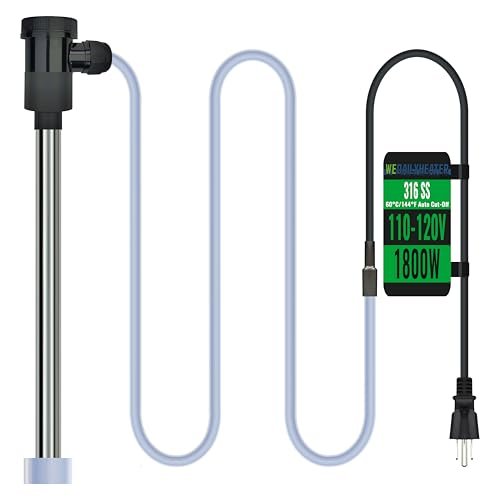
Smart WiFi Immersion Water Heater Review: Portable 316 Stainless Steel Heater With Timer and Thermal Control
Heating a tub, small pool, livestock trough, or other container of water without installing a permanent water-heating system can make a portable immersion heater attractive. These devices place an electric heating element directly in the water, allowing heat to transfer without pumps, tanks, or complicated plumbing.
This smart immersion water heater adds several features beyond a basic heating element, including thermal shutoff, automatic restart, WiFi timer control, a 316 stainless steel body, and a raised silicone base intended to keep the hottest portion of the heater away from vulnerable surfaces.
Those features can make the heater more convenient, but immersion heaters deserve unusually careful handling. Electricity and water create an inherently high-risk combination. The U.S. Consumer Product Safety Commission has previously recalled portable immersion heaters because defective units created shock, electrocution, overheating, and fire hazards.
For that reason, this type of product should be evaluated not only by how quickly it heats water, but also by its electrical certification, grounding, protection devices, installation environment, and operating instructions.
What Is a Portable Immersion Water Heater?
An immersion heater is an electric resistance heating element designed to transfer heat directly into water.
Instead of heating water inside a separate tank and circulating it afterward, the element is submerged in the container itself.
This can make portable immersion heaters useful for temporary or specialized applications where installing conventional plumbing equipment would be impractical.
Possible applications mentioned by the manufacturer include:
- Soaking tubs
- Inflatable pools
- Above-ground pools
- Buckets and containers
- Livestock troughs
- Baptismal pools
- Ponds
However, suitability for a specific application should always be verified against the manufacturer's actual safety instructions and electrical certification.
Built-In Temperature Regulation
The heater includes a thermal-control system intended to prevent excessive heating and dry operation.
According to the supplied specifications, it automatically shuts down at approximately 60°C (140°F) with a stated tolerance of ±5°C.
It is then described as restarting when the water temperature falls to approximately 25°C (77°F).
This type of thermal protection can provide a useful backup against uncontrolled heating, but those cutoff temperatures should not be confused with a comfortable or safe bathing-water thermostat.
140°F Is Extremely Hot for Bathing
The upper cutoff temperature is far above typical comfortable bathing temperatures.
A thermal shutdown at approximately 140°F should therefore be regarded as an equipment protection threshold rather than a user-selected bathing temperature.
Water temperature should always be checked independently before anyone enters a tub or pool.
Automatic Restart Requires Attention
The heater is described as automatically restarting after the water cools to approximately 77°F.
That can be convenient when maintaining water temperature, but it also means the appliance may become energized again without someone manually switching it back on.
Users should understand this behavior before relying on the heater in any unattended environment.
Smart WiFi Timer Control
The included WiFi timer allows the heating period to be scheduled instead of leaving the heater continuously powered.
The source describes several timer functions, including:
- Countdown
- Daily scheduling
- Automatic on/off control
This can make the heater easier to manage when warming water in advance.
Why a Timer Can Be Useful
Heating only during selected periods may reduce unnecessary electricity use.
For example, a container could be heated before planned use rather than keeping the element energized throughout the day.
The timer can also reduce repeated plugging and unplugging of the appliance.
A Timer Is Not a Safety Substitute
WiFi control should not be treated as the primary electrical safety mechanism.
A smart plug or timer can switch power, but it does not necessarily provide the same protection as:
- Ground-fault protection
- Proper grounding
- Overcurrent protection
- Certified immersion protection
Electrical safety must come from the complete installation and the heater's approved design rather than app control alone.
Never Enter Water With an Energized Heater Unless Explicitly Certified for Occupied Use
This is the most important practical consideration.
The product description suggests switching the heater off before entering the water, and that precaution should be taken seriously.
The CPSC has documented immersion water heaters capable of exposing users to dangerous electrical current through the surrounding water when faults occurred.
Unless the manufacturer explicitly certifies a particular model for occupied pool, spa, or bathing use under the applicable electrical safety standard, the safer practice is to disconnect electrical power before anyone touches or enters the water.
Use Ground-Fault Protection
Water and mains-powered equipment require particularly careful electrical protection.
Ground-fault circuit interrupters are designed to interrupt power when abnormal current leakage is detected, and electrical standards require GFCI protection in many wet-location applications.
The exact requirements depend on the installation and jurisdiction, but an immersion heater should never be casually connected to an unsuitable extension cord or unprotected receptacle.
Keep Electrical Connections Dry
The heating element may be designed for immersion, but the electrical plug, timer, receptacle, and other non-submersible components generally are not.
Connections should remain:
- Dry
- Protected from splashing
- Away from standing water
Wet electrical connectors can create a serious shock hazard. OSHA specifically warns about handling energized cord-and-plug equipment when connectors are wet.
316 Stainless Steel Construction
The heater body is described as being made from seamless 316 stainless steel.
316 stainless is commonly selected for wet or corrosive environments because it contains alloying elements that improve corrosion resistance relative to more basic stainless grades.
That can be useful for an immersion heater exposed repeatedly to water.
316 Stainless vs. 304 Stainless
Both 304 and 316 stainless steel are widely used corrosion-resistant materials.
316 generally performs better in more aggressive environments, particularly when chlorides or certain chemicals are present.
However, stainless steel is not universally immune to corrosion.
Water chemistry still matters.
Pool and Salt Exposure
Before using any stainless steel heater in:
- Chlorinated pools
- Saltwater pools
- Chemically treated water
verify that the manufacturer explicitly allows that environment.
Chemical concentration, temperature, and exposure time can all affect corrosion.
Fast Direct Heating
The source states that the heating element begins producing heat almost immediately after being powered.
That is expected behavior for a resistance immersion heater: the element itself can become hot very quickly.
However, this should not be confused with instantly heating the entire pool or tub.
Heating the Element Is Fast; Heating the Water Takes Time
The time required to raise the temperature of a body of water depends primarily on:
- Heater wattage
- Water volume
- Starting temperature
- Target temperature
- Ambient temperature
- Heat loss
A large above-ground pool can contain hundreds or thousands of gallons of water, so a portable heater may require a substantial amount of time to create a meaningful temperature increase.
Container Size Matters
A heater that performs well in a bucket or small soaking tub may be completely inadequate for a large swimming pool.
Before purchasing, determine:
- Heater power rating
- Water volume
- Desired temperature increase
Without those three figures, claims such as "fast heating" provide little information about real-world performance.
Insulation Can Improve Heating Performance
Heat escapes continuously through the water surface and container walls.
Using an appropriate insulated cover can reduce losses during heating.
This is especially relevant for:
- Inflatable tubs
- Outdoor pools
- Livestock tanks
in cooler weather.
Raised Silicone Base
The heater includes a silicone-supported base intended to hold the hot metal element slightly above the bottom of the container.
That design is particularly useful when the heater is used in a soft-sided or plastic vessel.
Direct contact between a high-temperature heating element and an inflatable pool liner could otherwise damage the material.
Protecting Inflatable Pools and Plastic Containers
Even with a raised base, the heater should be positioned carefully.
Make sure it cannot:
- Tip over
- Rest against a sidewall
- Become partially exposed
- Touch vulnerable plastic
during operation.
Water movement or an uneven floor may alter its position.
Keep the Heating Element Fully Submerged
One of the major hazards with immersion heaters is energizing the heating element when it is not adequately surrounded by water.
The CPSC has recalled immersion heaters that could ignite, melt, smoke, or overheat when not fully submerged.
Always follow the manufacturer's specified minimum and maximum immersion levels.
Do Not Power the Heater Before Submerging It
The safe operating sequence should follow the manufacturer's instructions.
Generally, the element should be positioned correctly in water before electrical power is applied.
Likewise, power should be disconnected before removing the heater from the water.
Avoid Dry Burning
Dry burning occurs when an immersion element heats without enough surrounding liquid to remove the generated heat.
This can rapidly raise element temperature and potentially damage:
- Heater
- Container
- Wiring
- Protective components
The built-in thermal protection is useful, but it should not be deliberately tested or relied upon as normal operating control.
Cleaning the Heating Element
Mineral scale can accumulate on immersion heaters, especially in hard-water areas.
Scale acts as insulation around the element and can reduce heat transfer.
Periodic cleaning can therefore help maintain performance.
Be Careful With Steel Scrubbers
The source suggests cleaning the heater with a steel scrubber.
That recommendation deserves caution.
Aggressive metal scrubbing can scratch stainless surfaces and may damage coatings, seals, or nearby components.
Follow the manufacturer's cleaning instructions rather than assuming any abrasive pad is safe.
Hard-Water Scale
If white mineral buildup appears on the element, a suitable descaling method may be preferable to heavy mechanical abrasion.
The appropriate method depends on the heater materials and manufacturer recommendations.
Portable Design
A major benefit of this type of heater is portability.
Unlike a permanently installed pool heater or water heater, it can be moved between compatible containers.
That may make it useful for occasional or seasonal applications.
Portable Does Not Mean Plug-and-Play Everywhere
Different use locations may have very different electrical conditions.
Before moving the heater, verify:
- Outlet rating
- Circuit capacity
- Grounding
- GFCI protection
- Distance from water
- Outdoor electrical suitability
The fact that a device can physically be carried somewhere does not make every outlet or environment appropriate.
Extension Cord Considerations
High-power resistance heaters can draw substantial current.
A lightweight household extension cord may overheat under continuous load.
The product's actual wattage and current requirement should be checked before using any extension cable.
If the manufacturer prohibits extension cords, that instruction should be followed.
Indoor and Outdoor Use
The source describes the unit as suitable for both indoor and outdoor applications.
Outdoor electrical use introduces additional considerations including:
- Rain
- Wet ground
- Outdoor-rated receptacles
- GFCI protection
- Weather-resistant connections
The heater itself being waterproof does not automatically make the timer, plug, extension cord, or outlet waterproof.
Using It for a Bathtub
Portable immersion heaters may seem convenient for warming bathwater, but this is also one of the highest-risk applications because a person will eventually enter the water.
If used in a bathing container, power should be disconnected according to the manufacturer's instructions before contact with the water.
Do not rely solely on the app showing the heater as "off."
Physically isolating power provides a clearer safety state.
Using It for an Inflatable Pool
Inflatable pools add the risk of heat damage to the liner.
The raised base may help, but users should confirm that:
- Heater does not touch the wall
- Required water depth is maintained
- Pool material is compatible
A permanent swimming-pool heater may be more appropriate for frequent use.
Above-Ground Pool Use
A portable immersion heater may assist with relatively small water volumes, but its effectiveness in a full-size above-ground pool depends heavily on wattage and pool capacity.
Do not assume a small portable heater can replace a properly sized pool-heating system.
Livestock Trough Use
Keeping livestock water from becoming excessively cold or frozen can be a legitimate immersion-heater application.
However, equipment used around animals should be specifically rated for that purpose.
Animals can:
- Damage cords
- Move equipment
- Contact water
so electrical safety and physical protection become especially important.
Aquarium Use Requires Specialized Equipment
The source mentions aquarium applications, but aquarium heating normally requires very precise temperature regulation and equipment designed specifically for continuous operation around aquatic life.
A general-purpose high-output immersion heater should not automatically be treated as a substitute for a dedicated aquarium heater.
Pond Use
The same caution applies to ponds.
Fish, plants, electrical installation, water volume, and outdoor exposure create requirements that may differ significantly from heating a bucket or empty soaking tub.
Verify explicit manufacturer approval before using the device around aquatic life.
Smart Timer vs. Thermostat
The WiFi timer controls when electricity is supplied.
The thermal control determines when the heater shuts down because of temperature.
These are two different functions.
Neither should be confused with a precise spa-style thermostat unless the manufacturer explicitly specifies adjustable closed-loop water-temperature control.
Temperature Measurement
For any application where final water temperature matters, use an independent thermometer.
Do not assume the heater's internal thermal cutoff represents the uniform temperature of the entire container.
Water can develop temperature gradients, especially without circulation.
Stirring and Circulation
A large container may have warmer water near the heater and cooler water elsewhere.
Natural convection helps distribute heat, but circulation can improve temperature uniformity.
Any pump or circulation system must itself be compatible with the application.
Advantages of This Type of Heater
The strongest potential benefits include:
- Direct water heating
- Portable design
- 316 stainless steel construction
- Built-in thermal cutoff
- Automatic restart
- WiFi timer scheduling
- Raised base for protecting container surfaces
- Broad potential use cases
These features can make it more flexible than a very basic immersion element.
Important Limitations
The biggest limitation is safety complexity.
A portable immersion heater combines:
- High electrical power
- Water
- Potentially wet surroundings
- Human or animal contact
That means suitability depends heavily on certification, installation, and operating procedure.
Who Might Find It Useful?
This type of heater may be appropriate for someone who needs temporary heating for a compatible water container and can follow strict electrical-safety procedures.
Possible scenarios include:
- Workshop water containers
- Utility tanks
- Temporary soaking tubs
- Certain agricultural applications
provided the manufacturer explicitly approves the intended use.
Who Should Consider a Permanently Installed Heater Instead?
A dedicated installed system is often preferable for:
- Regular swimming-pool heating
- Permanent hot tubs
- Household domestic hot water
- Large-volume applications
Purpose-built systems generally provide more precise temperature control and are engineered around the specific installation environment.
Common Mistakes to Avoid
The most serious mistakes include energizing the heater when it is not properly submerged, entering or touching the water while the heater remains powered, using unsuitable electrical outlets or extension cords, placing the heater directly against a plastic liner, and assuming that a waterproof heating element makes the entire electrical setup waterproof.
Another mistake is purchasing purely from marketing claims such as "instant heating." The element can heat instantly, but the water may take much longer.
Questions to Verify Before Buying
Before selecting a portable immersion heater, confirm the following with the manufacturer:
- Actual wattage and amperage
- Electrical safety certification
- Required voltage
- Whether GFCI protection is required
- Minimum immersion depth
- Maximum water volume
- Permitted water chemistry
- Whether occupied pools or tubs are explicitly permitted
- Outdoor-use rating
- Cord and plug protection
- Adjustable temperature capabilities
These details matter more than marketing terms such as "100% waterproof."
Frequently Asked Questions
What material is the heater made from?
The supplied description states that the heating body is made from 316 stainless steel.
What is the automatic shutoff temperature?
Approximately 60°C or 140°F, with a stated tolerance of ±5°C.
When does it restart?
The source states that it restarts after the water cools to around 25°C or 77°F.
Does it include WiFi control?
Yes. The supplied information describes a WiFi timer with countdown, cycle, and on/off scheduling.
Can it be used in an inflatable pool?
The manufacturer lists inflatable pools as a potential application and includes a raised silicone base intended to protect soft surfaces. The actual model instructions should still be checked carefully.
Can I enter the water while the heater is operating?
That should not be assumed safe. Portable immersion heaters have historically been associated with electrocution hazards when faults allow electrical current into the water. Disconnect power before entering or touching the water unless the manufacturer explicitly certifies the exact product for occupied-water use.
Does waterproof mean there is no shock risk?
No. Waterproof construction reduces water ingress but does not eliminate electrical-fault risk.
Should it be connected to a GFCI?
Wet-location electrical systems commonly require ground-fault protection, and GFCI protection is an important safeguard around water. Follow the product instructions and applicable electrical code.
Does it instantly heat a pool?
No. The heating element can begin producing heat very quickly, but heating the entire water volume depends on heater power, water quantity, starting temperature, and heat loss.
Can it run outside?
The source describes indoor and outdoor applications, but all plugs, timers, receptacles, and wiring must also be suitable for the environment.
Can it operate when partially out of the water?
It should not be assumed safe to do so. Immersion heaters should be operated within the manufacturer's stated immersion range. CPSC has documented portable heaters that overheated or caught fire when not fully submerged.
Can it heat an aquarium?
The source lists aquariums among potential applications, but aquarium use should only be considered if the manufacturer explicitly approves the model for that purpose and its temperature regulation is appropriate for aquatic life.
Final Thoughts
This smart WiFi immersion water heater with 316 stainless steel construction combines several useful ideas: direct water heating, automatic thermal shutoff, scheduled operation, corrosion-resistant construction, and a raised base intended to protect soft-sided containers.
Its convenience, however, should not overshadow the electrical-safety requirements of an immersed mains-powered appliance. Portable immersion heaters have been recalled in the past for shock, electrocution, overheating, melting, and fire hazards, which makes certification and correct use particularly important.
Before purchasing, the most important specifications to verify are not simply the claimed heating speed but the actual wattage, electrical certification, GFCI requirements, immersion limits, approved applications, and whether the manufacturer permits the equipment to be used around occupied water.
For appropriate temporary water-heating applications, the combination of 316 stainless steel, thermal protection, WiFi scheduling, and portable construction can be useful. For permanent pools, spas, or applications where people remain in the water, a purpose-built and properly installed heating system is generally the more appropriate solution.