18-Inch Rectangular Undermount Bathroom Sink Review: Compact Vitreous China Design with Overflow
A bathroom sink should fit the vanity as well as the way the bathroom is actually used. In smaller spaces, an oversized basin can consume valuable countertop area, interfere with drawers or plumbing, and make the vanity feel cramped. A compact undermount sink can solve those problems while still providing enough bowl space for everyday washing and grooming.
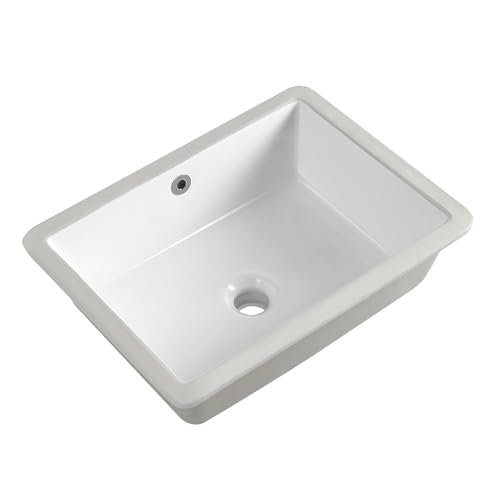
This 18-inch rectangular undermount bathroom sink is designed for that balance. It uses a glossy white vitreous china body, vertical bowl sides, an integrated overflow, and a clean under-counter installation that leaves the countertop edge exposed. Because there are no faucet holes in the sink itself, the basin can also be paired with a deck-mounted or wall-mounted faucet depending on the vanity layout.
With exterior dimensions of approximately 18.3 inches long, 13.8 inches wide, and 7.1 inches high, it is sized for compact and medium bathroom vanities where space efficiency matters without moving to an unusually small handwashing basin.
What Is This 18-Inch Undermount Bathroom Sink?
This is a rectangular ceramic bathroom sink designed to be installed beneath the countertop.
The supplied dimensions are approximately:
Exterior size: 18.3" L × 13.8" W × 7.1" H
Interior size: 16.1" L × 11.6" W × 4.9" D
The sink is made from glazed vitreous china and includes an overflow opening.
It does not include faucet holes, a faucet, or a pop-up drain.
Why Choose an Undermount Bathroom Sink?
An undermount sink is installed below the countertop rather than resting on top of it.
This creates a smooth transition from the counter surface into the bowl.
The style is especially popular with modern vanities because there is no raised rim interrupting the countertop.
Easier Countertop Cleaning
One practical advantage of an undermount sink is that water, dust, and small debris can be wiped directly from the countertop into the basin.
A drop-in sink has a visible perimeter lip that can collect residue around its edges.
The undermount format removes that obstacle.
Cleaner Visual Appearance
Because most of the basin is hidden beneath the countertop, the vanity looks less visually crowded.
That can be particularly useful in a smaller bathroom where simple lines help the room feel more open.
Rectangular Shape with Vertical Sides
The sink uses a rectangular bowl with relatively vertical sides.
This gives it a more structured appearance than a traditional oval basin.
It also helps maximize usable interior space within the overall footprint.
Rectangular vs. Oval Bathroom Sink
An oval sink often has softer, more traditional styling.
A rectangular sink generally feels:
- More contemporary
- More architectural
- Better suited to straight-edged vanities
The functional difference is usually less important than how each shape fits the countertop and available cabinet space.
Compact but Functional Dimensions
The external size of approximately 18.3 by 13.8 inches makes this sink relatively compact.
That can help preserve more countertop area for:
- Soap dispensers
- Toothbrushes
- Grooming products
- Decorative accessories
without reducing the sink to a very small utility basin.
Interior Bowl Size
The inner bowl measures approximately 16.1 inches long by 11.6 inches wide, with a stated depth of about 4.9 inches.
That should provide sufficient room for normal bathroom tasks such as:
- Handwashing
- Brushing teeth
- Washing the face
However, the relatively shallow depth means faucet selection becomes especially important.
Shallow Bowl and Splash Control
A 4.9-inch-deep basin is shallower than some larger bathroom sinks.
Splashing depends on several factors beyond bowl depth, including:
- Faucet height
- Spout reach
- Water pressure
- Where the stream lands
A faucet that is too tall or projects poorly into the bowl can cause unnecessary splashing onto the counter.
Choose the Faucet Carefully
Because the sink has no faucet holes, the faucet must be mounted elsewhere.
The most common options are:
- Countertop-mounted faucet
- Wall-mounted faucet
This gives the bathroom designer more flexibility but requires more planning.
Countertop-Mounted Faucet
A deck-mounted faucet installs through holes cut into the countertop behind the basin.
Before choosing one, make sure there is enough room between:
- Sink cutout
- Backsplash
- Wall
for the faucet body and handles.
Wall-Mounted Faucet
A wall-mounted faucet can preserve even more countertop space.
It also creates a clean, minimalist look.
However, the plumbing must be located correctly inside the wall before the finish work is completed.
Faucet Spout Reach Matters
The faucet stream should land comfortably inside the bowl, preferably near the drain area rather than against the rear wall.
If the spout is too short, water may hit close to the back of the sink.
If it extends too far, it can make handwashing awkward or increase splash.
Vitreous China Construction
The sink is made from glazed vitreous china, one of the most common materials used for bathroom fixtures.
The ceramic is fired at high temperature and covered with a smooth glazed finish.
This creates a surface that is:
- Hard
- Water resistant
- Smooth
- Relatively easy to maintain
High-Density Ceramic
The source describes the material as high-density vitreous china.
Dense fired ceramic is appropriate for daily bathroom use because it does not readily absorb moisture.
The glaze provides the primary protective and decorative surface.
Smooth Non-Absorbent Finish
The glazed surface is designed to resist absorbing common bathroom residue.
This can make soap film and ordinary dirt easier to remove during routine cleaning.
It is still important to clean the sink regularly, particularly around the drain and overflow.
Glossy White Appearance
The white finish is neutral and easy to coordinate with common bathroom materials.
It works particularly well with:
- Quartz countertops
- Marble-look surfaces
- Natural wood vanities
- Black hardware
- Chrome
- Brushed nickel
- Brass fixtures
A white ceramic sink can also be easier to match with a white toilet or bathtub.
Integrated Overflow
The sink includes an overflow opening.
This is an important practical feature that is sometimes missing from modern decorative basins.
The overflow provides an additional path for water to reach the drain if the basin fills too high.
What an Overflow Does
The overflow is designed to help limit accidental overfilling.
If water reaches the overflow opening, it can move through an internal channel toward the drain assembly.
However, it should not be treated as complete flood protection.
A running faucet can still exceed the drainage capacity under certain conditions.
Choose an Overflow-Compatible Drain
Because this sink includes an overflow, the pop-up drain should also be designed for a sink with overflow.
Overflow and non-overflow drains are constructed differently.
Using the wrong type can prevent the overflow channel from functioning correctly.
Pop-Up Drain Is Not Included
The supplied information states that the drain must be purchased separately.
Before buying one, confirm:
- Drain-hole diameter
- Overflow compatibility
- Desired finish
Matching the drain finish with the faucet can create a more cohesive look.
Faucet Is Not Included
The sink also does not include a faucet.
This allows greater freedom in selecting a fixture that matches the rest of the bathroom, but buyers should include the faucet in the overall project budget.
Undermount Installation Requirements
An undermount sink must be securely supported below the countertop.
Installation typically involves some combination of:
- Mounting clips
- Brackets
- Adhesive
- Sealant
The exact method should follow the manufacturer's installation instructions and the countertop fabricator's recommendations.
Do Not Rely on Sealant Alone Unless Specified
Ceramic sinks have significant weight.
The structural mounting method should support the basin independently rather than assuming a bead of silicone is sufficient.
This is especially important over the long term.
Countertop Compatibility
Undermount installation is most straightforward with solid countertop materials such as:
- Granite
- Quartz
- Marble
- Solid surface
- Other engineered stone
These materials can have a finished exposed cut edge around the sink.
Laminate Countertops Need Extra Consideration
Traditional laminate countertops are more difficult to use with undermount sinks because the substrate can be vulnerable to water.
Special installation systems exist, but the countertop must be designed specifically for that purpose.
Receive the Sink Before Cutting the Countertop
One of the most important installation practices is to have the actual sink available before the final countertop cutout is made.
Ceramic fixtures can have small dimensional variations from manufacturing.
Using the physical sink provides the most reliable fit.
Do Not Rely Only on Listed Dimensions
The published dimensions are useful for planning cabinet size, but they should not be treated as a precision countertop-cutting template.
The fabricator should use:
- Actual sink
- Manufacturer template
when determining the final opening.
Check Vanity Cabinet Clearance
The sink extends below the countertop by approximately 7.1 inches externally.
That means you must consider what is inside the cabinet.
The basin may interfere with:
- Upper drawers
- Shelves
- Plumbing organizers
A compact countertop footprint does not necessarily mean minimal under-counter space usage.
Drain Plumbing Needs Space Too
Below the sink, additional room is needed for:
- Pop-up drain
- P-trap
- Supply lines
Plan the vanity interior as a complete system rather than measuring only the ceramic bowl.
Easy Daily Cleaning
For routine maintenance, the glossy glazed surface should generally require only mild bathroom cleaner and a soft cloth or sponge.
The smooth finish helps prevent ordinary residue from becoming deeply embedded.
Cleaning Around the Overflow
The overflow opening is an easy area to overlook.
Moisture and residue can accumulate inside or around it over time.
Periodic cleaning can help prevent odor or buildup.
Hard-Water Deposits
If the home has hard water, mineral deposits may appear around:
- Drain
- Bowl walls
- Faucet splash zone
Use a ceramic-safe descaling method rather than harsh scraping.
Avoid Abrasive Tools
Vitreous china is durable, but the glaze can still be dulled by aggressive abrasion.
Avoid:
- Steel wool
- Metal scrapers
- Very coarse cleaning powders
unless the manufacturer specifically recommends them.
Undermount vs. Drop-In Sink
A drop-in sink rests in an opening from above and has a visible rim.
An undermount sink is secured below the counter.
Undermount Benefits
- Cleaner countertop
- Contemporary appearance
- Easier wiping into bowl
Drop-In Benefits
- Often easier installation
- Simpler replacement
- Wider countertop compatibility
The undermount style generally makes more sense when visual integration and countertop cleanliness are priorities.
Undermount vs. Vessel Sink
A vessel sink sits on top of the vanity and becomes a major design element.
An undermount sink is much more visually discreet.
The undermount option may be better when you want:
- More open countertop appearance
- Lower visual profile
- Easier counter cleaning
A vessel sink may be preferable when the basin itself is intended as a decorative centerpiece.
Is an 18-Inch Sink Good for a Small Bathroom?
Yes, this size is particularly well suited to compact and medium vanities.
It provides more usable bowl space than many tiny powder-room sinks while avoiding the countertop footprint of a large vanity basin.
The right fit still depends on the actual cabinet width and faucet layout.
Is It Large Enough for a Primary Bathroom?
That depends on how the sink is used.
For routine handwashing and grooming, it may be perfectly adequate.
If you frequently wash your face over the sink, fill containers, or prefer a spacious basin, a larger and deeper model may be more comfortable.
Package Inspection Is Important
The manufacturer recommends checking the sink when it arrives.
That is good practice for any ceramic fixture.
Inspect it before installation for:
- Cracks
- Chips
- Glaze defects
- Shipping damage
Inspect Before Countertop Fabrication
This is particularly important with an undermount sink.
If the sink is damaged after the countertop has already been custom-cut to its exact dimensions, replacement can become more complicated.
Pros and Considerations
Advantages
- Compact 18-inch class sink
- Modern rectangular shape
- Undermount installation
- Glossy white vitreous china
- Smooth easy-clean surface
- Integrated overflow
- No faucet holes, allowing flexible faucet placement
- Good fit for smaller vanities
Potential Considerations
- Bowl depth is only about 4.9 inches
- Faucet and pop-up drain are sold separately
- Faucet dimensions must be selected carefully to control splash
- Overflow-compatible drain is required
- Cabinet and drawer clearance must be checked
- Professional countertop fabrication may be preferable
Frequently Asked Questions
What are the exterior dimensions?
Approximately 18.3 inches long, 13.8 inches wide, and 7.1 inches high.
What are the interior dimensions?
Approximately 16.1 inches long, 11.6 inches wide, and 4.9 inches deep.
Is it an undermount sink?
Yes.
Is the sink rectangular?
Yes. It uses a rectangular bowl with relatively vertical sides.
What is it made from?
Glazed vitreous china.
Does it have an overflow?
Yes.
Does it include a faucet?
No.
Are there faucet holes in the sink?
No.
Can I use a countertop faucet?
Yes, provided the countertop is drilled and there is adequate clearance.
Can I use a wall-mounted faucet?
Yes.
Is the pop-up drain included?
No.
What type of drain should I buy?
Use an appropriately sized bathroom drain designed for a sink with overflow.
Is it easy to clean?
Yes. The glossy glazed ceramic surface is designed for straightforward routine maintenance.
Is it suitable for small bathrooms?
Yes. The compact dimensions make it appropriate for many smaller vanities and powder rooms.
Should the sink arrive before the countertop is cut?
Yes. Using the actual sink or the manufacturer's approved template is the safest approach for an undermount installation.
Final Thoughts
This 18-inch rectangular undermount bathroom sink offers a useful balance between compact dimensions and everyday functionality.
Its strongest features are the 18.3-by-13.8-inch exterior footprint, rectangular vitreous china construction, integrated overflow, glossy white finish, and clean undermount installation. The lack of built-in faucet holes also gives homeowners flexibility to choose either deck-mounted or wall-mounted fixtures.
The main consideration is bowl depth. At approximately 4.9 inches internally, careful faucet selection is important to minimize splashing. Buyers should also confirm the drain size, cabinet clearance, countertop cutout, and mounting method before installation.
For a powder room, guest bathroom, or compact vanity, this sink offers a practical combination of modern styling, space efficiency, easy maintenance, and flexible faucet placement.