One-Piece ADA Height Toilet Review: Dual Flush, Rimless Swirl Design, and Easy-Clean Skirted Construction
A toilet upgrade can make a bigger difference to everyday bathroom comfort than many homeowners expect. Bowl height affects how easy it is to sit and stand, flush design influences both cleanliness and water use, and the shape of the exterior can determine whether routine maintenance takes seconds or several frustrating minutes.
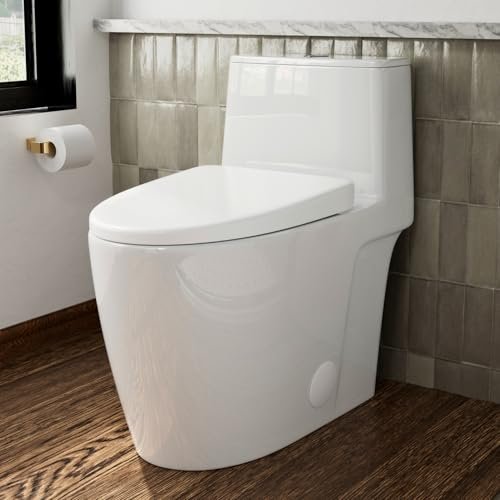
This one-piece toilet is designed around those practical details. It combines a 17-inch chair-height bowl, elongated seating, a skirted one-piece body, dual-flush operation, and a rimless swirl-style bowl rinse. The result is a modern toilet aimed at homeowners who want easier cleaning, more comfortable seating, and lower water use without moving into the more complicated world of electronic smart toilets.
Its standard 12-inch rough-in also makes it compatible with many residential bathrooms, while the included soft-close quick-release seat adds convenience for day-to-day use and maintenance.
What Is This One-Piece Toilet Designed For?
This model is built as a modern residential toilet with an emphasis on:
- Comfort-height seating
- Easy exterior cleaning
- Water-efficient dual flushing
- Rimless bowl rinsing
- Simple contemporary styling
- Standard residential installation
Its core features include:
- One-piece ceramic construction
- Skirted exterior
- 17-inch bowl height
- Elongated bowl
- 1.0 and 1.28 GPF dual flush
- Rimless swirl-flush design
- Glazed trapway
- Dual-nozzle flushing
- Soft-close seat
- Quick-release seat hinges
- 12-inch rough-in
This makes it a straightforward upgrade for homeowners who want better ergonomics and easier maintenance without adding electronics or bidet functions.
One-Piece Construction for a Cleaner Look
Unlike a two-piece toilet, where the tank and bowl are joined together during installation, a one-piece toilet is manufactured as a single main ceramic body.
That gives it a smoother, more integrated appearance.
It also eliminates the seam between the tank and bowl, which is one of the places where dust and grime tend to collect on traditional toilets.
For many homeowners, that alone makes a one-piece model easier to maintain.
Why a Skirted Toilet Is Easier to Clean
The exterior is also skirted.
Traditional toilets often expose the shape of the trapway on the sides of the bowl, creating contours, bolts, and recesses that can be awkward to wipe down.
A skirted toilet hides much of that plumbing geometry behind a smooth exterior shell.
That can make routine cleaning faster because there are fewer:
- Grooves
- Exposed bolt areas
- Curves
- Dust-catching recesses
For a bathroom used every day, this is a practical advantage rather than just a design choice.
ADA-Style Chair Height
The toilet uses a bowl height of approximately 17 inches.
That places it in the chair-height or comfort-height category and aligns with the general height range commonly used for accessible toilet design.
A taller toilet can make sitting down and standing up easier for many adults.
It may be particularly helpful for:
- Older adults
- Taller users
- People with knee discomfort
- People with reduced lower-body mobility
Does 17 Inches Automatically Mean ADA Compliant?
Not necessarily.
Toilet height is only one part of ADA bathroom compliance.
A fully compliant installation may also depend on:
- Seat height
- Clear floor area
- Distance from adjacent walls
- Grab-bar placement
- Flush-control accessibility
If this toilet is being installed in a commercial or code-regulated accessible bathroom, confirm the full set of applicable requirements.
For residential use, the 17-inch bowl height mainly translates into easier everyday sitting and standing.
Elongated Bowl for More Support
The toilet uses an elongated bowl rather than a compact round-front design.
Elongated bowls generally provide:
- More seating area
- Better thigh support
- Greater comfort for many adults
The tradeoff is that they project slightly farther into the room.
Before replacing a smaller round toilet in a tight bathroom, check that door, vanity, and walkway clearances remain comfortable.
Why Bowl Height and Shape Work Together
Comfort is not determined by height alone.
A taller bowl can reduce knee and hip bending, while an elongated shape provides more support.
Together, these features may feel more like sitting in a regular chair than using a traditional low-profile toilet.
That can make a noticeable difference in a bathroom used by older family members.
Dual Flush: 1.0 and 1.28 GPF
The toilet uses a dual-flush system with two stated flush volumes:
- 1.0 gallons per flush
- 1.28 gallons per flush
The lower-volume flush can be used for lighter waste loads, while the 1.28 GPF option provides more water when needed.
This gives users some control over water consumption instead of using the maximum flush volume every time.
Why Dual Flush Can Reduce Water Use
A toilet may be flushed several times per person every day.
Even a small reduction in average flush volume can add up over time.
The actual savings depend on:
- Household size
- Number of daily flushes
- How often the 1.0 GPF setting is used
- Efficiency of the toilet being replaced
If the existing fixture is an older high-volume toilet, the reduction in water use can be more significant.
Rimless Swirl Flush Design
The bowl uses a rimless swirl-style flushing system.
Traditional toilets often direct water through holes hidden beneath the rim.
Those channels can become harder to clean because residue and mineral deposits build up in areas that are difficult to reach.
A rimless bowl removes much of that hidden channel.
Instead, water is directed around the bowl in a controlled sweeping pattern.
Why Rimless Bowls Are Easier to Maintain
A rimless design provides better access to the upper bowl surface.
That makes it easier to see and clean the areas where water enters.
Potential maintenance advantages include:
- Fewer hidden surfaces
- Less buildup beneath a traditional rim
- Easier wiping
- Better visual inspection
This does not make the toilet self-cleaning, but it can simplify regular maintenance.
Swirl Action for Better Bowl Coverage
The flush is designed to create a circular or swirling motion around the bowl.
The goal is to wash more of the interior surface rather than sending water directly downward in only a few locations.
Better bowl coverage can help reduce:
- Residue
- Streaking
- Frequent manual brushing
The quality of the result still depends on the bowl geometry and flush system working together.
Dual-Nozzle Flush Design
The source also describes a dual-nozzle system.
Using more than one directed water outlet can help distribute flush energy more effectively.
One outlet may focus on bowl rinsing while another helps move waste toward the trapway.
This can improve flushing efficiency without simply increasing water volume.
Glazed Trapway
The trapway is glazed.
The trapway is the curved internal passage that carries waste from the bowl into the drain line.
A smoother interior surface can help reduce friction and make it harder for waste to catch inside the passage.
That can support:
- Better waste movement
- Reduced buildup
- Easier flushing
A glazed trapway does not guarantee a clog-free toilet, but it is a useful design feature.
Flush Efficiency vs. Flush Volume
A common mistake is to assume that more water automatically means better flushing.
Modern toilets are designed to use:
- Bowl geometry
- Jet direction
- Siphonic action
- Trapway design
to make each gallon work more effectively.
A well-designed 1.28 GPF toilet can outperform an older fixture that uses much more water.
Glossy Ceramic Finish
The toilet is made from fired ceramic with a glossy white finish.
A smooth glazed surface is easier to wipe clean than a porous or textured material.
It also helps resist visible staining during normal use.
Routine cleaning is still necessary, but the smooth finish should make maintenance more straightforward.
Soft-Close Seat
The included toilet seat uses a soft-close mechanism.
Instead of dropping abruptly, it lowers slowly.
This helps reduce:
- Slamming noise
- Impact on the bowl
- Sudden seat movement
It is a simple convenience feature, but one that quickly becomes noticeable in daily use.
Quick-Release Seat
The seat is also designed to be removable.
Quick-release hinges allow the seat to be detached more easily for cleaning around the mounting area.
That matters because the back of the seat is one of the places where dirt can accumulate and become difficult to reach.
A removable seat makes thorough cleaning much easier.
Standard 12-Inch Rough-In
The toilet is designed for a standard 12-inch rough-in.
The rough-in is measured from the finished wall behind the toilet to the center of the floor drain.
Twelve inches is common in residential construction, but it should still be measured before ordering.
Some bathrooms use:
- 10-inch rough-ins
- 14-inch rough-ins
- Nonstandard layouts
Buying the wrong rough-in can create installation and clearance problems.
How to Measure the Rough-In
Measure from the finished wall—not the baseboard—to the center of the toilet's floor bolts.
The floor bolts usually align with the drain center.
If the measurement is close to 12 inches, the toilet is likely compatible, but confirm against the installation manual.
One-Piece Toilets Can Be Heavier
One-piece construction simplifies the finished appearance, but it can make installation more physically demanding.
Because the tank and bowl are one unit, the toilet may be significantly heavier than one component of a two-piece model.
That can make:
- Carrying
- Positioning
- Aligning with the flange
more difficult.
Having a second person available is often useful.
Installation Kit
The source states that the toilet comes with the components needed for installation.
Even so, an installer should inspect the existing plumbing before proceeding.
Older bathrooms may need additional parts such as:
- New supply line
- Replacement flange
- Shims
- Alternate wax or waxless seal
Do not assume that every existing installation is ready to accept a new toilet without adjustment.
DIY Installation vs. Professional Installation
A standard toilet replacement is within reach for many experienced DIYers.
However, professional installation may be worthwhile if:
- The flange is damaged
- The floor is uneven
- The shutoff valve leaks
- The drain alignment is uncertain
- The toilet is too heavy to handle safely
One-piece models can be particularly awkward to position correctly without help.
Check the Floor Before Installation
The toilet should sit firmly on the finished floor without rocking.
If the floor is uneven, the base may require appropriate shimming.
A rocking toilet can eventually compromise the drain seal.
That can lead to leaks around the base.
Replace Questionable Supply Components
When replacing a toilet, inspect the existing:
- Shutoff valve
- Flexible supply hose
- Flange
If any of these components are old, corroded, or unreliable, replacing them during the installation can prevent problems later.
Water Efficiency in Daily Use
A dual-flush toilet can help reduce water use when operated correctly.
The lower setting should be used when appropriate, while the higher setting remains available for larger waste loads.
This provides a practical balance between efficiency and performance.
One-Piece Toilet vs. Two-Piece Toilet
Both designs can perform well, but they have different strengths.
One-Piece Toilet Advantages
- Cleaner appearance
- Easier exterior cleaning
- No tank-to-bowl seam
- More integrated design
Two-Piece Toilet Advantages
- Usually easier to carry
- Often less expensive
- Tank and bowl can be replaced separately
A one-piece model is often preferred for modern remodels where appearance and cleaning convenience matter.
Rimless Toilet vs. Traditional Rimmed Toilet
Rimless Toilet Advantages
- Easier access for cleaning
- Fewer hidden channels
- Improved visibility
- Modern bowl design
Traditional Rimmed Toilet Advantages
- Familiar design
- Widely available
- Proven over many years
For homeowners focused on easier bowl maintenance, rimless designs are particularly appealing.
Chair Height vs. Standard Height
A lower toilet can be comfortable for shorter adults and children.
A chair-height model may be easier for:
- Seniors
- Taller adults
- People with mobility limitations
There is no universally perfect height, so consider who uses the bathroom most often.
Common Buying Mistakes
Not Measuring the Rough-In
This model is designed for a 12-inch installation.
Forgetting Room Clearance
An elongated bowl requires more space than a compact round-front model.
Assuming Chair Height Guarantees Full ADA Compliance
Accessibility depends on the complete bathroom layout.
Choosing Based Only on GPF
Flush design is as important as water volume.
Underestimating One-Piece Weight
Plan for safe handling during installation.
Who Is This Toilet Best For?
This model may be a strong fit for:
- Primary bathroom renovations
- Older adults
- Taller users
- Households seeking lower water use
- Homeowners who prefer easy-clean designs
- Modern or minimalist bathrooms
It may be less suitable for very compact powder rooms where an elongated bowl creates clearance issues.
Advantages and Considerations
Advantages
- One-piece construction
- Skirted easy-clean exterior
- 17-inch chair-height bowl
- Elongated seating
- Dual flush
- 1.0 GPF option
- 1.28 GPF option
- Rimless bowl design
- Swirl flushing
- Dual-nozzle flush
- Glazed trapway
- Glossy ceramic surface
- Soft-close seat
- Quick-release seat
- Standard 12-inch rough-in
Potential Considerations
One-piece toilets can be heavy.
Elongated bowls require more room.
Full ADA compliance depends on installation details.
Flush performance still depends on correct plumbing and installation.
Frequently Asked Questions
Is this a one-piece toilet?
Yes. The tank and bowl form one integrated ceramic unit.
Is the exterior skirted?
Yes. The design hides much of the trapway geometry for easier cleaning.
What is the bowl height?
The bowl is listed at approximately 17 inches.
Is it ADA height?
The height is within the chair-height range commonly associated with accessible toilets, but full ADA compliance depends on the complete installation.
Is the bowl elongated?
Yes.
Does it have dual flush?
Yes.
What are the flush volumes?
The source lists 1.0 GPF and 1.28 GPF.
Is the bowl rimless?
Yes.
What is a swirl flush?
Water is directed around the bowl in a circular pattern to improve surface rinsing.
Is the trapway glazed?
Yes.
Does the seat close slowly?
Yes. A soft-close seat is included.
Can the seat be removed for cleaning?
Yes. It uses a quick-release design.
What rough-in is required?
A standard 12-inch rough-in.
Final Thoughts
This one-piece ADA-height dual-flush toilet focuses on the features that matter most in a non-electronic bathroom upgrade: comfort, efficiency, easier cleaning, and reliable everyday usability.
The 17-inch chair-height bowl and elongated seat can make sitting and standing easier for many adults, while the smooth skirted exterior reduces the number of awkward surfaces that need to be cleaned. Inside the bowl, the rimless swirl-flush system and glazed trapway are designed to improve rinsing and waste movement without relying on excessive water.
The 1.0/1.28 GPF dual-flush system also gives households more control over water consumption.
For homeowners looking for a modern one-piece toilet with chair-height comfort, dual-flush water efficiency, an elongated bowl, rimless swirl cleaning, and a standard 12-inch rough-in, this model offers a practical combination of contemporary design and everyday functionality.