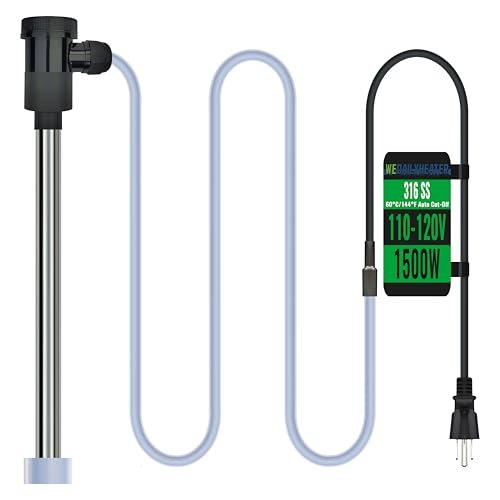
Smart WiFi Immersion Water Heater Review: Portable 316 Stainless Steel Heating for Tubs, Pools, and Utility Water
Portable immersion heaters offer a simple way to warm water without installing a permanent boiler, pool heater, or storage tank. By placing the heating element directly in the water, these devices transfer heat where it is needed and can be useful for temporary or specialized applications where fixed plumbing equipment would be impractical.
This smart immersion water heater combines direct electric heating with built-in thermal protection, WiFi timer control, a 316 stainless steel heating body, and a raised silicone base designed to keep the hot element away from vulnerable container surfaces. The manufacturer positions it for uses ranging from soaking tubs and inflatable pools to utility containers and livestock water.
The flexibility is appealing, but this category requires more careful safety planning than an ordinary household appliance. An immersion heater combines mains electricity, water, and potentially wet surroundings. Its electrical rating, ground-fault protection, approved applications, immersion depth, and operating instructions therefore matter at least as much as heating speed.
What Is a Smart Immersion Water Heater?
An immersion heater uses an electric resistance element placed directly into water.
When energized, the element converts electrical energy into heat and transfers that heat into the surrounding liquid. Unlike a conventional tank water heater, there is no separate storage vessel or heat exchanger between the element and the water being heated.
This design makes the unit compact and portable. It can potentially be moved between compatible containers instead of becoming a permanent part of the plumbing system.
How Direct Immersion Heating Works
The heating element becomes hot soon after electricity is supplied. Water immediately surrounding the element absorbs that energy, becomes warmer, and begins circulating naturally through convection.
Warmer water rises while cooler water moves toward the heating element. Over time, this circulation raises the overall temperature of the container.
The important distinction is that the element can heat quickly while the entire body of water may take much longer.
Smart Thermal Regulation
The heater includes built-in thermal control intended to reduce the risk of overheating and dry operation.
According to the supplied specifications, the unit is designed to shut down at approximately 60°C (140°F), with a stated tolerance of ±5°C. It is then described as restarting automatically when the water temperature falls to approximately 25°C (77°F).
This automatic cycle can provide equipment protection and reduce continuous operation, but the upper cutoff should not be interpreted as a normal bathing temperature.
The 140°F Cutoff Is a Protection Threshold
Water at 140°F is far hotter than typical comfortable bathwater.
The automatic cutoff is therefore better understood as a maximum protective limit for the appliance rather than a temperature users should intentionally target.
If the heater is being used for any application involving eventual human contact with the water, check the temperature independently before use.
Automatic Restart Deserves Attention
The heater is described as automatically restarting after the water cools sufficiently.
That is convenient for maintaining water temperature, but it also means the appliance may energize again without someone pressing a button.
Anyone using the heater should understand this behavior before relying on the timer or thermal protection system.
WiFi Timer Control
The included smart timer adds scheduled power management.
According to the supplied description, available timer functions include:
- Countdown operation
- Daily cycle schedules
- Automatic on/off programming
Instead of repeatedly plugging and unplugging the heater, users can determine when the appliance receives power.
Why Scheduling Can Be Useful
Heating water only when needed can reduce unnecessary operating time.
For example, a soaking tub could be heated for a predetermined period before use rather than leaving the appliance powered indefinitely.
The timer can also make repetitive heating routines easier to manage.
A WiFi Timer Is Not the Main Safety Device
Remote control is convenient, but it should not be mistaken for electrical protection.
A timer can control whether electricity is being supplied, but it does not replace:
- Ground-fault protection
- Proper grounding
- Correct circuit sizing
- Overcurrent protection
- Manufacturer-approved wet-location installation
Those protections need to exist independently of the smartphone app.
Disconnect Power Before Entering the Water
For any portable immersion heater used in a tub or pool, the safest approach is to follow the manufacturer's instructions exactly and ensure electrical power is disconnected before anyone enters or touches the water unless the exact heater is explicitly certified for operation with occupants present.
Simply seeing an "off" state in an app is not the same as verifying that the appliance is electrically isolated.
Portable immersion heating should be treated as a heat-the-water-first application rather than assuming the heater can remain energized during bathing.
316 Stainless Steel Construction
The heater body is described as being made from seamless 316 stainless steel.
This material is commonly used in wet and corrosive environments because of its resistance to oxidation and many forms of corrosion.
Compared with more basic stainless-steel grades, 316 stainless is generally better suited to environments involving moisture and some dissolved salts.
316 vs. 304 Stainless Steel
Both 304 and 316 stainless steel are widely used in plumbing, food processing, and wet environments.
316 contains additional alloying elements that improve resistance to chloride-related corrosion.
That can make it attractive for a heater repeatedly submerged in water.
However, no stainless steel should be considered universally corrosion-proof.
Water Chemistry Still Matters
The heater's compatibility with a specific liquid should be confirmed before use.
Factors that can influence corrosion include:
- Chlorine concentration
- Salt content
- Acidity
- Temperature
- Exposure duration
A heater suitable for ordinary freshwater may not automatically be appropriate for highly chlorinated or saltwater environments.
Fast Element Heating
The product description states that the heater reaches operating temperature almost immediately.
This is reasonable for an electric resistance element: it can begin generating heat within seconds of being energized.
But this does not mean a bathtub or swimming pool reaches the desired temperature in seconds.
How Long Does It Take to Heat Water?
Total heating time depends on:
heater power + water volume + desired temperature increase + environmental heat loss
A small bucket may warm relatively quickly.
A large above-ground pool may take many hours or may be too large for a portable heater to warm effectively at all.
Heater Wattage Is Critical
The supplied article does not state the electrical wattage.
That is one of the most important specifications to verify before purchase.
Without the heater's power rating, it is impossible to estimate accurately how long it will take to warm:
- 5 gallons
- 50 gallons
- 500 gallons
The phrase "fast heating" should therefore be interpreted cautiously.
Water Volume Matters More Than Marketing Language
Heating 10 gallons of water by 20°F requires far less energy than heating 1,000 gallons by the same amount.
Before selecting an immersion heater, calculate or estimate the container's water volume.
Then compare it with the manufacturer's recommended capacity.
Insulation Improves Performance
Water loses heat continuously to the surrounding air and container walls.
An insulated or covered container can retain heat better than an uncovered pool.
For temporary soaking tubs or outdoor containers, reducing heat loss can materially improve heating performance.
Raised Silicone Base
One thoughtful feature is the silicone base that lifts the heating element slightly away from the bottom of the container.
This helps reduce direct contact between the hottest part of the heater and surfaces that may be sensitive to heat.
That is particularly relevant for:
- Inflatable pools
- Plastic tubs
- Soft-sided soaking containers
Why Bottom Clearance Matters
A heating element placed directly against thin plastic could create a concentrated hot spot.
Even if the surrounding water is relatively cool, the point of contact may become much hotter.
Raising the heater allows water to circulate underneath it and helps spread heat more evenly.
The Heater Still Needs Stable Positioning
A silicone base cannot protect the container if the heater tips over.
The unit should be positioned so that it cannot:
- Fall against the side wall
- Float or shift unexpectedly
- Become partially exposed
- Touch an inflatable liner
during operation.
Keep the Heater Properly Submerged
Immersion heaters need water around the heating element to carry away heat.
Operating with insufficient water can cause the element temperature to rise rapidly.
Always follow the manufacturer's specified:
- Minimum immersion level
- Maximum immersion level
- Required orientation
Avoid Dry Heating
Dry operation can damage an immersion heater very quickly.
It can also create excessive surface temperatures that may harm nearby materials.
The built-in thermal protection should be considered a backup system rather than permission to operate the heater without adequate water.
Safe Operating Sequence
The manufacturer's instructions should always take priority, but a typical safe-use concept is:
Position the heater correctly in the water before energizing it, allow it to heat while maintaining the required immersion level, disconnect electrical power when heating is complete, and allow appropriate cooling before removing the device.
Never deliberately test the dry-burn protection.
Silicone-Wrapped Power Cable
The source describes the heater as using a silicone-wrapped electrical cable.
Silicone insulation can tolerate heat and moisture better than many ordinary cable materials.
However, cable construction alone does not make every part of the electrical system submersible.
Keep the Plug and Timer Dry
The heater body may be designed for immersion, while components such as the:
- Plug
- WiFi timer
- Receptacle
- Extension connection
may need to remain completely dry.
Pay close attention to which components are actually rated for water exposure.
Ground-Fault Protection
Any high-power electrical appliance operating near water should receive appropriate ground-fault protection where required.
A GFCI or equivalent protective device is designed to disconnect electricity when current flows along an unintended path.
That provides an important layer of protection in wet environments.
Outdoor Electrical Safety
Using the heater outdoors introduces additional considerations.
The power source and connections may be exposed to:
- Rain
- Splashing
- Wet ground
- Condensation
Outdoor use should involve properly rated electrical equipment and receptacles rather than simply running an ordinary indoor extension cord outside.
Extension Cord Considerations
Electric heaters can draw substantial current.
An undersized extension cord can overheat.
Before using any extension cable, verify:
- Heater amperage
- Cord rating
- Cable length
- Manufacturer instructions
If the manufacturer prohibits extension cords, connect the heater directly as instructed.
Cleaning the Stainless Steel Element
Mineral deposits may accumulate on the heating surface over time.
This is particularly common in hard-water areas.
Removing scale helps maintain good heat transfer.
Be Careful With Abrasive Cleaning
The source suggests using a steel scrubber.
Before doing so, confirm that the manufacturer specifically approves that cleaning method.
Aggressive abrasives can scratch stainless steel and may damage nearby seals or protective surfaces.
A suitable descaling method may sometimes be preferable.
Hard-Water Scale
Mineral deposits act as an insulating layer around a heating element.
Heavy scale can:
- Reduce heat transfer
- Increase element temperature
- Increase heating time
- Reduce efficiency
Regular inspection can help identify buildup before it becomes severe.
Portable Bathtub Use
A portable heater can be useful for warming water in a soaking tub that lacks a built-in heating system.
Its effectiveness depends on the tub volume and heater wattage.
The heater should be electrically disconnected before someone enters the water unless the exact product documentation explicitly states otherwise.
Inflatable Pool Use
The raised base is particularly relevant for inflatable pools because their walls and floor can be vulnerable to concentrated heat.
Make sure the heater remains:
- Fully submerged as required
- Upright
- Away from sidewalls
- Stable on the bottom
during heating.
Above-Ground Pool Use
Large above-ground pools contain substantial quantities of water.
A portable immersion heater may not provide enough power to replace a purpose-built pool heater.
Before purchasing for this use, compare the heater's wattage with the total pool volume and desired temperature increase.
Hot Tub Use
A permanent hot tub normally includes integrated:
- Heating
- Circulation
- Filtration
- Temperature regulation
A portable immersion heater does not provide those systems.
It may be more appropriate for temporary heating applications than as a replacement for a damaged spa heater.
Baptismal Pool Use
Temporary pools used for ceremonies may benefit from preheating, particularly in cooler buildings.
However, electrical power should be disconnected before people enter the water unless the equipment is explicitly rated and installed for occupied use.
Livestock Trough Applications
Keeping water warmer in cold weather can be useful for animals.
But equipment used in livestock areas needs particular protection because animals can:
- Damage cables
- Move equipment
- Contact the water
A heater should only be used for this purpose if the manufacturer explicitly supports that application.
Aquarium Applications Require Caution
The source lists aquariums among possible uses.
Aquariums normally require very precise and continuous temperature regulation appropriate to specific species.
A high-output general-purpose immersion heater should not automatically be treated as a replacement for an aquarium heater.
Verify that the manufacturer explicitly approves aquarium use before placing it with aquatic life.
Pond Heating
Ponds present similar considerations.
Outdoor exposure, large water volume, plants, fish, and electrical connections make pond heating a specialized application.
The unit's compatibility should be confirmed before use.
Timer Control vs. Thermostat Control
These two functions should not be confused.
The WiFi timer determines when power is supplied.
The thermal protection determines when the heater stops because it has reached a protective temperature limit.
Neither necessarily provides the precise thermostatic control expected from a dedicated spa or aquarium heating system.
Use an Independent Thermometer
For applications where water temperature matters, an independent thermometer is valuable.
The heater's internal thermal sensor may measure conditions near the appliance rather than the average temperature throughout the container.
Large containers can develop warm and cool zones.
Water Circulation Improves Uniformity
Natural convection helps distribute heat, but a large container may benefit from circulation.
Without movement, water near the heater may become much warmer than water at the opposite end of the pool or tub.
Any circulation pump used alongside the heater must itself be appropriate for the application.
Portability as a Major Advantage
The heater's compact construction allows it to be moved between compatible applications.
That can make it useful for homeowners or property managers who need temporary water heating rather than a fixed system.
There is no need to dedicate floor space to a storage tank.
Portable Does Not Mean Universally Compatible
A heater that works well in one container may not be appropriate in another.
Before moving it between applications, check:
- Water chemistry
- Container material
- Water volume
- Electrical supply
- Required temperature
Portability increases convenience but does not eliminate technical limitations.
Immersion Heater vs. Traditional Water Heater
A conventional household water heater supplies hot water through the plumbing system.
An immersion heater directly heats a specific container.
They serve fundamentally different purposes.
A portable unit is better considered a local water-heating tool rather than a substitute for whole-home hot water equipment.
Immersion Heater vs. Dedicated Pool Heater
A dedicated pool heater typically circulates water through a heat exchanger.
Advantages can include:
- Higher heating capacity
- Better circulation
- Integrated temperature regulation
- Permanent installation
A portable immersion heater has the advantage of lower complexity and portability, but usually at a much smaller scale.
Advantages of This Smart Immersion Heater
The design combines several practical features:
- 316 stainless steel heating body
- Automatic thermal cutoff
- Automatic restart
- WiFi timer control
- Countdown and recurring schedules
- Silicone-protected power cable
- Raised protective base
- Portable construction
Together, these features provide more control than a basic unsupervised heating element.
Important Limitations
Several points should be evaluated before purchasing:
- Heater wattage is not provided in the source
- Maximum recommended water volume is not stated
- A 140°F cutoff is not a bathing-temperature control
- Automatic restart means the heater can re-energize
- Electrical connections need proper wet-location protection
- Large pools may exceed practical heating capacity
These are not minor details; they determine whether the product is suitable for the intended application.
Who Is This Heater Best For?
This type of heater may be useful for someone who needs temporary water heating in a compatible container and understands the electrical requirements.
Potentially appropriate applications include utility water, soaking containers, and other temporary installations specifically approved by the manufacturer.
Who May Be Better Served by a Permanent Heater?
A purpose-built installed system is generally more appropriate when heating is needed regularly for:
- Swimming pools
- Permanent spas
- Domestic hot water
- Large-volume applications
Permanent systems tend to offer greater output and more precise control.
Common Mistakes to Avoid
Assuming "Instant Heating" Means Instant Hot Water
The element heats quickly; the entire water volume does not.
Entering the Water While the Heater Is Energized
Disconnect electrical power unless the exact product is certified and intended for occupied use.
Allowing the Element to Run Partially Exposed
Maintain the required immersion depth.
Letting the Heater Touch an Inflatable Wall
Keep the unit stable and clear of soft surfaces.
Treating "Waterproof" as Meaning Risk-Free
The electrical system still needs appropriate grounding and ground-fault protection.
Ignoring Wattage
Without heater power, meaningful heating-time calculations are impossible.
Frequently Asked Questions
What material is the heater made from?
The supplied description states that the body is made from 316 stainless steel.
What is the automatic shutoff temperature?
Approximately 60°C or 140°F, with a stated tolerance of ±5°C.
When does the heater restart?
The source states that it restarts when the water temperature falls to approximately 25°C or 77°F.
Does it have WiFi?
The included timer is described as WiFi enabled.
What scheduling options are available?
The source mentions countdown, daily cycle, and automatic on/off programming.
Is the heater waterproof?
The manufacturer describes the heating assembly as waterproof, but that does not mean every electrical component can be submerged. Follow the product's immersion and connection instructions exactly.
Can I use it in an inflatable pool?
The manufacturer lists inflatable pools as an application and includes a raised silicone base intended to protect soft surfaces.
Can I leave it touching the bottom of an inflatable pool?
The raised base is intended to create clearance, but the heater should remain correctly positioned and should not contact vulnerable walls or surfaces.
Can I get into the water while it is running?
Do not assume that is safe. Disconnect electrical power before entering or touching the water unless the manufacturer explicitly certifies the exact model for occupied-water operation.
Does the heater warm water instantly?
It begins generating heat very quickly, but the time needed to warm the entire container depends on wattage, water volume, starting temperature, and heat loss.
Can it heat a large swimming pool?
Possibly not efficiently. The heater's wattage and the pool volume must be compared before assuming it can provide meaningful temperature increases.
Can it be used outdoors?
The source describes outdoor applications, but the electrical supply, timer, plug, and receptacle must also be suitable for outdoor wet-location use.
Can it heat livestock water?
The manufacturer lists livestock troughs among potential uses. Confirm that the exact model is approved for continuous use around animals before installation.
Can it be used in an aquarium?
Do not assume so solely from the marketing description. Aquarium heating requires precise temperature control and equipment suitable for continuous operation around aquatic life.
Does 316 stainless steel eliminate corrosion?
No. It offers strong corrosion resistance but can still be affected by certain chemicals, chlorides, salt concentrations, and water conditions.
Final Thoughts
This smart WiFi immersion water heater with 316 stainless steel construction combines portability with several useful control features. The automatic thermal cutoff, scheduled WiFi operation, corrosion-resistant heating body, and raised silicone base make it more sophisticated than a simple plug-in immersion element.
Its usefulness ultimately depends on matching the heater to the application. The most important specifications to verify before buying are the actual wattage, maximum recommended water volume, electrical certification, required ground-fault protection, immersion depth, approved container materials, and permitted use cases.
The claims of fast heating and waterproof construction should also be interpreted realistically. The element may begin generating heat immediately, but warming a large pool still requires substantial energy and time. Likewise, a waterproof heating body does not remove the electrical hazards associated with mains-powered equipment operating in water.
For temporary heating of a compatible tub or water container, this type of heater can provide a convenient combination of direct electric heating, WiFi scheduling, automatic thermal protection, 316 stainless steel durability, and portable installation. For permanent pools, hot tubs, or other high-demand applications, a dedicated heating system may provide better performance, temperature control, and long-term integration.