ECOTINYMACH Electric Tankless Water Heater Review: Compact On-Demand Hot Water With Fahrenheit and Celsius Display
A compact electric tankless water heater can be a practical solution when a sink or other low-demand fixture is located far from the main water heater. Instead of waiting for hot water to travel through a long plumbing run, a point-of-use heater warms water close to where it is needed.
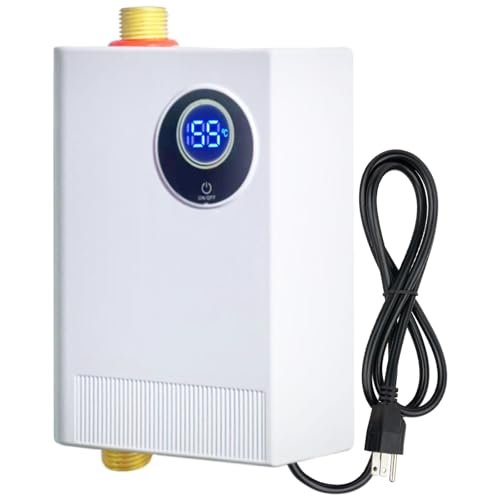
The ECOTINYMACH electric tankless water heater is designed around that idea. Its compact body, on-demand heating system, switchable Fahrenheit and Celsius display, and 1/2-inch NPT plumbing connections make it suitable for installations where space is limited and hot-water demand is relatively modest.
Its small size should not, however, be confused with plug-and-play installation. The supplied specifications call for a dedicated electrical circuit with a breaker rated at least 32 amps, along with appropriately sized wiring. That makes electrical compatibility one of the most important considerations before purchase.
What Is the ECOTINYMACH Tankless Water Heater?
The ECOTINYMACH is a compact electric water heater that heats water as it flows through the unit rather than storing hot water in a tank.
That means it does not need to keep several gallons of water hot throughout the day.
Instead, the heating element activates when sufficient water flow is detected and transfers heat directly to the moving water.
This type of system is commonly called an electric tankless water heater, instant water heater, or point-of-use water heater.
Why Point-of-Use Heating Can Be Useful
In many homes, hot water has to travel a considerable distance from the main heater to the fixture.
During that time, cooled water already sitting in the pipes must be discharged first.
A point-of-use heater can reduce that problem by placing the heat source much closer to the faucet.
It can be particularly useful for:
- Bathroom sinks
- Utility sinks
- Workshops
- Small kitchens
- Guest spaces
provided the heater's output is appropriate for the required flow.
Compact Design for Tight Spaces
One of the product's main selling points is its small footprint.
Unlike a conventional storage water heater, it does not require room for a large insulated tank.
That can make installation easier in places such as:
- Under a sink
- Inside a utility cabinet
- On a wall near the fixture
The actual installation location must still provide the manufacturer's required clearances and access for maintenance.
Compact Does Not Mean Low-Power Wiring
This is an important distinction.
The appliance may be physically small, but electric resistance water heating can draw substantial current.
The supplied instructions specify a circuit breaker of at least 32 amps.
Therefore, electrical capacity needs to be evaluated before deciding where the unit can be installed.
How an Electric Tankless Water Heater Works
When a faucet opens, water enters the heater.
A flow sensor detects the demand and allows the heating element to energize.
The element transfers heat to the passing water, which then travels to the fixture.
When the water stops flowing, the heater shuts down.
This eliminates the need for a storage tank.
Tankless Does Not Mean Unlimited Hot Water
A tankless heater can continue operating as long as water and electricity are available, but its heating capacity is finite.
The outlet temperature depends on three main factors:
- Electrical power
- Water-flow rate
- Incoming water temperature
If water moves through the heater too quickly, the unit may not have enough time or power to achieve the desired temperature.
Flow Rate and Temperature Rise Are Closely Connected
This relationship is fundamental to electric tankless water heaters.
At a lower flow rate, the heater has more heating capacity available per unit of water.
At a higher flow rate, the available temperature rise generally decreases.
That means a compact electric heater that performs well at a bathroom faucet may not necessarily be suitable for a high-flow shower.
Know the Required Temperature Rise
Suppose incoming water is 65°F and the desired outlet temperature is 105°F.
The heater needs to provide a 40°F temperature rise.
If incoming water drops to 45°F in colder weather, the same outlet temperature requires a 60°F rise.
The second situation demands significantly more heating power.
For this reason, buyers should evaluate actual heater wattage and performance curves rather than relying on terms such as "instant hot water."
Fahrenheit and Celsius Display
A useful feature is the ability to switch between Fahrenheit and Celsius.
This does not change heater performance, but it makes the display easier to interpret for users accustomed to one temperature scale or the other.
It can also be helpful in households where appliances use mixed measurement systems.
Temperature Monitoring
Being able to see the selected or measured temperature is useful when adjusting a point-of-use heater.
However, displayed temperature should not be treated as a substitute for safe hot-water practices.
Actual outlet temperature can be influenced by:
- Flow changes
- Incoming water temperature
- Supply voltage
- Plumbing conditions
Avoid Excessively High Temperatures
Hot water can cause burns.
Temperature settings should therefore be chosen conservatively, particularly in homes with:
- Children
- Older adults
- People with limited mobility
A water heater should provide useful hot water without creating unnecessary scalding risk.
Electric Operation
The ECOTINYMACH uses electricity rather than natural gas or propane.
That simplifies combustion-related requirements because there is:
- No burner
- No fuel line
- No combustion exhaust
However, electric tankless heaters require substantial electrical capacity.
No Venting Required
Because the heater does not burn fuel, it does not need a combustion vent.
This can make it easier to install in locations where gas venting would be impractical.
Electrical and plumbing requirements still remain.
Electrical Requirements Are Critical
The supplied instructions specify:
Circuit breaker: at least 32 amps
and
Wire size: approximately 2.5 mm² / 13 AWG
These specifications should be verified against the exact unit's nameplate and installation manual.
Electrical conductor sizing depends on more than a simple wire-gauge conversion and may be affected by:
- Voltage
- Appliance load
- Circuit length
- Insulation rating
- Installation method
- Local electrical code
A licensed electrician should determine the final circuit design.
Dedicated Circuit May Be Required
A high-current electric water heater generally should not share a circuit with ordinary household outlets or appliances.
It may require:
- Dedicated breaker
- Dedicated conductors
- Proper grounding
Do not connect the heater to an ordinary receptacle unless the manufacturer explicitly specifies that type of installation.
Breaker Size Is Not the Only Electrical Requirement
Simply installing a larger breaker is not enough.
The wiring must also be correctly sized for the electrical load.
An oversized breaker on undersized wiring can create overheating and fire risk.
The entire circuit must be designed as a system.
Verify Household Electrical Capacity
Before purchase, check whether the electrical panel has enough available capacity.
Older homes or small electrical services may require upgrades before another high-current appliance can be added.
This can materially affect the total installation cost.
Professional Electrical Installation Is Recommended
Because the supplied specification calls for a high-amperage circuit, installation is not comparable to plugging in a countertop appliance.
Professional installation is advisable unless the user is appropriately qualified and local regulations allow otherwise.
A qualified electrician can verify:
- Breaker size
- Wire sizing
- Grounding
- Disconnect requirements
- Panel capacity
1/2-Inch NPT Connections
The heater uses 1/2-inch NPT plumbing threads, according to the supplied information.
This is a common connection size for point-of-use plumbing equipment.
The installer should verify compatibility with:
- Cold-water supply
- Hot-water outlet
- Shutoff valves
- Flexible connectors
Use Appropriate Plumbing Materials
Connections should be made with materials rated for:
- Potable water
- Hot-water temperature
- System pressure
Improvised hoses or incompatible fittings can create leaks or failures.
Install Isolation Valves
Installing accessible shutoff valves can make maintenance much easier.
If the heater needs to be removed, serviced, or flushed, water can be isolated without shutting down the entire building.
Check for Leaks Before Energizing
Water connections should be completed and tested before electrical power is applied.
Inspect:
- Inlet
- Outlet
- Threaded fittings
- Connections
for any signs of leakage.
Water and electrical equipment require especially careful installation.
Never Operate the Heater Dry
Tankless water heaters are designed to transfer heat into flowing water.
Electrical power should not be applied unless the plumbing is correctly connected and the unit is filled or operating according to the manufacturer's commissioning procedure.
Dry operation can damage the heating element.
Is It Really Easy to Install?
The source describes installation as straightforward.
Mechanically, a compact unit may indeed require only a few plumbing connections and wall mounting.
The electrical side can be much more demanding.
For many homeowners, installation may require both:
- Plumbing work
- Electrical work
So "easy installation" should be interpreted in context.
Energy Efficiency of Tankless Heating
Electric resistance heating converts electricity directly into heat at the point of use.
A tankless design also avoids continually maintaining a reservoir of hot water.
This can reduce standby losses compared with a traditional storage tank.
Does Tankless Automatically Lower Energy Bills?
Not necessarily.
Energy costs depend on:
- Electricity price
- Hot-water consumption
- Existing heater efficiency
- Usage pattern
A tankless heater avoids standby storage losses, but every gallon of heated water still requires energy.
Claims of guaranteed savings should therefore be treated cautiously.
Environmental Claims Need Context
The source describes electric operation as environmentally friendly.
The environmental impact of an electric appliance depends partly on how the electricity is generated.
Electricity supplied largely by renewable or low-carbon sources may have a different emissions profile from electricity generated primarily from fossil fuels.
The heater itself does not produce combustion exhaust at the installation point.
Best Use as a Point-of-Use Heater
A compact electric tankless unit is generally most compelling when serving a relatively limited load close to the installation location.
For example, it can reduce the long wait for hot water at a remote bathroom sink.
This is often a more realistic use case than attempting to replace a high-capacity whole-house heater with a very compact unit.
Bathroom Sink Use
Bathroom faucets usually have moderate flow rates, making them a natural application for compact electric water heaters.
If the heater's output matches the faucet flow and incoming water conditions, it may provide useful on-demand warm water.
Kitchen Sink Use
Kitchen faucets can require higher flow and hotter water.
Before using the heater for a kitchen sink, verify that its output is sufficient under the expected conditions.
A low-power unit may struggle at full faucet flow.
Shower Use
The supplied source does not provide enough performance information to assume this model is appropriate for a shower.
Showers usually require substantially more sustained flow than a handwashing sink.
Before considering shower use, verify the unit's rated GPM at the required temperature rise.
Whole-House Use
A compact point-of-use electric heater should not automatically be treated as a whole-house water heater.
Whole-house service can require substantially more electrical capacity and output.
The exact role of the ECOTINYMACH unit should be based on its technical performance specifications.
Tankless vs. Mini-Tank Water Heater
A mini-tank heater stores a few gallons of hot water close to a fixture.
A tankless heater heats water only while it is flowing.
Tankless Advantages
- No stored hot-water tank
- Compact form
- Continuous operation within rated capacity
Mini-Tank Advantages
- Can provide a short burst of higher flow
- Less sensitive to instantaneous heating capacity
- May have simpler electrical requirements depending on model
The better choice depends on usage.
Tankless vs. Whole-House Storage Heater
A small electric tankless heater is designed for a different scale of demand than a conventional large storage heater.
A tank heater can deliver stored hot water at high flow for a limited time.
A tankless heater delivers continuously but only within its real-time heating capacity.
Hard Water and Mineral Scale
Mineral deposits can accumulate inside electric tankless heaters.
Hard water can gradually reduce heat-transfer performance and restrict internal passages.
Periodic maintenance may be required depending on local water quality.
Water Treatment
If the home has very hard water, consider whether:
- Filtration
- Softening
- Periodic descaling
is appropriate.
Follow the manufacturer's maintenance instructions.
Space-Saving Benefits
The lack of a storage tank is one of the ECOTINYMACH heater's clearest advantages.
For small homes, workshops, or remote fixtures, being able to mount the heater on a wall can preserve cabinet or floor space.
Plan for Service Access
Do not mount the heater in a location where future service becomes impossible.
Leave enough room to:
- Inspect wiring
- Reach plumbing fittings
- Perform maintenance
- Remove the unit
if necessary.
Common Buying Mistakes
Choosing by Physical Size Instead of Heating Capacity
A small heater may still require substantial electrical power and may not meet high-flow demand.
Ignoring Electrical Panel Capacity
The stated 32-amp requirement may require new wiring or panel work.
Assuming It Can Power a Shower
Verify GPM at the required temperature rise first.
Increasing Breaker Size Without Upgrading Wiring
Breaker and conductor sizing must be coordinated.
Expecting Instant Hot Water at Any Flow
Heating capability decreases as flow demand increases.
Who Is This Water Heater Best For?
The ECOTINYMACH may be appropriate for buyers who need:
- Compact point-of-use hot water
- Electric operation
- No gas venting
- Fahrenheit/Celsius temperature display
- 1/2-inch NPT plumbing connections
It can make sense for remote sinks or other modest hot-water loads where suitable electrical service is available.
Who Might Need a Larger Heater?
A more powerful system may be needed for:
- Showers
- Multiple simultaneous fixtures
- Whole-house service
- Large temperature rises
Always compare the required flow and temperature rise with the heater's performance specifications.
Advantages and Considerations
Advantages
- Compact tankless design
- No hot-water storage tank
- Electric operation
- No combustion venting
- Fahrenheit/Celsius display
- 1/2-inch NPT plumbing connections
- Potentially useful for point-of-use installations
- Reduces standby storage losses
Potential Considerations
- Requires a high-current electrical circuit
- Supplied specification calls for at least a 32-amp breaker
- Wiring must be professionally verified
- Actual heating performance depends on flow and incoming temperature
- May not be suitable for high-flow fixtures
- Hard water may require maintenance
Frequently Asked Questions
Is the ECOTINYMACH a tankless water heater?
Yes. It heats water on demand rather than storing it in a tank.
Is it electric?
Yes.
Does it need gas?
No.
Does it require venting?
No combustion vent is required because it is electric.
What circuit breaker does it require?
The supplied information specifies a breaker rated at least 32 amps. The exact requirement should be verified from the unit's official installation documentation.
What wire size does it require?
The source lists approximately 2.5 mm² / 13 AWG, but final conductor sizing should be determined according to the appliance rating and applicable electrical code.
Can I install it on a normal household outlet?
Do not assume so. The stated amperage requirement suggests a dedicated high-current circuit may be necessary.
What plumbing connection size does it use?
Approximately 1/2-inch NPT.
Can it display Celsius?
Yes.
Can it display Fahrenheit?
Yes.
Will it provide unlimited hot water?
It can continue heating while demand remains within its electrical and thermal capacity, but flow is not unlimited.
Does higher flow reduce water temperature?
Generally, yes. Higher flow leaves less available heating energy per gallon.
Is it suitable for a bathroom sink?
Potentially, provided its rated output matches the faucet flow and local inlet-water temperature.
Is it suitable for a shower?
The supplied description does not provide enough information to confirm that. Check the rated GPM at the required temperature rise.
Can it be used for the whole house?
That should not be assumed. Compact electric units are often better suited to point-of-use applications unless explicitly rated for whole-house demand.
Does it save energy?
Tankless heating avoids storage-tank standby losses, but actual utility savings depend on usage, energy prices, and the system being replaced.
Final Thoughts
The ECOTINYMACH compact electric tankless water heater is most interesting as a point-of-use solution for locations where space is limited and running hot water from the main heater is inconvenient.
Its main strengths are the small footprint, on-demand electric operation, switchable Fahrenheit/Celsius display, standard 1/2-inch NPT connections, and elimination of a traditional storage tank.
The biggest consideration is electrical installation. The supplied requirements call for a circuit breaker of at least 32 amps, which means this is not simply a small appliance that should be connected wherever space is available. Circuit capacity, wiring, grounding, and local electrical requirements need to be verified before installation.
For a bathroom sink, utility area, or another modest hot-water application, this type of compact tankless heater can be useful when properly sized. The best purchasing decision comes from matching the heater's actual electrical power and temperature-rise performance to the required water flow, rather than relying solely on terms such as "instant" or "energy efficient."